

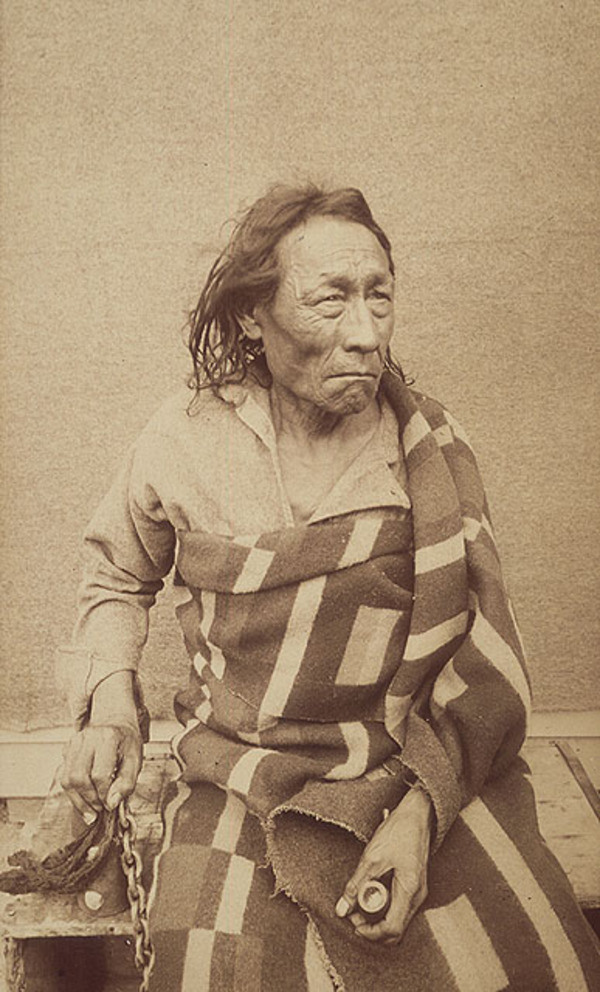
One of the most important Indigenous leaders of the 19th century passed into history on this date in 1888. Mistahimaskwa, known widely as Big Bear, was a Cree military and political leader who, sadly, foresaw the full negative impacts of European colonization would have on the Indigenous peoples of the Western Plains.
Born in 1825, Mistahimaskwa was a veteran of inter-First Nation wars before Canada seriously began moving west. By 1870, he was negotiating with the Dominion of Canada’s new government as part of efforts to have the Cree sign a treaty with Ottawa. Looking into the future, Big Bear correctly predicted that confining his people on reserves would destroy their way of life. He advised other Indigenous leaders to follow his lead, as he kept refusing to sign on to Treaty 6.
In 1882, however, after other Cree chiefs ignored his warnings and signed the treaty with Ottawa, he then did so reluctantly, believing he had been betrayed by his fellow Native leaders.
Though he played only a marginal role in the uprising on the plains led by Louis Riel in 1885, he was still tried and unjustly convicted of treason by Canadian authorities and sentenced to a three-year prison term. He only served half of his sentence before being released due to ill-health. Big Bear was 62-years-old when he died on January 17, 1888.
Professor Rudy Wiebe sums up Mistahimaskwa’s (Big Bear’s) life and legacy the following way: “Big Bear was a traditional chief, chosen and followed by the Plains Cree because of his wisdom rather than because he was acknowledged by trader or missionary or government official for his cooperation,” he wrote. “For him the land, the water, the air, and the buffalo were gifts from the Great Spirit to all mankind; everyone might use them, but in no sense could one person own them or forbid their use to others. He saw white civilization as humiliatingly destructive of Indian civilization, but he resisted whites with ideas, not useless guns. He was the last of the great chiefs to try to unite the North American peoples against European invasion, and to that end he wanted a new treaty: one huge reserve for all Plains Indians. If his young men had not followed Riel’s example, perhaps he could have persuaded other Plains chiefs that his way was their only hope.”
You can read this visionary 19th century Indigenous leader’s entry at the Dictionary of Canadian Biography on-line in full at this link.
Arthur Milnes is an accomplished public historian and award-winning journalist. He was research assistant on The Rt. Hon. Brian Mulroney’s best-selling Memoirs and also served as a speechwriter to then-Prime Minister Stephen Harper and as a Fellow of the Queen’s Centre for the Study of Democracy under the leadership of Tom Axworthy. A resident of Kingston, Ontario, Milnes serves as the in-house historian at the 175 year-old Frontenac Club Hotel.