
In the most recent provincial election, the BCNDP clinched its second consecutive majority by just one seat. While the party’s win was razor-thin, women’s representation in B.C. is anything but. In a glass-ceiling–shattering triptych, women are now 53 per cent of MLAs, 66 per cent of the governing caucus, and 68 per cent of cabinet, and they hold central ministries such as Finance, Justice, and Health. While this puts B.C. well ahead of the House of Commons and all provincial legislatures, these advances are precarious, resting on BCNDP’s internal rules rather than law. The question now is whether Premier Eby will entrench these gains, or whether they will vanish when another party takes power.
Gender Representation and How B.C. Broke Records
No other jurisdiction matches the extent to which women are represented in B.C.’s provincial political institutions. Cabinets range from B.C.’s record-setting 68 per cent women to Saskatchewan’s 19 per cent. And even where women are numerous, men still dominate the most senior portfolios.
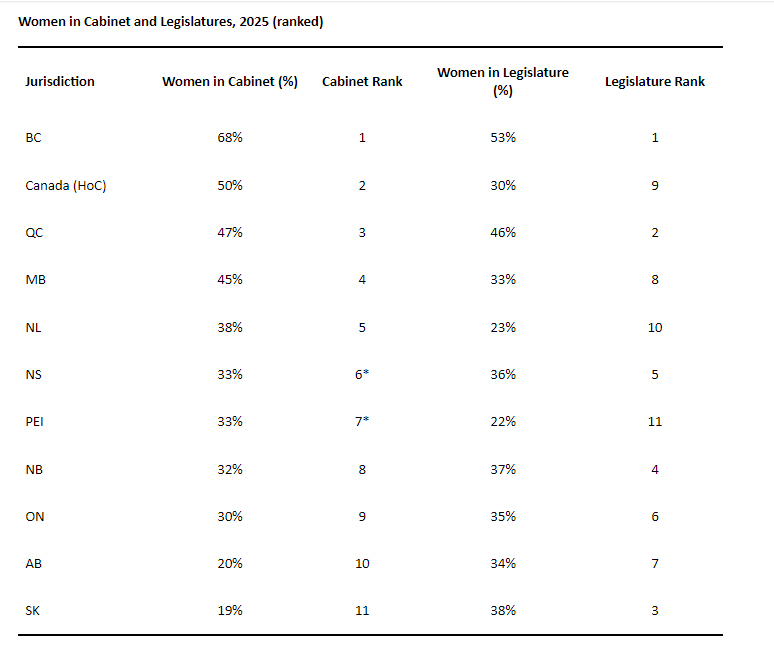
Sources: Federal and provincial government websites (cabinet and legislature compositions); Equal Voice Canada (legislatures). Data include premiers/PM. P.E.I and NS tied in cabinet rank (33%). Current as of August 2025.
Legislatures span from B.C.’s 53 per cent to P.E.I.’s 22 per cent. Most provinces hover in the 30 per cent range. While the federal cabinet is at parity (50%), the House of Commons lags badly at 30 per cent, placing it near the bottom and ahead of only N.L. and P.E.I. This contrast makes a critical point: cabinet parity rests on a premier’s or prime minister’s discretion; legislative parity depends on electing more women in the first place.
The gains made by women in B.C. have produced real wins: free prescription contraception; access to $10-a-day childcare in expanding areas; and a government commitment to introduce up to five days of annual paid leave for survivors of domestic and sexual violence. They’ve also advanced a Gender-Based Violence Action Plan, strengthened pay transparency laws, expanded reproductive and gender-affirming health care, and made provincial statutes gender-neutral. These gains are not coincidences; they reflect what happens when women are at the table in large numbers.
But significant work remains even with women holding a supermajority in the BCNDP’s caucus and cabinet. The gender pay gap persists; violence against women, especially Indigenous women and girls, remains at crisis levels; and an undersupply of affordable housing and childcare disproportionately affects women. Recent cuts to women’s organizations and the 2024 Name Amendment Act, restricting access to legal name changes — a move widely condemned for disproportionately harming transgender and Indigenous people — demonstrates significant slippage. Thus, equitable representation helps bring equitable policies but does not guarantee real change.
A key takeaway from B.C. is that recent advances in women's political representation rest on rules that the BCNDP have put in place themselves and not legislation. The BCNDP’s 2006 Equity Mandate requires local riding associations to nominate women or equity-seeking candidates when a male incumbent retires. Since then, the share of women candidates, and in turn MLAs and ministers, has risen. No other jurisdiction in Canada has anything like it.
Make the Triptych Permanent in B.C.
Without legislated quotas, these levels of equity are tenuous. Women’s representation will likely decline if another B.C. party forms government since no other provincial party uses quotas to select candidates. This isn’t inevitable: many democracies use legislated quotas to turn occasional breakthroughs into a political norm. Quotas aren’t radical. What is radical is accepting cabinets and legislatures where women are systemically under-represented. Without moving to enshrine quotas more generally, B.C. risks losing its lead.
The Eby government should amend the Election Act to require all parties to nominate at least 50 per cent women or gender-diverse candidates or have their election rebates reduced according to how far below the threshold they fall. It should also pass a Gender Parity in Cabinet Act to ensure women always hold half of cabinet posts, whatever party forms government. In addition to these legislative changes, the Eby government should reinstate the Minister of Women and Gender Equality with the full budget, authority, and mandate required to make Gender-Based Analysis Plus a standard practice across all government decision-making. That urgency was echoed when gender justice groups told the federal Minister for Women and Gender Equality during a recent B.C. visit that “gender equality is not optional” and warned of rising violence, unaffordable housing, childcare shortages, and deepening inequities.
B.C.’s triptych is more than a provincial milestone. It’s a model for the country. Legislating parity in legislatures and cabinets and restoring a full Ministry for Women and Gender Equality would lock in these critical gains for women in B.C. and set a national standard. B.C. can either entrench its lead or risk watching the shattered ceiling be rebuilt, pane by pane.
Jeanette Ashe holds a PhD from Birkbeck, University of London. She is faculty in political science at Douglas College and visiting faculty at the Global Institute for Women’s Leadership at King’s College London. Her research focuses on political recruitment and gender- and diversity-sensitive parliaments. Follow her @jeanetteashe.