
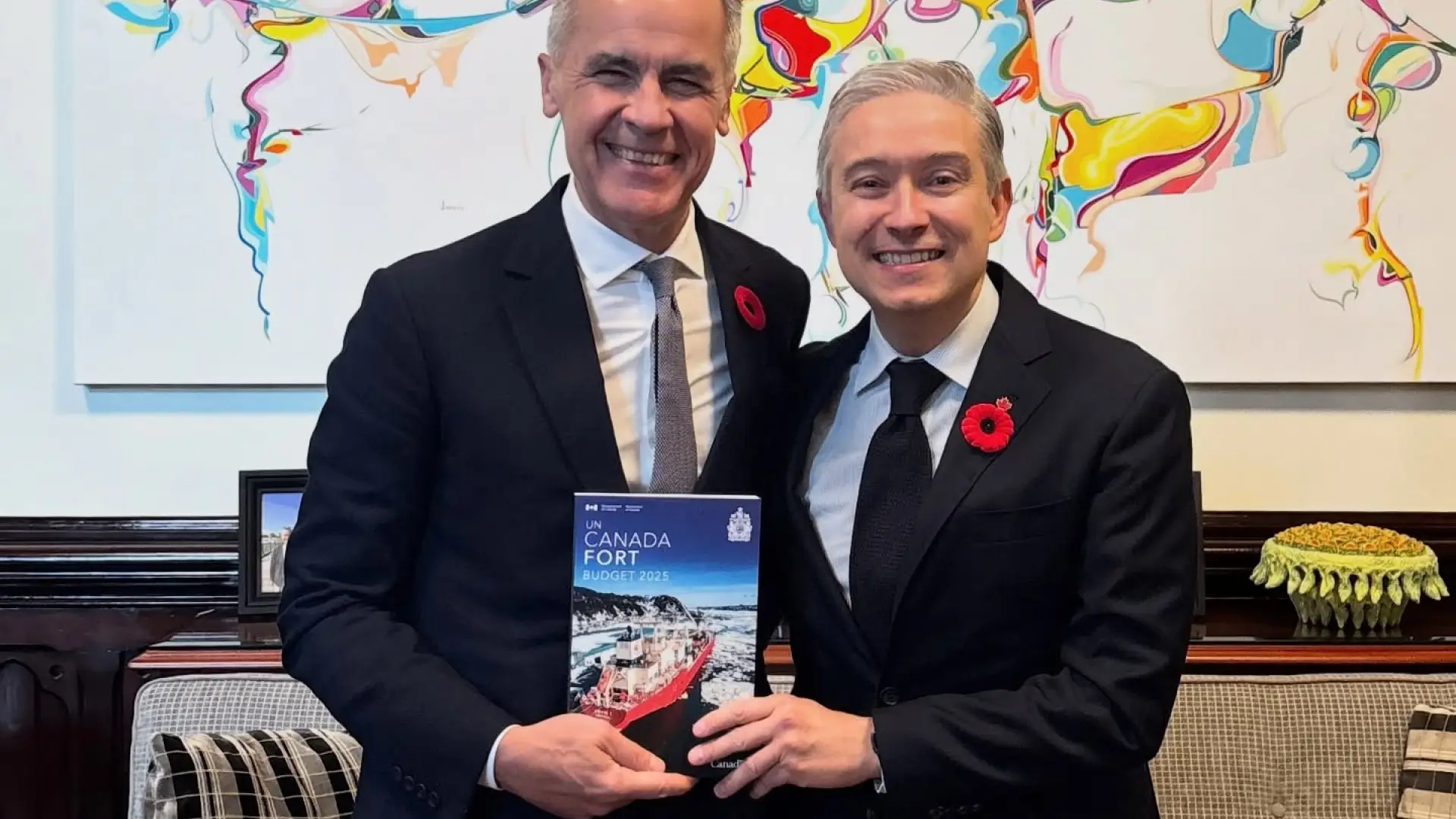
Given the anti-budget rhetoric of Bloc Québécois leader Yves-François Blanchet, political observers elsewhere in Canada might assume Prime Minister Mark Carney’s fiscal blueprint has missed the mark in Quebec.
No stranger to hyperbole, Blanchet is urging Parliament to defeat the Carney budget for failing to meet his list of “non-negotiable” demands, an act that would trigger an unwanted election, and accused the new cabinet of being “ignorant of the Quebec nation.”
But Quebecers are not going out of their way to bristle at Carney’s refusal to satisfy the Bloc’s wish list, most of which rehash familiar ground: more unconditional health and infrastructure transfers, higher Old Age Security payments for those aged 65 to 74 (a measure the PBO estimates would cost $3.5 billion annually), and a nearly $1 billion refund the Bloc maintains is owed to Quebecers due to the carbon-tax rebate exclusion.
Of all its demands, the Bloc’s push for increased unconditional health transfers touches a top concern in Quebec. Yet an unpopular provincial government led by Premier François Legault, struggling with service delivery and fractious relations with the medical community, means voters are unlikely to blame Ottawa for health care woes, especially on its first budget. The trust deficit lies in Quebec City, not in Ottawa.
If anything, the Bloc’s singular focus on its own demand highlights its struggle to keep pace with a public opinion landscape reshaped by Donald Trump’s emergence as a political X factor. The mood in Quebec is not primed for a federal–provincial fight. It wants competence, stability, prudence, productivity, and preparedness.
Quebecers’ priorities now mirror those of the rest of the country. A recent Léger poll found housing, health care, tariffs, inflation, and immigration to be the top five concerns both provincially and nationally. And according to Abacus, a plurality of Quebecers and Canadians alike view the deficit as “a problem, but one that can be reduced gradually over time,” preferring modest cuts and limited new spending.
In short, the Carney Liberals seem to have successfully read the room.
The budget’s approach may not thrill as a historic turning point, but it positions the Liberals to maintain ground in Quebec, a clear advantage over a Bloc still relitigating policy battles from the Trudeau era.
While Blanchet derided Finance Minister François-Philippe Champagne’s fiscal plan as “a sham” and “a mess,” commentators across Quebec’s ideological spectrum called it “sober,” “responsible,” “adult,” “not flamboyant,” and even “borderline boring.” Its lack of spectacle was received as a feature, not a flaw.
A passing grade, in this case, is a win, and that’s exactly what Carney earned.
Crucially, the Carney Liberals succeeded in shedding the self-inflicted “austerity” frame they had generated in a lapse of communications judgment, opting instead to drill down on a message of fiscal prudence and strategic investment in Canadian sovereignty.
That shift matters in Quebec’s cultural sector, which initially feared deep cuts. The lesson from Stephen Harper’s 2008 missteps, when ill-timed cuts to culture cost him a majority and long-term goodwill in Quebec, was not lost on Carney. Instead, the budget affirms that protecting Canadian culture remains central to the government’s vision for a strong Canada, with more than $400 million over three years to support film, audiovisual, and music creators in a fast-moving global marketplace, and $150 million to revamp and strengthen CBC/Radio-Canada.
As with defence, culture receives investment rather than austerity, signaling that Carney’s “Canada Strong” agenda about is more than just hard power.
Although questions remain about funding levels, infrastructure projects in Quebec figure prominently. The province also stands to gain from the Canadian Critical Minerals Strategy through job creation, investment, and value-chain development, as well as from Carney’s $82 billion plan to rebuild, rearm, and reinvest in the Canadian Armed Forces. Accounting for 28 percent of Canada’s defence industry employment, the province’s aerospace and defence ecosystem, anchored by CAE, Thales, Pratt & Whitney Canada, and Bombardier, stands to benefit directly.
If there is one potential ticking time bomb in the budget, it lies in climate policy. The environment has quietly slipped out of Quebec’s top five priorities and climate policy barely registered in post-budget Quebec commentary. For now, Carney’s decision to pursue a complex, technically focused, and low-profile climate strategy counts as a communications win. Still, the bill, environmental or political, will eventually come due. But that is simply not where voters are in the now.
In today’s geopolitical and economic environment, no budget is likely to be celebrated in Quebec or anywhere else. The goal is Hippocratic: to do no harm. On that score, Carney has met his mission in Quebec.
Eric-Antoine Ménard is Vice-President at NorthStar Public Affairs and head of its operations in Québec