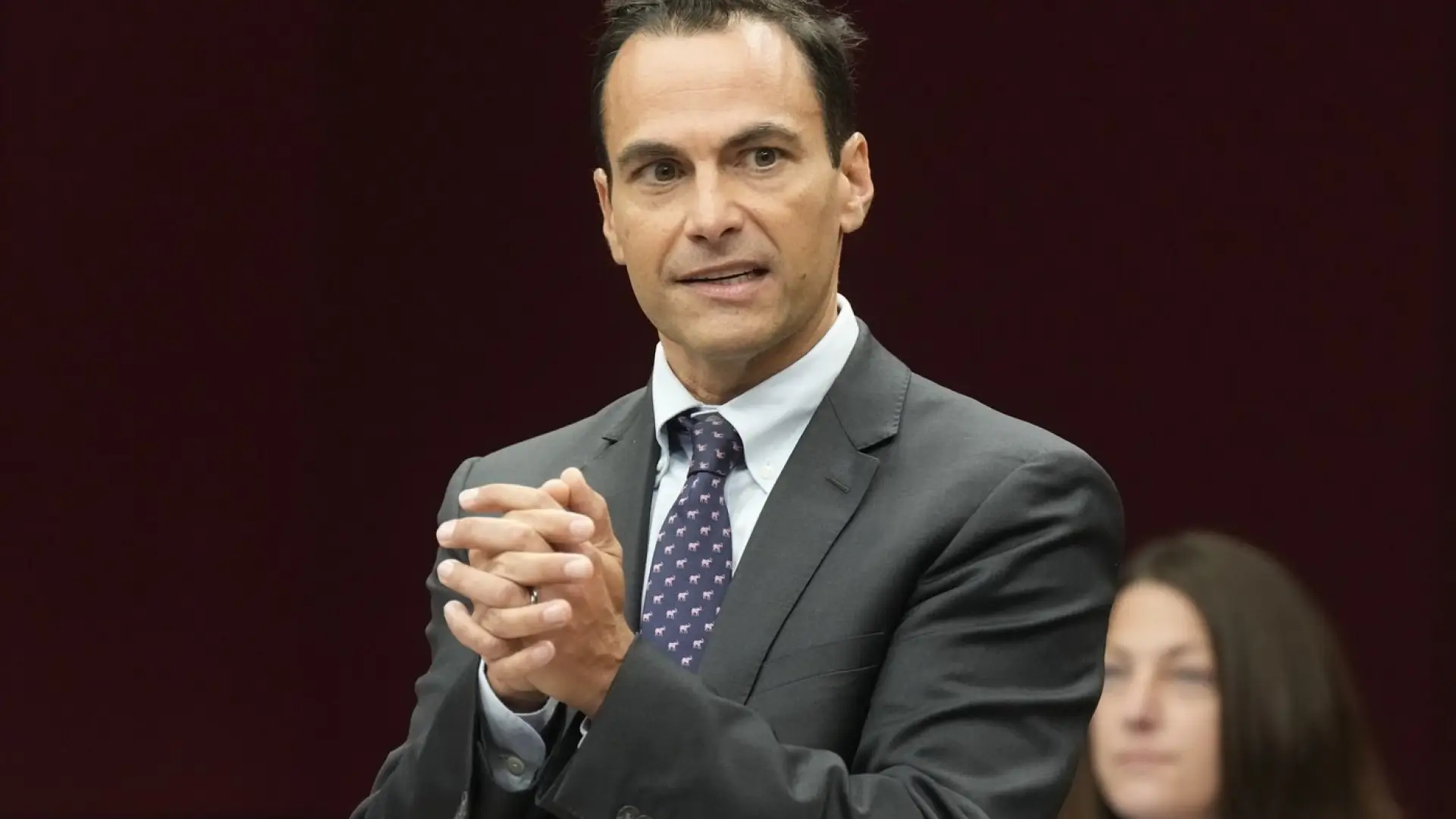
OTTAWA -- Jason Jacques says he learned a lot about the importance of choosing his words carefully in his first few months as the interim parliamentary budget officer.
His whirlwind ascent from obscure bureaucrat to high-profile thorn in the Liberal government's side began in late summer, when outgoing budget officer Yves Giroux's term was set to end without a formal successor in place.
Tapped over the Labour Day long weekend to step into the role for a six-month term, Jacques quickly made waves among parliamentarians and the media with his blunt assessment of Ottawa's fiscal management.
After Jacques released a fiscal forecast in September, he told MPs on a parliamentary committee that the current state of federal finances was "unsustainable," "shocking" and "stupefying."
Politicians and pundits seized on Jacques' comments ahead of Prime Minister Mark Carney's hotly anticipated first federal budget in November. The Conservatives held up Jacques' words as proof of the Liberals' "reckless" approach to spending.
But in a year-end interview with The Canadian Press earlier this month, Jacques said he would not have used those words if he could rewind the past three months.
"It was totally unnecessary," he said. "People make mistakes. And again, for myself, it was a learning opportunity."
Before stepping into the interim budget officer role on Sept. 3, Jacques was a mainstay of the office. He was recruited in 2008 by inaugural PBO Kevin Page.
Page, now head of the Institute of Fiscal Studies and Democracy at the University of Ottawa, publicly disagreed with Jacques' warning that Ottawa's finances were heading toward a "precipice."
He argued in a Public Affairs magazine piece published on Oct. 14 that while the Carney government's fiscal pivot was a big swing, its ambition matched the challenge posed by U.S. trade aggression.
The Liberal budget tabled on Nov. 4 posted a sizable deficit of $78.3 billion for this year, with steep but shrinking deficits over the horizon. It was presented as a "generational" investment plan to boost Canada's productive capacity and reduce its economic reliance on the United States.
Jacques said in his budget analysis that while the projections for federal finances appear sustainable in the long term, he believes the Liberals are unlikely to meet some of their new fiscal objectives.
In the interview, he acknowledged it's possible the economy surges as a result of the Liberals' economic pivot, to the point where Ottawa's fiscal position is greatly improved in the years to come.
But he also warned that if Carney's move to ramp up capital investments doesn't pay off, those higher spending levels will undermine the feds' capacity to absorb the next economic shock.
"Conceptually, all of it works," Jacques said. "The trick really ends up being on the execution."
Before stepping into the spotlight in September, much of Jacques' experience in the PBO involved explaining his fiscal analysis to parliamentarians in their offices, or to reporters over coffee. While those kinds of conversations don't make headlines, they help to impart a general understanding of highly technical fiscal policy.
Jacques said he realizes the words he'd sometimes use in those meetings -- when he was trying to describe the big picture to someone without an accounting degree -- aren't necessarily the right ones for the spokesperson for the PBO office to use.
"I'm familiar with the words 'shocking' and 'stupefying,' and in my personal life, I might use those words. I have lots of personal opinions that are completely irrelevant to the job that I'm doing and in many situations are really unhelpful," he said.
Jacques said he does not believe the PBO is supposed to be a critic -- or even a watchdog, as the office is often described by the media.
The parliamentary budget officer, he said, is meant to give an objective view of the government's finances -- to strip the politics out of the numbers. He said he believes his role is to give parliamentarians a confident grasp of the figures so they can ask informed questions of the government.
"It's a very political environment. And if I'm not careful with my language, there is a risk that it'll be politicized. And that's not helpful for anybody," Jacques said.
"If your accountant is using language or adjectives that are giving you pause or catching your attention, it's probably not a good sign overall."
The Liberal government issued a posting for the full-time, permanent PBO position in November. The successful candidate must secure parliamentary approval before beginning a seven-year term.
The permanent job posting says the successful candidate must have "tact and discretion." Jacques said he doesn't think that phrasing was targeted at him -- he points out the previous posting from 2018 also included that language.
While Jacques has committed to applying for the permanent gig, he said he would be surprised to land it. The permanent role has never gone to someone within the office in the PBO's history, he noted.
For now, he said, he's working on ensuring the office maintains its reputation as a source of objective analysis of fiscal policy for MPs and senators from any party.
Jacques said he owes it to the people working in the budget office -- and whoever assumes the mandate after him -- to leave the role in a "respectful" position.
He said that after his interim term wraps up in March, he expects to continue the work he believes in -- breaking down the state of parliamentary finances for the people who rely on the budget office.
"Regardless of the role that I play or the title that I have, I want to continue doing that," he said.
This report by The Canadian Press was first published Dec. 23, 2025.