

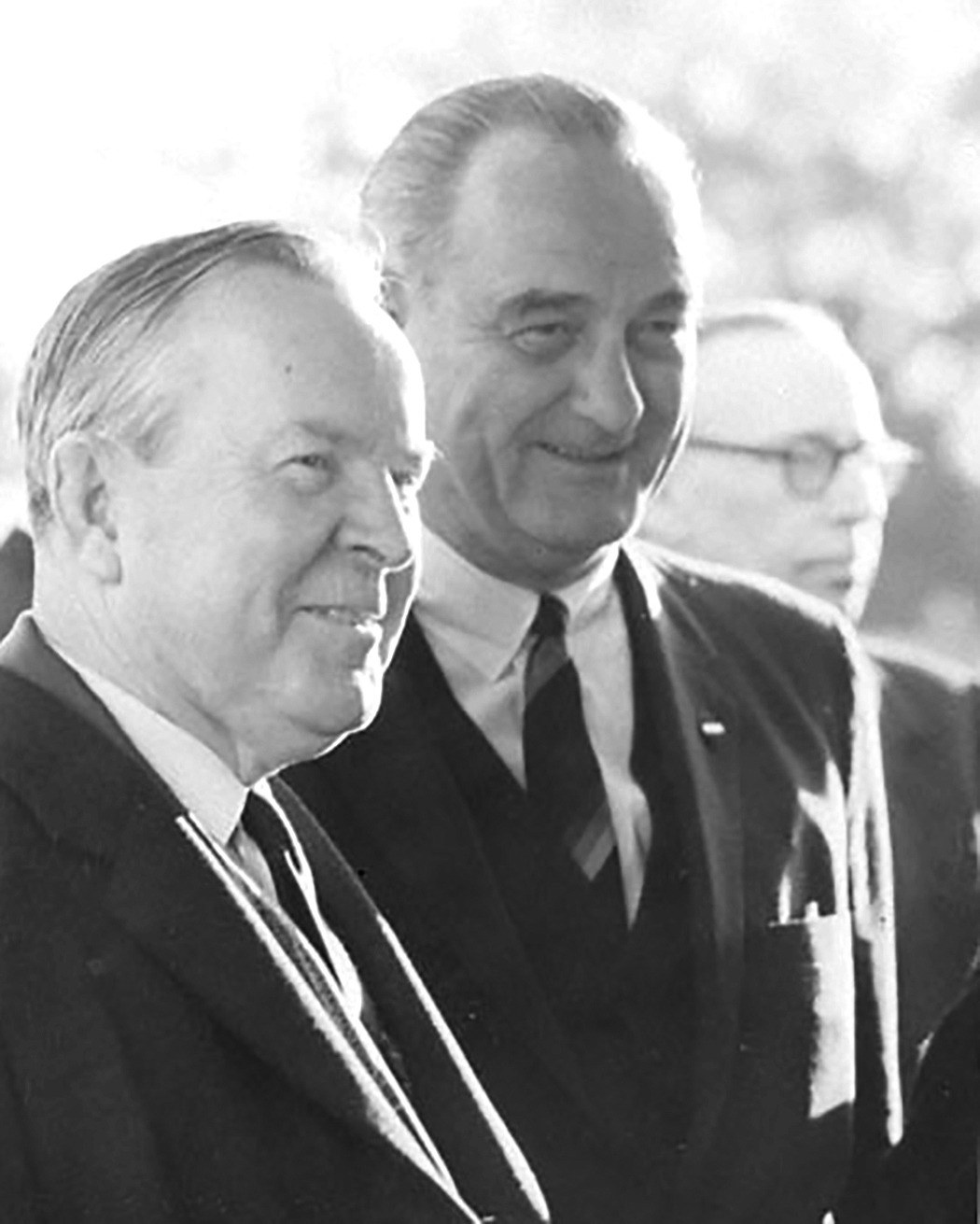
Prime Minister Lester Pearson was at the White House on this date in 1964 for talks with America’s new President, Lyndon Johnson. One of the highlights of the visit was the signing of an agreement between Canada and the United States making the summer home of Franklin Roosevelt on Campobello Island, New Brunswick an international park to be jointly administered by Canada and the United States. “We have no problems that cannot be solved. We have no differences that cannot be settled,” Johnson said. “We have no future that cannot be shared. That is why I am happy, in concert with the distinguished Prime Minister of Canada, Mr. Pearson, to sign this agreement.”
You can read the remarks by President Johnson and Prime Minister Pearson remarks at the signing ceremony below.
President Lyndon B. Johnson: President Roosevelt would have approved of what we are doing here today. He approved of anything that advanced, however small, the general well-being of human beings. So it cheers me to join with Prime Minister Pearson in taking the first step toward establishing Franklin Roosevelt's Campobello summer home as a memorial park.
I want to publicly thank Dr. Armand Hammer and Mr. Harry Hammer and Mr. Victor Hammer for their most generous contribution in President Roosevelt's memory, and to his deeply held love for the Canadian people. I think that President Roosevelt would be pleased that this is a new and very special project. It is, as you know, the first jointly owned U.S.-Canadian park. This is ample evidence of a close tie between the United States and Canada.
This involves land and people. This is the heart of human concern and national kinship. Canada and the United States are not only good neighbors, but we are good partners. We are going to stay good partners. Each will help the other to stay strong, to stay solvent, to stay stable, and to stay compassionate.
We have no problems that cannot be solved. We have no differences that cannot be settled. We have no future that cannot be shared. That is why I am happy, in concert with the distinguished Prime Minister of Canada, Mr. Pearson, to sign this agreement.
I hope that Campobello Park will live eternally as a symbol of our friendship that cannot be shaken or diverted. President Roosevelt would want it this way.
Prime Minister Pearson: Mr. President, may I tell you how deeply I appreciate the privilege of joining you today in signing the agreement which will make possible the establishment of the Franklin D. Roosevelt Campobello International Park.
I recall last May when I was in Hyannis Port when this idea was advanced and we were able to proceed with it at that time through the generosity of Dr. Hammer and his brothers. And through the understanding support and cooperation of the members of the Roosevelt family, the process which began then has now come to the stage of completion insofar as the signing of this agreement is concerned. I am very happy, indeed, to be a part of it.
As you say, Mr. President, this is something of which Mr. Roosevelt would have approved. We cherish this action in Canada not only because it will establish another link in the friendship between our two peoples across our border, that border which is so easily crossed, but also because it will be an eternal memorial to one of the great and towering figures of our age, a man who had done so much for human freedom and one whose memory is as imperishable in Canada, a country which he loved, and in which he spent so much of his time, whose memory will be as imperishable in Canada as it is in the United States.
My colleagues and I are very proud, Mr. President, to be able to take part in this ceremony today.
President Johnson: To some of you here for the first time I would like to point out that the beauty of this room is made possible because of the great, dedicated effort of Mrs. Kennedy. She had just completed the decoration of it. It is known as the Treaty Room. The Indian Treaty was signed here, a number of other treaties. We have had two agreements and one treaty signed since November in this room ourselves.
President Andrew Johnson's first Cabinet met in this room for the first time. It has many things of historical importance here, including its chandelier that hung in my office in the Capitol for a number of years. It had originally been in the White House. But when President Theodore Roosevelt became President, in the days before air conditioning, he would have to open the windows in the evening to let the breeze come in to keep cool, and the chandelier glass would tinkle and keep him awake. So he told the butler one evening to get that chandelier out of here and take it down to the Capitol. The frustrated butler said, "Well, where do I take it to the Capitol?" He said, "Take it to the Vice President. We need something to keep him awake." So it stayed there, Mr. Prime Minister, for many years, and I guess Mrs. Kennedy finally concluded that I was wide awake and she told me she wanted that chandelier brought back to the White House where it belonged, and her wish was my command.
Arthur Milnes is an accomplished public historian and award-winning journalist. He was research assistant on The Rt. Hon. Brian Mulroney’s best-selling Memoirs and also served as a speechwriter to then-Prime Minister Stephen Harper and as a Fellow of the Queen’s Centre for the Study of Democracy under the leadership of Tom Axworthy. A resident of Kingston, Ontario, Milnes serves as the in-house historian at the 175 year-old Frontenac Club Hotel.