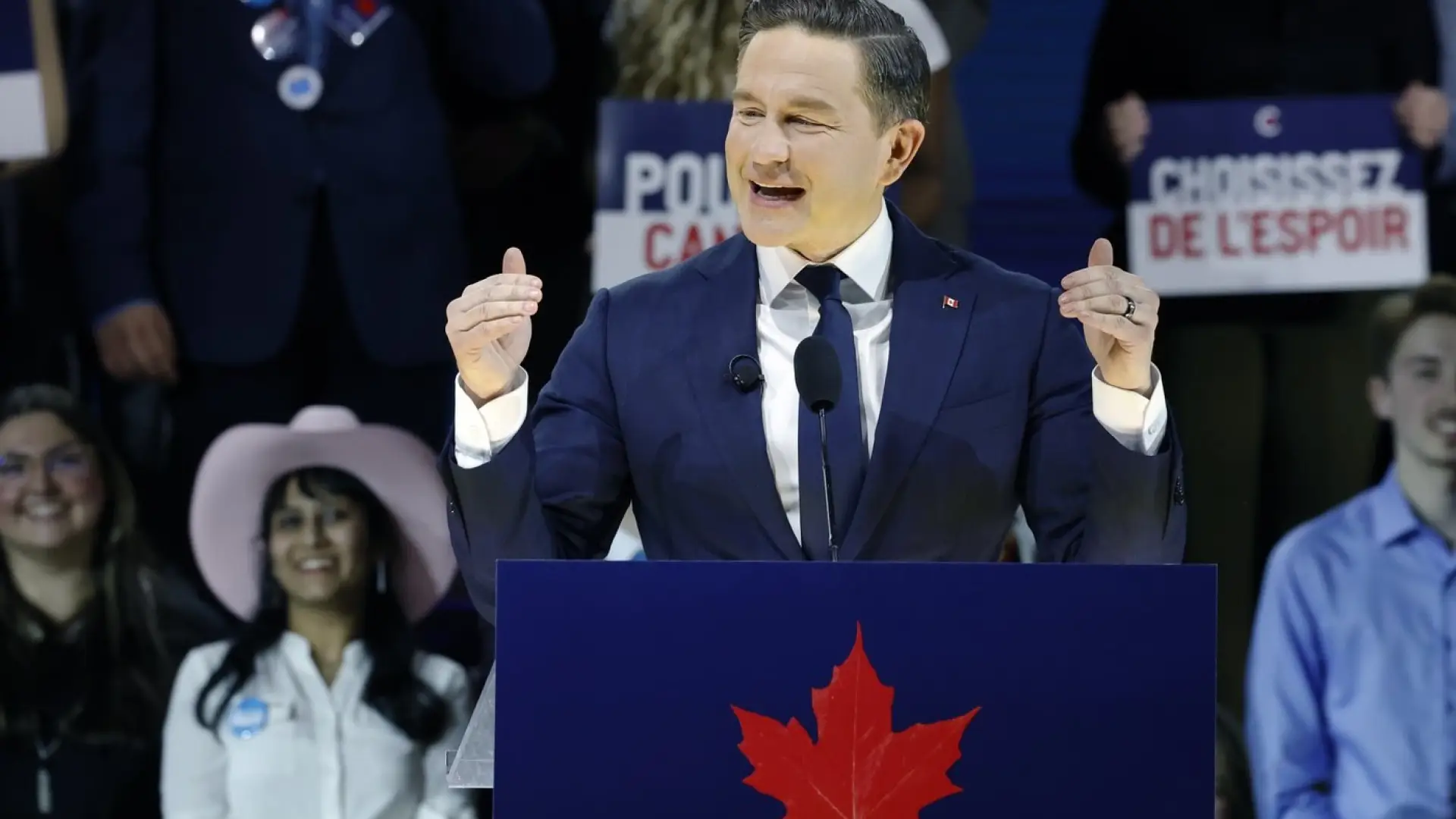
CALGARY -- Conservative Leader Pierre Poilievre blamed the federal Liberals for past and present separatist movements in Canada, but a separatist leader in Alberta said his group will still push to leave regardless of who is in office in Ottawa.
During his nearly hour-long speech Friday evening at the Conservative convention in downtown Calgary, Poilievre addressed the separatist sentiment in Alberta and Quebec.
"Liberals are in power, and just as night follows day, separatist movements are in resurgence," Poilievre said to a full ballroom in Calgary's BMO Centre.
The problem in both Alberta and Quebec, Poilievre claimed, is that for the past decade Ottawa has told "our young people" that Canadian history is filled with shame and horror. He said Liberal policies have driven up the cost of living and dimmed younger Canadians' prospects of home ownership.
Ottawa has been stomping "on Alberta's energy sector and Quebec's jurisdiction," he said.
Jeffrey Rath, general counsel for the separatist promoter group Stay Free Alberta and who is among the leaders of the movement, was in the crowd and was unmoved by Poilievre's mention of Alberta separation.
Rath said Alberta independence won't stray from its goal regardless of who is in office, and there's nothing that any federal politician can do to change their minds.
"We don't believe that Pierre Poilievre is coming to save us," he said.
Rath is among those working to gather signatures for a citizen-led petition to push for an independence referendum in the province, describing Alberta's relationship to Ottawa as toxic and abusive.
He said Alberta has been insulted, denigrated and taken advantage of by central Canada as a resource-laden province.
"I think (Poilievre is) dreaming if he thinks this is going back in the box," he said.
Rath has become a titular character in the Alberta separation movement. At the Tory convention, he said delegates approached him for pictures and let him know they are registered as canvassers for the petition.
The petition needs nearly 178,000 signatures to push forward to the next step in a provincial vote on separation.
Provinces cannot unilaterally separate from the country. If a referendum was to succeed, it would trigger negotiations between the province, the federal government and First Nations groups, among others.
Alberta Liberal MP Cory Hogan, who represents the constituency of Calgary Confederation, said there has not been a rise in separatism, but that the movement has been given a legitimacy by politicians like Poilievre, who are amplifying it.
"We can't be distracted by these grievance politics and by giving these winks to these movements that are fundamentally damaging and of no benefit," he said.
Scott Armstrong, a Progressive Conservative member of Nova Scotia's legislature who listened to the speech in Calgary, said he agreed with Poilievre's assertion.
"I think that what we've seen is the Conservative party respects the individual roles of provincial governments and provincial jurisdiction," he said.
When Ottawa goes beyond that, he said, provinces consider secession.
Philippe J. Fournier, a polling analyst and founder of the polling and electoral projection website 338Canada, contests Poilievre's claim that Quebec separatism is in resurgence.
"This is the level sovereignty has been in Quebec, not for just a few years, but even for decades," said Fournier.
In reality, he said, the Parti Quebecois's leading position in the polls is fostering the perception that separation has gained ground.
Fournier said he expects this fall's election in Quebec to be a competitive five-way split.
Moreover, Fournier disagreed with Poilievre's assertion that separation sentiment was borne out of Liberal power. He said that ignores the historic tensions and complexities that gave rise to the independence movement, including under the Progressive Conservative government of Brian Mulroney.
Alberta Premier Danielle Smith did not mention separatism in her speech at the convention Saturday.
A recent poll from Ipsos, a global market research firm, found about 28 per cent of Alberta residents say they would vote to separate from Canada.
That number dropped to between 15 and 16 per cent when "real-world consequences" were introduced, the online poll said.
This report by The Canadian Press was first published Jan. 31, 2026.
-- With files from Sarah Ritchie