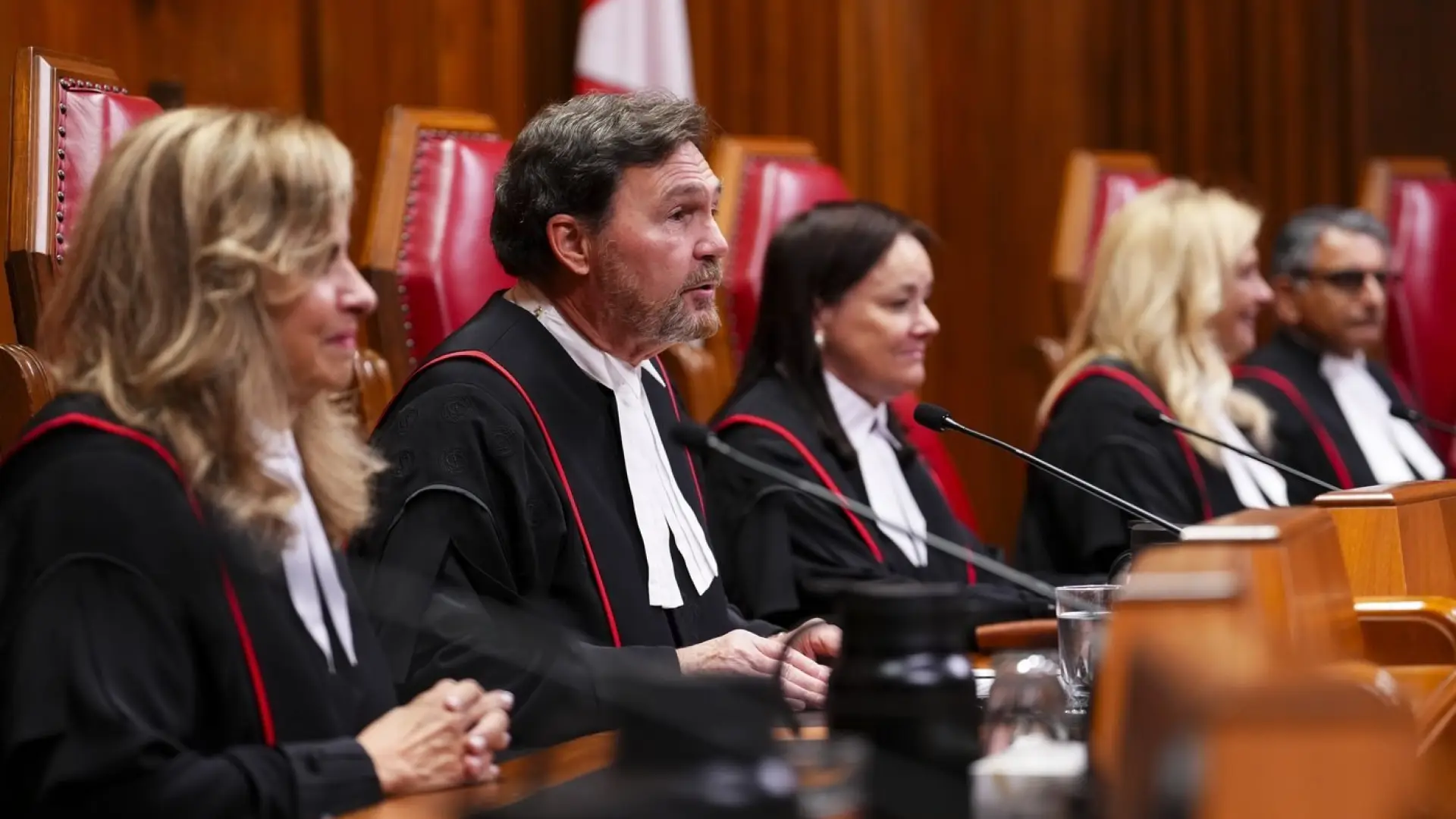
The Supreme Court of Canada has invalidated a federal Liberal candidate's one-vote victory in last spring's federal election, pushing the governing party further away from a majority in the House of Commons.
Liberal Tatiana Auguste has sat as a member of Parliament since the spring, after being declared the winner over Nathalie Sinclair-Desgagné, the Bloc Québécois candidate.
Sinclair-Desgagné let out a long sigh of relief shortly after she heard the ruling, announced from the bench following a hearing earlier on Friday.
She challenged the election results and demanded a byelection after a Bloc Québécois supporter complained that she had tried to vote by mail using a special ballot that was never counted.
The voter, Emmanuelle Bossé, said the special ballot was returned to her own mailbox due to an error on the postal code printed on a label supplied by Elections Canada.
"The Supreme Court decided today that every vote counts and that the vote of one person isn't worth more than the vote of another, and that, when there is a tie, there should be a new election," said Sinclair-Desgagné, reacting to the decision.
"Up until today, someone was representing the riding who, however, did not have the legitimacy to do so. Fortunately, this was corrected today."
Before the country's highest court delivered its verdict, Marc-Étienne Vien, lawyer for Auguste, faced a barrage of questions from the justices.
As Vien argued that the Bloc Québécois voter whose special ballot had been returned to her “was not prevented from voting,” Chief Justice Richard Wagner interrupted him.
“Hold on a minute,” the judge told him. “The purpose of the law is to promote public participation at a time in history when institutions are under strain.”
This was the beginning of a series of interruptions.
“It seems to me that the responsibility is perfectly clear. The responsibility for this problem today lies with Elections Canada, not with (the voter who cast her ballot by mail),” Justice Malcolm Rowe said without even asking Vien a question.
Vien said invalidating the election required “a serious error … associated with fraud.” He added that lowering the threshold for challenging an election could create “a problematic precedent.”
“This isn’t about a breach of procedures or Elections Canada’s responsibilities,” said Vien. “It’s simply a routine, clerical error."
The April 28 general election returned the Liberals to power with a minority government under Prime Minister Mark Carney. In the Terrebonne riding, Auguste was initially declared the winner before the result flipped to Sinclair-Desgagné after the votes went through a validation process.
A judicial recount completed on May 10 concluded the Liberal received 23,352 votes — one more than Sinclair-Desgagné.
The Supreme Court decision to invalidate this result would leave the federal Liberals with 168 seats in the House of Commons, short of the 172 required to form a majority government.
The new ruling also rejects an earlier decision from October, when a Superior Court judge denied Sinclair-Desgagné's request for a new election, saying the "human error" did not affect the integrity of the Canadian electoral system.
The Bloc said it was thrilled with Friday's ruling, noting it reaffirms that the right to vote is fundamental in a democracy.
"Now that the seat is vacant, we are demanding that the byelection be called without delay, so that Terrebonne residents can go the polls rapidly," said Suzanne Proulx, president of the Bloc.
Liberal Party of Canada spokesperson Matteo Rossi said the party respects the ruling and is ready for another campaign in the Terrebonne riding.
In most cases, byelections must be called within six months of a seat being vacated.
Terrebonne will become the third vacant seat in the House of Commons, after Chrystia Freeland and Bill Blair both resigned their Toronto seats this year. Byelections have not yet been called in any of them.
Sworn statements filed in the case show that an election employee discovered he had mistakenly printed his own postal code on several special ballots about three weeks before election day. He estimated that a minimum of 40 envelopes had gone out with the wrong postal code.
The employee said he didn't deem it necessary to inform his superior of the mistake because the number of ballots returned to the elections office wasn't higher than during past elections.
In a statement, a spokesperson for Elections Canada did not address the court ruling itself.
"Following the Supreme Court's decision, Elections Canada is ready to administer a byelection in Terrebonne," Matthew McKenna said in an email.
This report by The Canadian Press was first published Feb. 15, 2026.
1811