
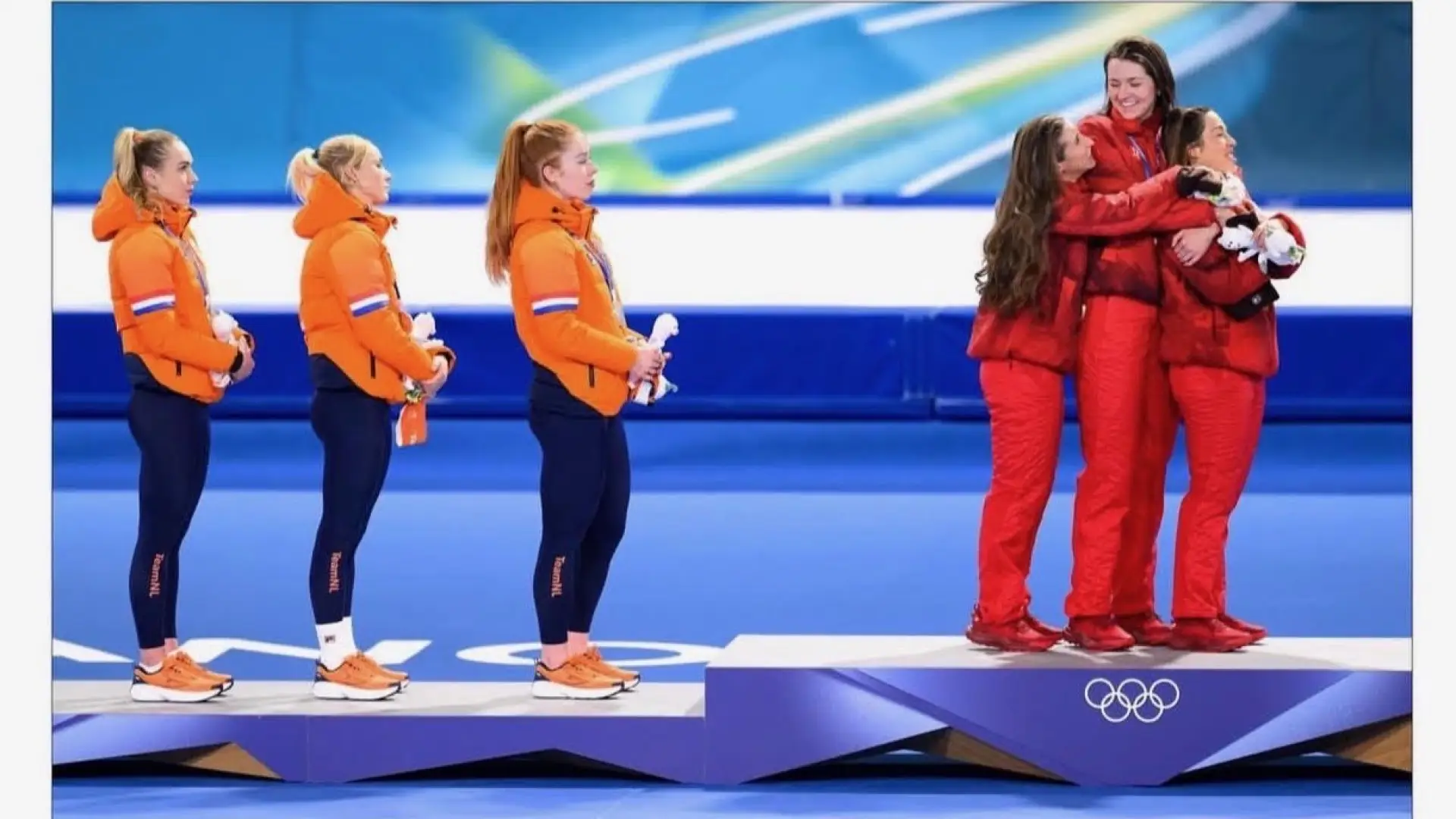
Perhaps the only thing harder than winning an Olympic Gold Medal is defending one. Canada’s superstar women’s team pursuit in long track speedskating is the first team to ever do it in this discipline, and they made it look pretty routine here in Milan. Isabelle Weidemann, Ivanie Blondin and Valérie Maltais have 11 Olympic medals among them – and one of Val’s (who is a 5x Olympian) is a silver in short track from 12 years ago. These are three of Canada’s most incredible endurance athletes of all time, and they’ve got a secret to share with Canadians.
Okay, real-talk they didn’t tell me a secret. But I noticed something as they were lining up to race in the A-final against the Netherlands – a nation with less than half our population but 16 indoor speedskating ovals to Canada’s 3, and culturally obsessed with speedskating. Our team also clobbered the American team in the semi- to make the final, but who is paying attention to details like that (I am). Anyway, here’s what I saw from where I was watching…
Just before the start, as they were taking their positions on the ice, the umpire indicated that it would be 60 seconds until the start gun. It was their reaction that made me almost certain that they were going to win. Isabelle looked back at Ivanie with this huge smile, and then Ivanie looked at Val and did the same. 45 seconds before the start of a maximum effort 3minute test of endurance and mind-boggling precision, and they were smiling at each other, like they knew something the other competitors didn’t. What I saw was two things simultaneously: 1. a deep love for one another as teammates and friends, and 2. a kind of eagerness to get the legs burning hot like molten lava, ASAP – with no fear or hesitation.
Speed skating is also mostly an individual sport. Coming together to achieve something this phenomenal is actually pretty rare for individual athletes. Their chemistry requires trust, respect and vulnerability. The smile at the start demonstrated all the work they put into those elements, which is the foundation of a strong partnership, whether your speedskating in circles or doing almost anything as a group.
They know each others' strengths and weaknesses, and this vulnerability gives them power, not weakness. That acknowledgement and mutual admiration is what makes them greater than the sum of their parts.
They fully embraced the process, a pure veteran move. A sincere and genuine smile elicits positive social, psychological and physiological responses, and promotes feelings of trust and a will to cooperate. When someone you like smiles at you, it’s actually really hard not to smile back – so they used a natural, contagious gesture in that 60-seconds to position themselves in the best way to perform. Veteran instinct and a champion's wisdom.
It made me smile, too. It made millions of Canadians scream at the CBC Gem apps on their phones and tablets and TV screens approximately 3 minutes later. The love they have for one another was confirmed when they sang O Canada together, in a full three-way hug, with huge grins, clutching each other as enthusiastically as their stuffed Tina stoats.
So, is the real secret that smiling can make you a winner, or that endurance activity makes you smile, or kind of both?
I think we all agree, that when Canadians are winning the Olympics, we all smile – but I believe it’s all part of the same equation. Sport is very good for us, and we should all find ways to make it more affordable, attainable, accessible and a bigger part of our daily routines. If you ask a Norwegian about how that applies to youth sport, they’ll tell you that smiles are actually the only kind of reward they’re interested in.
When I was training for the Olympics in kayaking, I spent a lot of time analyzing and copying Norwegian paddling technique (they’re really good at winning in my sport, too). And now, I'm reflecting on how they build their sport system.
The Norwegian youth sport model has more or less eliminated competition before the age of 13. They also don’t travel for tournaments or even really keep score until then. This is because they found that these things distract from the two most essential parts of sport and physical activity at an early age – basic skill development, and joy.
The vibes at these games have been impeccable. The power of sport is proving again that the world can come together, prove unequivocally that we can be great neighbours and still compete against one another, demonstrating that rules matter, and so does sportsmanship. It’s more proof that kindness isn’t weak or unfashionable – but a natural human asset, free of charge, contagious and worth sharing.
Canadians are known around the world as some of the nicest people on planet Earth, and something I’m taking away from Milano-Cortina is how Team Canada has embodied that notion. Canadian athletes are proud, ambitious and fierce competitors – but also some of the most respectful, sportsmanlike opponents on the scene, to the point where other countries are sincerely stoked for us when we win.
I’m obviously rather biased here, but I think our athletes are our greatest ambassadors, they’re doing an amazing job representing the maple leaf and cheering them on as their Secretary of State for Sport has been one of the proudest experiences of my Olympic journey.
With three days left in competition, I hope every Canadian will follow the lead of Isabelle, Valerie and Ivanie – share a smile, be ambitious, optimistic and a great teammate, and embrace the day.
Adam Van Koeverden, Secretary of State for Sport, Member of Parliament for Burlington North—Milton West