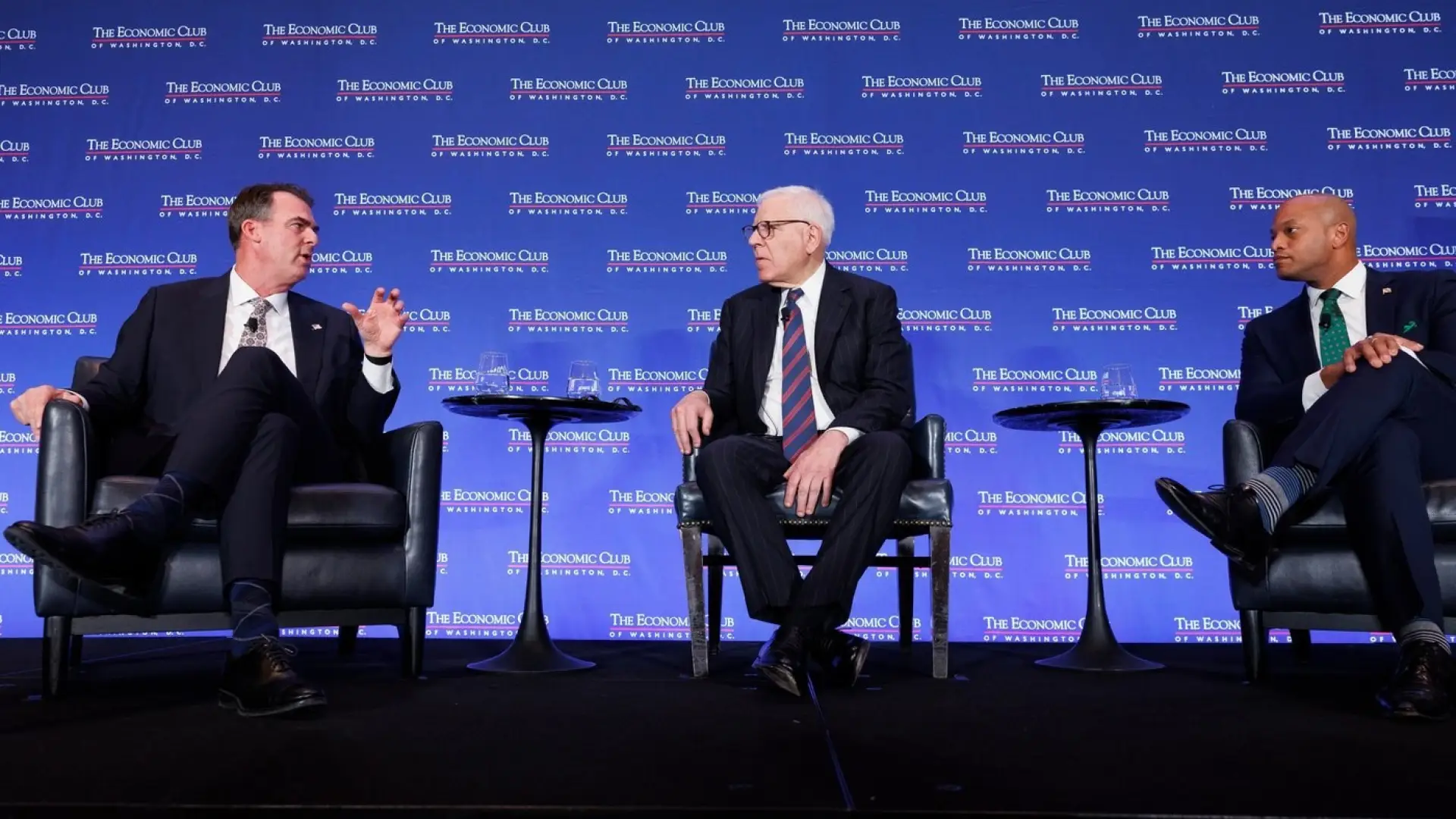
WASHINGTON (AP) -- In another era, the scene would have been unremarkable. But in President Donald Trump's Washington, it's become increasingly rare.
Sitting side by side on stage were Oklahoma Gov. Kevin Stitt, a Republican, and Maryland Gov. Wes Moore, a Democrat. They traded jokes and compliments instead of insults and accusations, a brief interlude of cordiality in a cacophony of conflict.
Stitt and Moore are the leaders of the National Governors Association, one of a vanishing few bipartisan institutions left in American politics. But it may be hard for the organization, which is holding its annual conference this week, to maintain its reputation as a refuge from polarization.
Trump has broken with custom by declining to invite all governors to the traditional White House meeting and dinner. He has called Stitt, the NGA's chair, a "RINO," short for Republican in name only, and continued to feud with Moore, the group's vice chair, by blaming him for a sewage spill involving a federally regulated pipeline.
The break with tradition reflects Trump's broader approach to his second term. He has taken a confrontational stance toward some states, withholding federal funds or deploying troops over the objections of local officials.
With the Republican-controlled Congress unwilling to limit Trump's ambitions, several governors have increasingly cast themselves as a counterweight to the White House.
"Presidents aren't supposed to do this stuff," Utah Gov. Spencer Cox said about the expansion of executive power in recent administrations. "Congress needs to get their act together. And stop performing for TikTok and actually start doing stuff. That's the flaw we're dealing with right now."
Cox, a Republican, said "it is up to the states to hold the line."
Moore echoed that sentiment in an interview with The Associated Press.
"People are paying attention to how governors are moving, because I think governors have a unique way to move in this moment that other people just don't," he said.
Still, governors struck an optimistic tone in panels and interviews Wednesday. Stitt said the conference is "bigger than one dinner at the White House." Moore predicted "this is going to be a very productive three days for the governors."
"Here's a Republican and Democrat governor from different states that literally agree on probably 80% of the things. And the things we disagree on we can have honest conversations on," Stitt said while sitting beside Moore.
Tensions over the guest list for White House events underscored the uncertainty surrounding the week. During the back-and-forth, Trump feuded with Stitt and said Moore and Colorado Gov. Jared Polis were not invited because they "are not worthy of being there."
Whether the bipartisan tone struck Wednesday evening can endure through the week -- and beyond -- remains an open question.
"We can have disagreements. In business, I always want people around me arguing with me and pushing me because that's where the best ideas come from," said Stitt. "We need to all have these exchange of ideas."