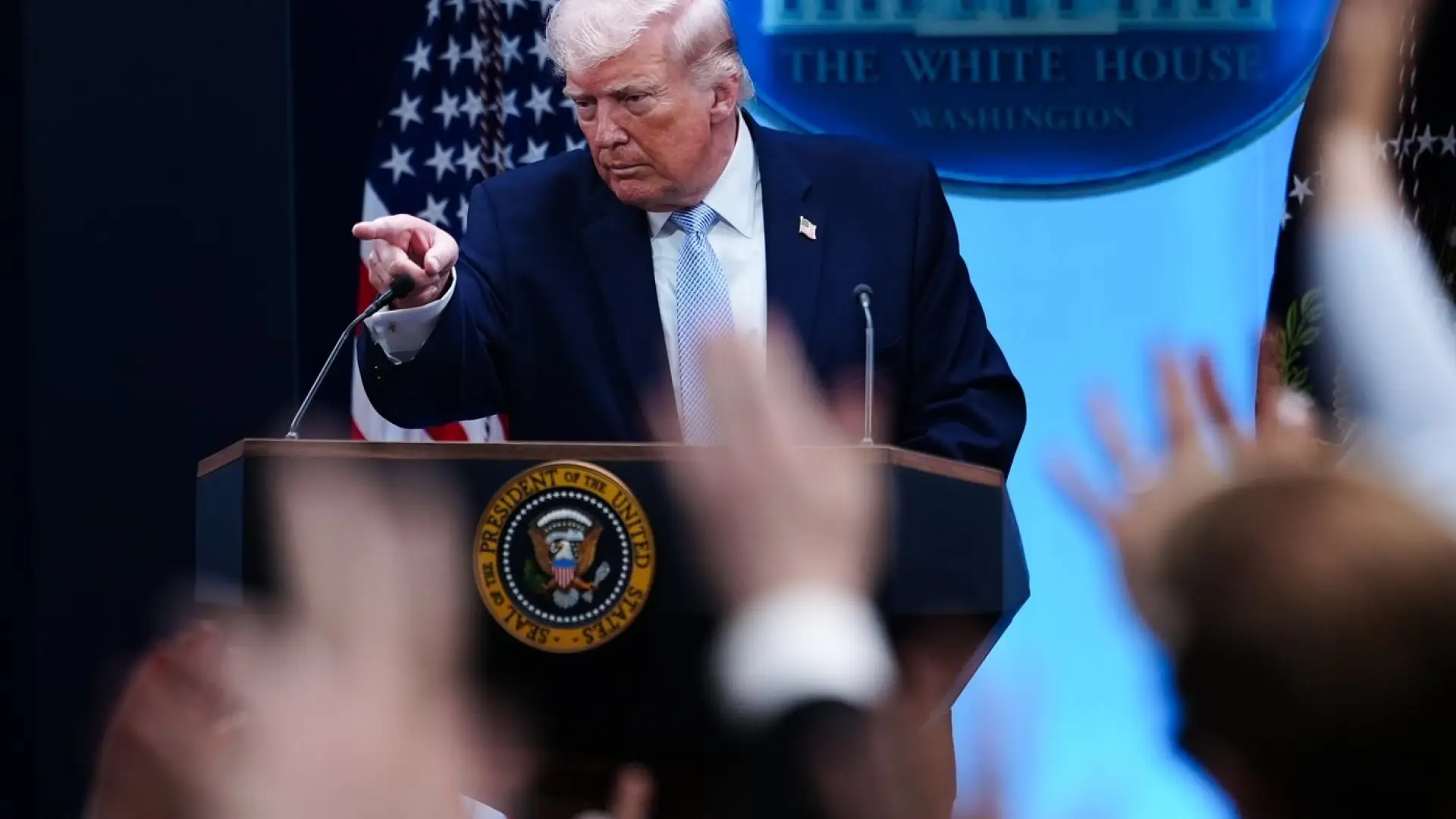
WASHINGTON (AP) -- President Donald Trump's search for an off-ramp from the war with Iran is getting bumpy inside his Republican Party.
In the decade since Trump's "America First" movement rose to power by rejecting military intervention, his coalition has rarely been tested the way it is now. Trump's exit efforts -- first through threats of annihilation, then with a ceasefire that is proving precarious -- are doing little to paper over tensions that have festered since the war began six weeks ago.
Laura Loomer, a conservative activist close to the president and often one of his top boosters, rejected the notion of brokering a deal with Iran. In an interview, she knocked Vice President JD Vance for being "in charge" of talks expected to start Saturday in Pakistan, as he takes on a larger diplomatic role ahead of a potential 2028 White House run.
"I support President Trump," Loomer said in an interview. "I just don't believe in negotiating with Islamic terrorists."
Vance's office did not respond to a request for comment.
Former Rep. Marjorie Taylor Greene of Georgia, a Trump supporter-turned-critic, called for the president to be removed from office through the Constitution's 25th Amendment after he said earlier this week that a "whole civilization will die tonight" unless Iran made a deal. Megyn Kelly, the former Fox News anchor who now hosts a podcast, unloaded on Trump with a profane critique and asked, "Can't he just behave like a normal human?"
During a recent taping of "The Charlie Kirk Show," the host wondered what would end first, their episode or the ceasefire deal.
Despite the growing criticism, Republican leaders in Congress were largely silent. Many were privately uncomfortable with Trump's threats on social media and were concerned about how the war would play out, especially in an election year. But with Congress on recess for the opening two weeks of April, House Speaker Mike Johnson, R-La., and Senate Majority Leader John Thune, R-S.D., have offered little public reaction to Trump's moves.
Some said the developments were simply unfolding too quickly.
"How do you go up and give a presentation or speech in a situation where every 12 hours, the baseline story has a new gradient?" Rep. Dave Schweikert, an Arizona Republican who is running for governor, said in an interview. "In many ways, it is the sin of arrogance thinking you can go out and talk about something when the story is still unfolding."
A factor in the midterms?
That leaves Republicans in an uncertain position, much like the state of the war. The party already faces fierce headwinds ahead of the November midterms, and some say its best bet is for voters to forget about Iran by then.
"My hope is that it will be long behind us by the time votes are cast," said Chris Wilson, a veteran Republican strategist. "Fortunately for the GOP, foreign policy flare-ups rarely decide midterm elections on their own, especially when voters are far more focused on the economy and prices at home."
For now, Trump and his White House are expressing confidence. Trump hailed a "big day for World Peace" after the ceasefire was first announced. White House press secretary Karoline Leavitt heralded a "victory for the United States of America that the president and our incredible military made happen."
In a social media post, Trump dismissed his detractors, including podcasters such as Kelly, as "stupid people" who will "say anything necessary for some 'free' and cheap publicity."
Some of the president's supporters in Congress are pushing back at the suggestion that Trump has become too entangled overseas at the expense of domestic priorities.
"Part of America First is making sure that the homeland stays safe and Iran is a factor in our safety," Rep. David Kustoff, R-Tenn., said in an interview. "We are all hopeful that the ceasefire does hold and that Iran lives up to their side of the agreement.
Recent elections are cause for GOP concern
Any president's party typically loses seats in Congress during a midterm election year and races this week offered a fresh reason for concern for Republicans.
Republican Clay Fuller won Greene's district by about 12 percentage points. She had a 29-percentage-point win two years earlier, and Trump carried the district by almost 37 percentage points. In Wisconsin, the liberal majority on the state Supreme Court grew this week when a Democratic-backed candidate won by a double-digit margin.
That follows strong performances for Democrats in other recent races, including the Florida state legislative district that is home to Trump's Mar-a-Lago resort.
Only about 4 in 10 U.S. adults approved of how Trump was handling his job as president, according to Associated Press-NORC Center for Public Affairs Research polling last month. That share is largely unchanged since he returned to office in January 2025. But it is also roughly where Trump was at this point in his first term, when Democrats went on to gain 40 House seats in the 2018 midterms.
While Trump still has deep support from Republicans, there are signs that he risks frustrating his supporters if the U.S. becomes involved in a prolonged war. Although 63% of Republicans back airstrikes against Iranian military targets, the March survey found, only 20% back deploying American ground troops. Rising gas prices could pose a problem, with about 6 in 10 Republicans saying they are at least "somewhat" concerned about affording gas in the next few months, though they are less worried than the rest of the country.
'People are willing to endure some short-term pain'
Republicans who have spent time with voters over the recess say they believe the party has political breathing room to navigate the war.
Kustoff said constituents across his rural northwestern Tennessee district seemed "generally supportive" of Trump's actions in Iran, even when they have been accompanied by higher prices at the pump.
"My takeaway is that people are willing to endure some short-term pain as it relates to gas prices if the situation with Iran is resolved," he said.
But as they return to Washington next week, Republicans face a series of difficult choices.
At the outset of the war, some GOP lawmakers said Trump would need to seek approval from Congress if the conflict lasted longer than 60 days, a deadline that would approach near the end of April if the ceasefire did not hold. The administration is seeking billions of dollars in additional spending for the war, setting up a vote that could put budget-conscious Republicans in a difficult spot before the fall campaigns.
Democrats are also moving to force another vote on a war powers resolution that would curb Trump's options in Iran. A similar effort failed last month, but another vote could add pressure on Republicans, depending on how the ceasefire plays out.
Schweikert described the war powers vote as the "dance of parties."
"Their job is to try to embarrass us and our job as the majority is to try to make things work," he said. "It's just the job."
___
Peoples reported from New York and Kinnard from Columbia, S.C. Associated Press writer Mary Clare Jalonick contributed to this report.