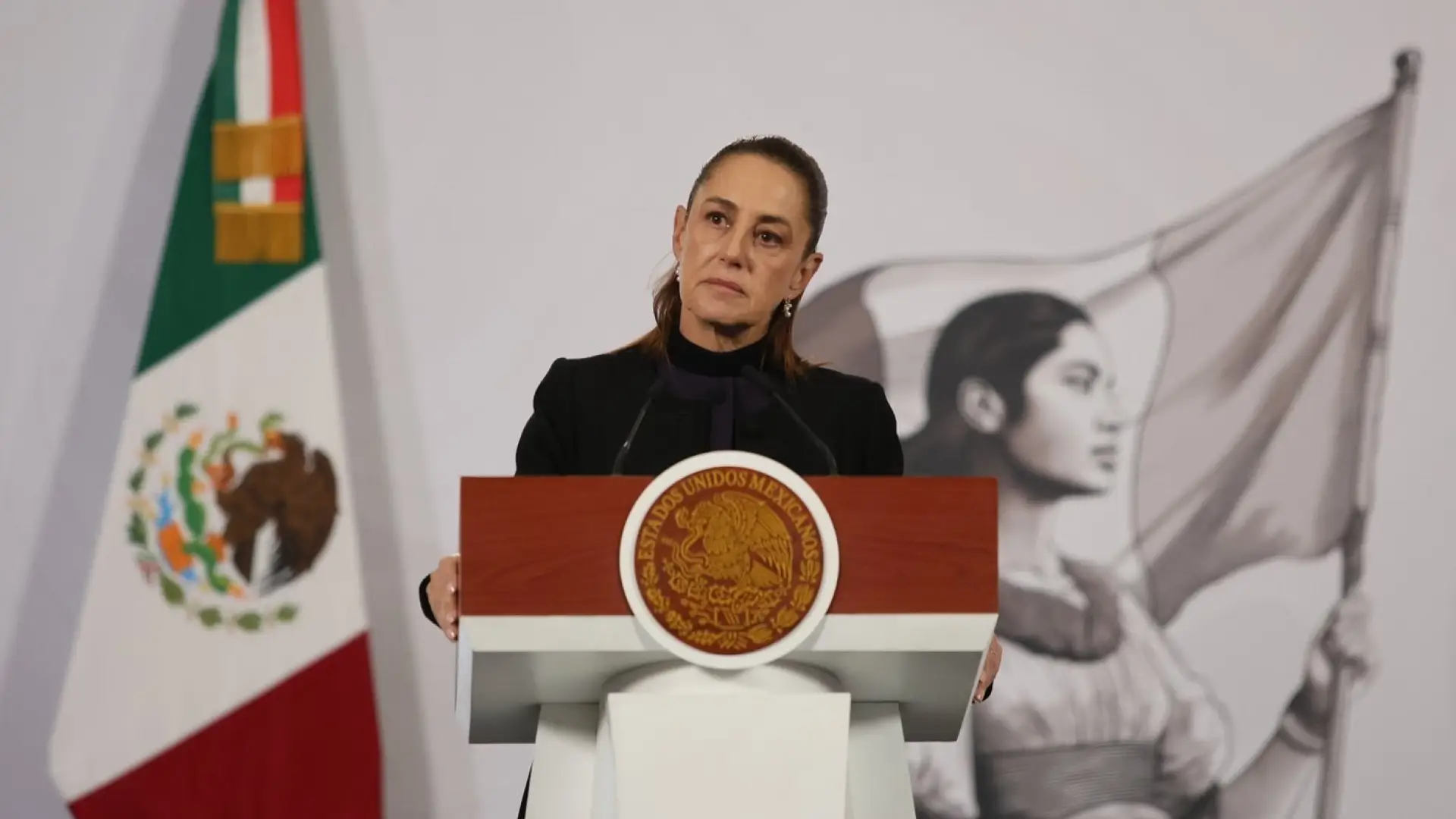
MEXICO CITY (AP) -- The Mexican government on Tuesday protested the number of its citizens who have died in U.S. custody as President Claudia Sheinbaum pushes back against U.S. President Donald Trump 's policies on multiple fronts.
The progressive Mexican leader has walked a careful line with Trump for more than a year, addressing provocations with a measured tone and meeting U.S. requests to crack down on criminal cartels more so than her predecessors, in an effort to offset threats of tariffs and U.S. military action against the gangs.
But in the wake of mounting deaths of Mexican citizens in custody of immigration officials and the Trump administration's decision to impose an energy blockade on Cuba - a key Mexican ally - Sheinbaum has taken a harder line.
"We've seen the president raise her tone," said Palmira Tapia, an analyst for Mexico's Center for Economic Research and Teaching. "There's been a shift, and we've seen Sheinbaum be more vocal than before."
Deaths in ICE custody
Sheinbaum's latest rebuke came on Tuesday, a day after 49-year-old Mexican citizen Alejandro Cabrera Clemente died in a detention center in Louisiana of the Immigration and Customs Enforcement agency, or ICE, the fifteenth death of a Mexican citizen in U.S. custody in little over a year.
Mexico's government quickly called the deaths "unacceptable" and the ICE detention centers "incompatible with human rights standards and the protection of life."
The next morning, during a press briefing Sheinbaum added that she requested investigations into the deaths of the 15 migrants, but hasn't received a response and instructed Mexican consuls to visit detention centers daily.
"We are going to defend Mexicans at every level," Sheinbaum said, adding that "there are many Mexicans whose only crime is not having papers."
Her government already said it would file a legal brief supporting a lawsuit by detainees over poor conditions in detention centers and would raise the detainee deaths with the Inter-American Commission on Human Rights. On Tuesday, she added that her government was also considering appealing to the United Nations.
The moves by Sheinbaum's government come on top of mounting disapproval in the U.S. of Trump's immigration enforcement. About 6 in 10 U.S. adults say Trump has "gone too far" in sending federal immigration agents into American cities, according to a February AP-NORC poll.
"Growing dissatisfaction around ICE activities in the United States creates a more comfortable platform for members of the Mexican government to raise concerns about the fate of Mexican citizens," said Carin Zissis, Washington interim director of the Council of the Americas.
A 'cool head'
Sheinbaum has maintained what she has described as a "cool head" to provocations by Trump, who has exerted more pressure on Latin America than any U.S. leader in decades. In just a few months, the Trump administration deposed Venezuela's president, imposed an oil blockade on Cuba and threatened military intervention against Mexican cartels.
She has to balance maintaining a strong relationship with Trump while repeatedly stressing Mexico's sovereignty to appease her own base. Her measured responses resemble that of a lawyer rather than the head of Mexico's most powerful populist political movement.
Her government has come down harder on cartels than her predecessor and sent dozens of cartel members to the U.S. Meanwhile, Mexican economic officials have routinely traveled to Washington to bolster relations ahead of renegotiations of the United States-Mexico-Canada Agreement, or USMCA, free trade agreement.
While Trump has taken public jabs at Sheinbaum -- at one point suggesting cartels have greater control over Mexico than her government -- he's also regularly made nods to their amicable relationship.
"She is really a nice person, I like her a lot," he said last month, proceeding to imitate the Mexican leader in a high voice.
Divide over Cuba
But shifting geopolitics in the region, and the mounting deaths in ICE facilities, have also opened the door for Sheinbaum to take a firmer stance.
The main point of contention between the two governments has been Cuba. Solidarity with the U.S. adversary has been a cornerstone of Mexico's political ethos since the Cuban revolution, which Fidel Castro, Ernesto "Che" Guevara and a group of exiles famously planned while in Mexico City. It's a particular sticking point with her progressive Morena party, whose founder ushered Sheinbaum into office.
The relationship hit a hurdle in late January, when Trump announced he would slap tariffs on any country that sends oil to Cuba. The move directly impacted Mexico, which for years has shipped oil to Cuba.
While Sheinbaum reluctantly paused oil shipments to Cuba, she has continued to challenge the Trump administration's push for regime change.
"Mexico has every right to send fuel, whether for humanitarian or commercial reasons," Sheinbaum said earlier this week, adding that the government has treaded carefully because it doesn't want tariffs to hurt Mexico.
She has described Trump's energy blockade of Cuba as "unjust" and accused the U.S. government of "suffocating" Cubans with sanctions. The Mexican leader has sent shipments of food and other aid, and even donated $1,000 of her own money to relief efforts in a symbolic gesture.
"For her, the defense of Cuba also means the defense of Mexico," Tapia said.
Even then, the moves by the Mexican leader have raised eyebrows in Washington.
Sheinbaum recently announced that her country would continue to have Cuban doctors work in the country, diverging from other nations in Central America and the Caribbean that have ended their programs in the face of U.S. pressure.
It was met with veiled threats from the Trump administration, which pointed to visa restrictions imposed on Central American officials with ties to what U.S. Secretary of State Marco Rubio referred to as a "forced labor scheme."
The White House offered no comment on Tuesday about Sheinbaum's tougher stances, nor did it comment on the rising number of deaths of Mexican nationals in ICE custody.
Greater leverage
Sheinbaum's recently bolder tone suggests a calculation that her administration can push back on some politically important fronts as long as they also are making progress on strengthening trade and meeting Trump administration requests on security and migration, Zissis said.
At the same time, surging energy prices due to the Iran war have made the U.S. more dependent on allies in Mexico, she and other analysts said, prompting Washington to walk back from any drastic moves against Mexican cartels or Cuba, at least in the short term.
"We're at a moment where, due to global events, we're facing different economic uncertainties. That gives the U.S. and Mexico more reason to work together," she said.
----
Associated Press journalist Will Weissert contributed to this report from Washington D.C.