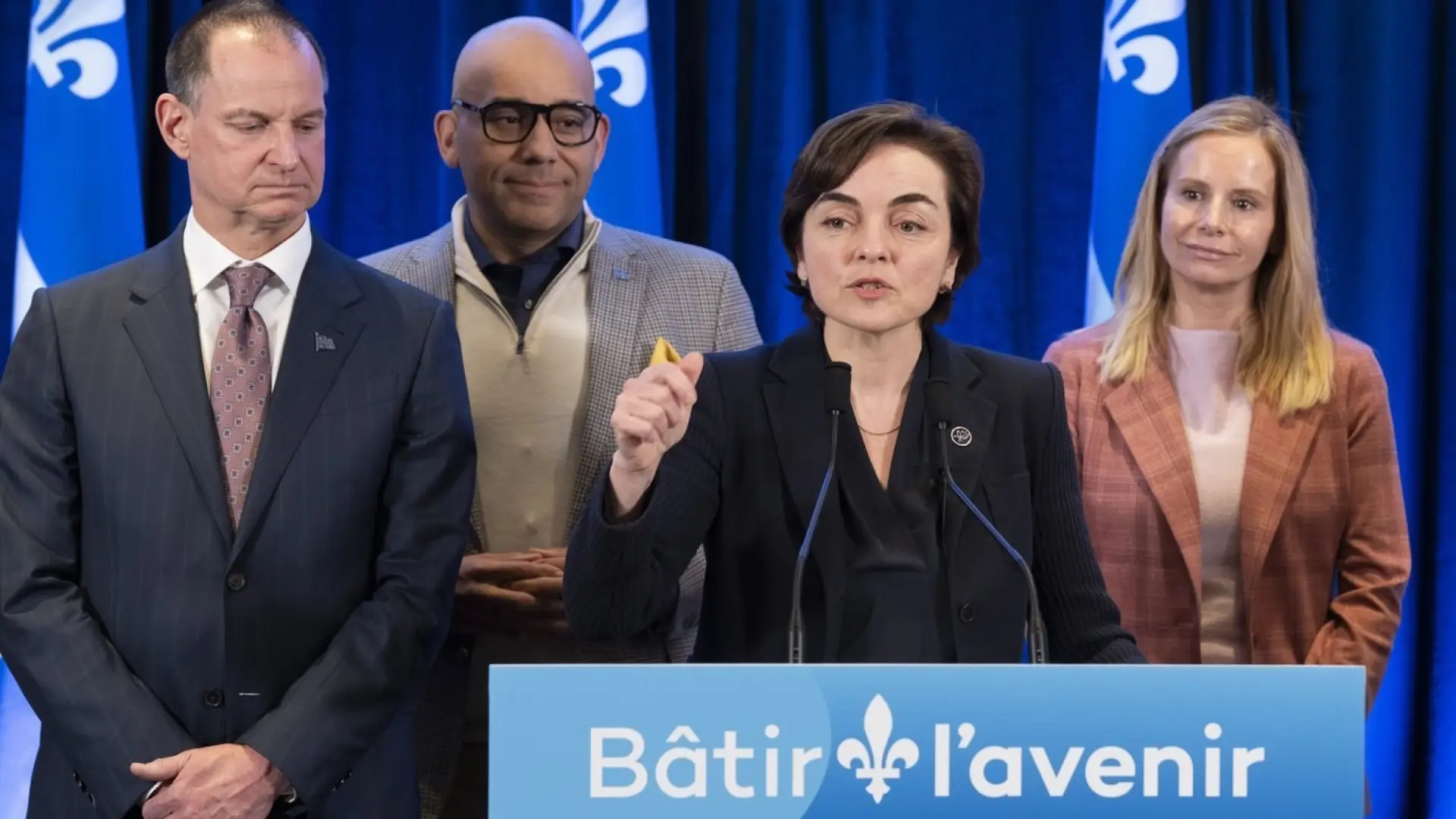
QUEBEC -- Newly minted Quebec Premier Christine Frechette has unveiled a cabinet that leans on experienced ministers, opting for stability instead of a shakeup as her government heads into a pre-election period.
After winning the Coalition Avenir Quebec leadership race on April 12, Frechette spent just over a week before introducing the senior members of the team she is expected to lead into a fall general election.
More than a third of the ministers will be remaining in existing portfolios in the new cabinet of 29 people.
Jean-Francois Daoust, a professor at Universite de Sherbrooke's school of applied politics, says Frechette's new team appears to be designed to demonstrate experience and stability ahead of the election campaign.
''It's a government of continuity which is not surprising,'' said Daoust.
Frechette will rely on senior, high-profile ministers who already oversee critical portfolios and have the experience needed to manage their files during a tight pre-election timeline, he added.
Ahead of the ceremony at Quebec's National Assembly, Frechette said she was ''excited'' to introduce her cabinet, describing them as ''talented and dedicated people.''
Overall, the cabinet will have 12 women and 17 men, with several key positions unchanged, including Finance Minister Eric Girard and Culture and Communications Minister Mathieu Lacombe and France-Elaine Duranceau as president of the Treasury Board.
"We also need stability,'' said Jean Boulet, prior to the swearing in ceremony.
Boulet will pursue his role as labour minister, while taking on additional responsibilities overseeing Canadian relations. "It's a delicate balance, it's not an easy task."
Ian Lafreniere has become the deputy premier while retaining his previous responsibilities for public security and relations with First Nations and Inuit. His department is also being rebranded and will now be known as the interior security ministry.
Sonia Belanger remains the health minister and minister responsible for seniors and family caregivers. She loses the social services minister position to Lionel Carmant, who is returning to cabinet after he resigned last fall over former premier Francois Legault's health care policies.
Sonia LeBel stays on as education minister. She announced earlier this year she wouldn't seek reelection.
Simon Jolin-Barrette remains justice minister, and is relinquishing his responsibilities overseeing Canadian relations, while taking on new responsibilities for constitutional affairs.
Christopher Skeete retains his role as minister of international relations and of the Francophonie, the French-speaking equivalent of the Commonwealth.
Jean-Francois Roberge will keep responsibilities related to the French language and secularism, but loses the immigration portfolio.
Francois Bonnardel, who is taking over the immigration portfolio, received a standing ovation during the ceremony.
Bonnardel was dropped from the cabinet under Legault, but will now also be taking over the position of leader of the government in the legislature.
Frechette's former leadership rival, Bernard Drainville, becomes the economy, innovation, and energy minister, a position Frechette occupied before her candidacy as leader of the CAQ.
"It's exactly what I was hoping for,'' said Drainville. "We work as a team."
Four new faces are also joining the new premier's cabinet, including Mathieu Levesque who will take over a newly created position as the minister responsible for the regions.
Benoit Charette, absent from the ceremony, shifts from infrastructure and environment to become the transport minister. Samuel Poulin moves into the role of minister of municipal affairs.
Pascale Dery takes on the environment portfolio, while Jean-Francois Simard takes on her previous position of employment minister.
Five former ministers are not in the new cabinet: Genevieve Guilbault, Jonatan Julien, Caroline Proulx, Isabelle Charette, and Gilles Boulanger. Boulanger had been one of the first to support Christine Frechette in the race.
Julien, Charette, Proulx, and Guilbault had announced that they would leave politics at the end of their mandates.
Parti Quebecois leader Paul St-Pierre Plamondon held a press conference a few hours before Frechette's announcement, where he described the new cabinet as "a missed opportunity to send a signal of consistency and to streamline the bureaucracy.''
St-Pierre Plamondon reiterated his commitment to a smaller cabinet if he formed a government, but he did not specify how many ministers he would appoint.
During her campaign to become CAQ leader, Frechette had emphasized the need for efficiency and agreed on the need to shrink the size of government. She also promised to bring change while maintaining a strong focus on economic priorities.
The legislature will resume May 5.
This report by was first published April 21, 2026.
--with files from Thomas Laberge