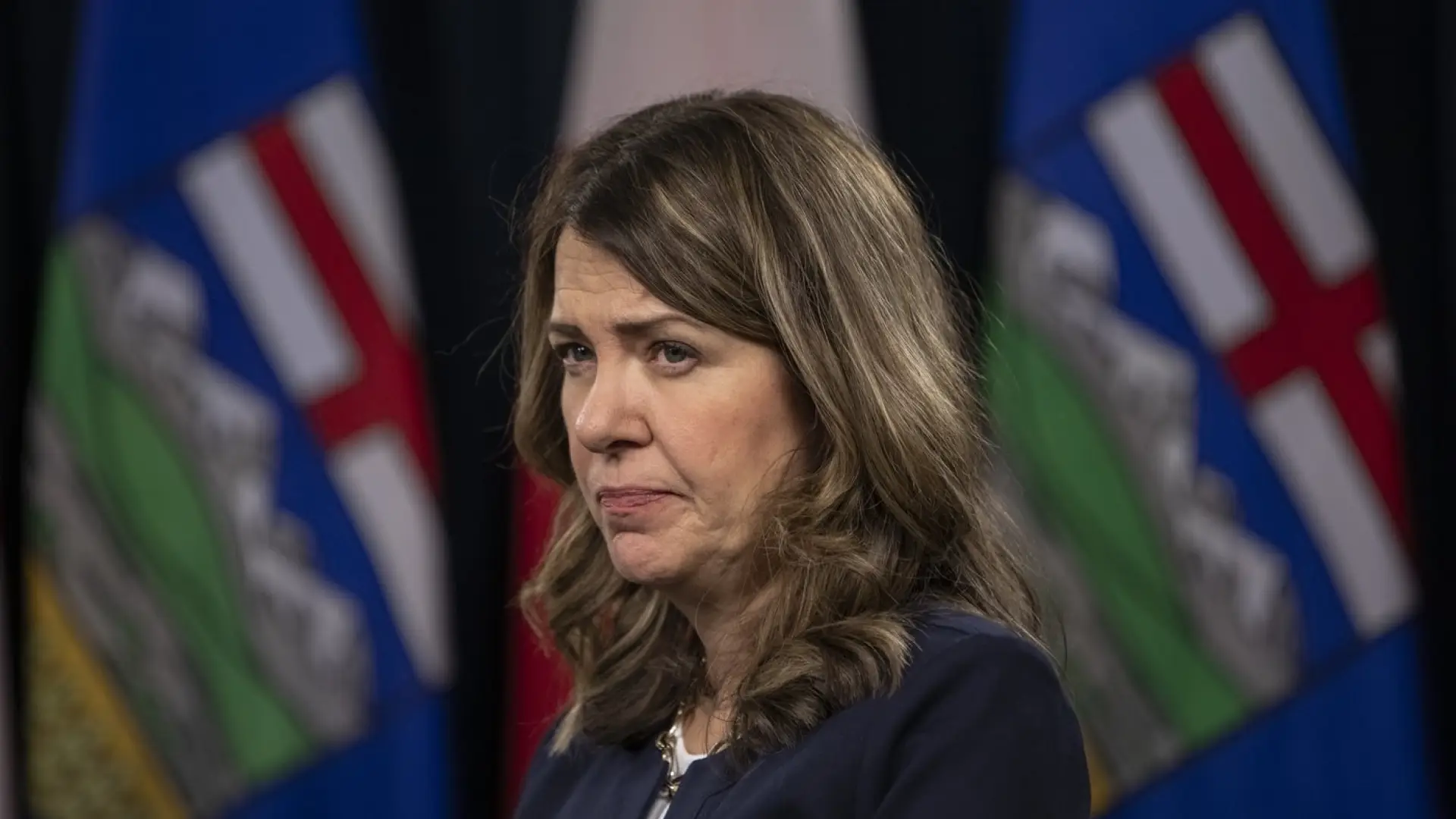
EDMONTON -- Premier Danielle Smith says her government will look at new legislation depending on what comes out of investigations into claims a separatist group breached the personal information of nearly three million Albertans.
Smith made the comments on social media Friday as the provincial privacy watchdog called for broader reforms and election officials faced questions over whether they could have acted sooner.
Smith, in a post on the site X, said protecting the private information of Albertans is critical. She said those responsible should be held accountable.
"We understand both Elections Alberta and the RCMP are looking into this matter thoroughly and we will wait for the results of those investigations before commenting further and assessing whether any future legislative changes need to be considered," she said.
Earlier this week, Elections Alberta announced it is investigating a group called the Centurion Project for publishing an app that made publicly accessible the names and addresses of every Albertan on the most recent voter list.
The RCMP now say they, too, are investigating.
On Thursday, Elections Alberta went to court and got a judge to grant an injunction ordering the Centurion Project to take the app down, which it did within hours. The group later said it would comply with Elections Alberta's investigation.
Lawyers for Elections Alberta said in court that investigators had determined the database matched a voter list provided to the pro-independence Republican Party of Alberta last summer. They said it was still unclear if a party official had given the list to the group, or if it had been obtained through other means.
The Republican Party was legally allowed to have the list. Such voter lists are only distributed by Elections Alberta to elected officials, political parties and party officials. Provincial law dictates that it can only be used to solicit donations, recruit party members and communicate with electors.
Alberta's privacy watchdog says the breach was incredibly serious and called on Smith’s government to change privacy laws to give her jurisdiction over political parties.
"This incident demonstrates that it is high time for political parties to be made subject to (the Personal Information Protection Act),” Privacy Commissioner Diane McLeod said.
She added that it's a move she and her predecessors have long sought, and is something already in place in British Columbia.
McLeod said the personal information that became public through the Centurion Project's puts people at risk.
"Some examples might be those who work for law enforcement, who are public officials, who are fleeing intimate partner violence and other vulnerable individuals," McLeod said.
"As this matter unfolds, we will continue to work to determine whether we have jurisdiction over the Centurion Project."
Republican Party leader Cameron Davies has said his party will also comply with Elections Alberta's investigation and that it warned the Centurion Project that any information the group may have allegedly received — if it came from the party — is not to be used.
The Centurion Project said Thursday it relied on an unnamed third-party to build the dataset it used and that the app will stay shut down until it complies with privacy laws.
The group's leader, longtime political organizer David Parker, has said its goal was to identify and recruit supporters of Alberta's separatist movement ahead of a possible referendum this fall.
Elections Alberta is by law not allowed to discuss or even confirm investigations, but said in this case it went public because the threat to citizens warranted it.
However, the agency is being criticized for not acting sooner.
Calgary-based journalist and political commentator Jen Gerson published an article with supporting documentation saying she raised the alarm on the database last month only to have Elections Alberta decline to investigate.
An April 10 letter shared by Gerson from Alberta's election commissioner Paula Hale in response says the agency determined the evidence was "compelling" but fell short of clearly coming from a voter list and therefore declined to investigate further.
Gerson criticized the response in her article, saying the agency shouldn't have called off the investigation with the privacy breach at stake.
Michelle Gurney, a spokesperson for Elections Alberta, said in an email the agency must adhere to a high standard of evidence to launch a probe — a standard similar to the amount of evidence police need to make arrests.
The higher threshold was added to legislation last summer by Smith's government, and Gurney called it "a much higher standard" than what the agency previously had to meet to launch investigations.
"(We) are doing everything we can within the bounds of the legislation," Gurney said.
Justice Minister Mickey Amery's office didn't immediately respond to questions about the legislation last year and the higher threshold to launch investigations.
The provincial law regulating the use of voter lists says violations can lead to fines of up to $100,000 and imprisonment of one year.
This report by The Canadian Press was first published May 1, 2026.
1646