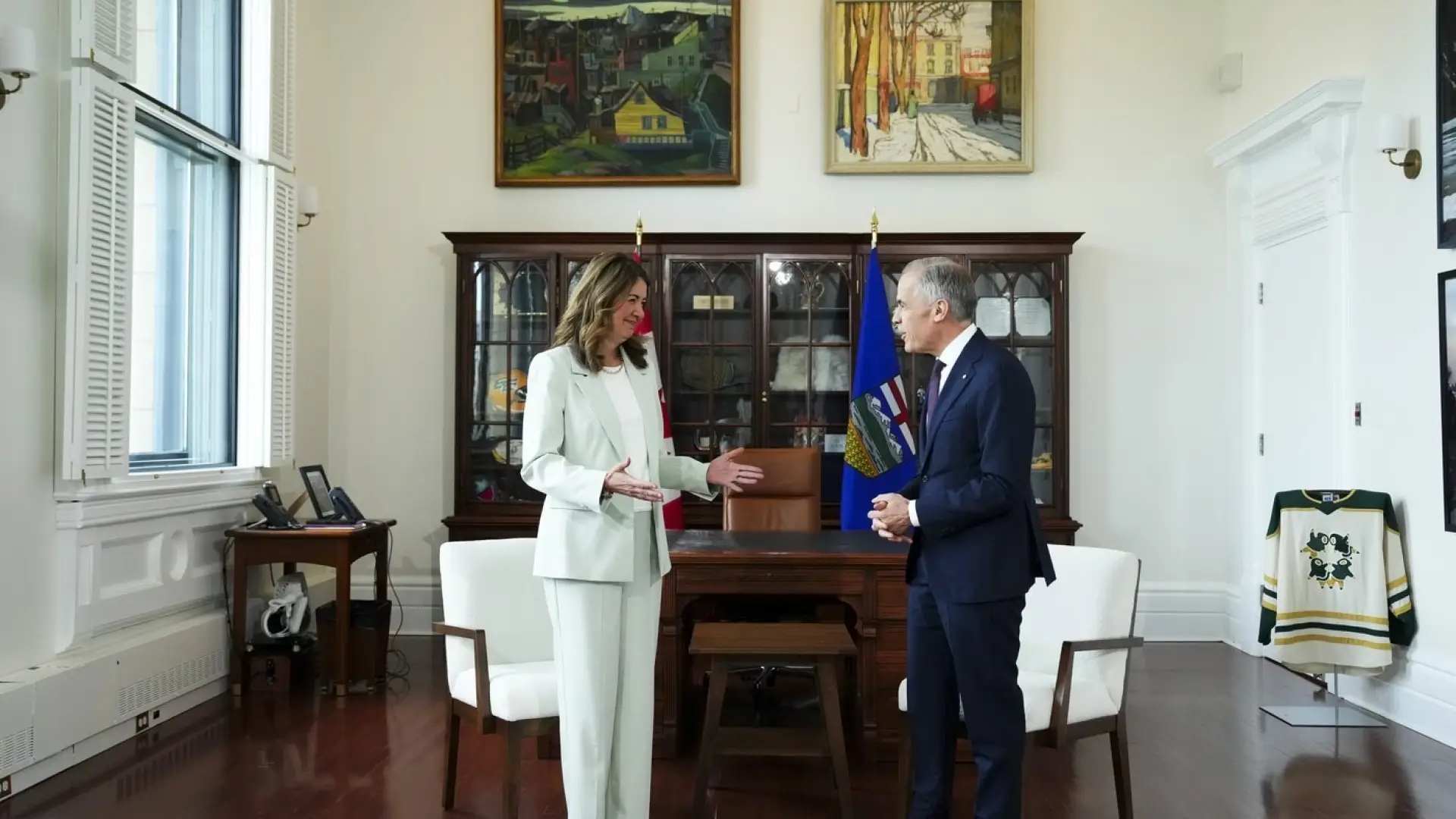
OTTAWA -- The best place for Alberta to be is in Canada, Prime Minister Mark Carney said Thursday after a judge's decision to throw out a separatist petition in the province.
"Certainly a Canada that works, which is what we're pursuing," Carney told reporters.
"I think the evidence -- well -- others will judge."
On Wednesday, Justice Shaina Leonard ruled the petition calling for a referendum on separation shouldn't have been issued under a provincial law that Premier Danielle Smith's government made changes to, aiding the separatist effort.
The judge also said Smith's government neglected its duty to consult First Nations.
Carney, asked whether he thinks a vote should be held on Alberta separation, said referendums on any topic are part of a democracy but rules also need to be followed.
"That means respecting the rights of Indigenous peoples, respecting the right of people to privacy," he said.
He also said it means following the federal Clarity Act, which gives Ottawa a say on whether any separation question is clearly understood and what should be considered a sufficient majority vote.
"Ultimately, Parliament has a role in making the judgment about the question," Carney said.
Smith called the judge's decision "anti-democratic" and quickly announced her government would appeal. She also questioned the duty to consult ruling, saying it's something reserved for specific projects such as pipelines.
The group behind the petition, Stay Free Alberta, also said it would appeal, saying the judge erred in law.
Athabasca Chipewyan First Nation and the Blackfoot Confederacy launched the court challenge. They argued the petition process was unconstitutional and that separation would violate treaty rights.
The premier is now facing calls to put the separatist question on the ballot herself, but she hasn't committed one way or another. She has said she needs to discuss it with her United Conservative Party caucus and cabinet.
Carney didn't say whether he's worried about the prospect of an Alberta vote on separation and repeated that Ottawa is focused on working with all provinces and territories to make Canada work.
"We're making that progress on behalf of Albertans. But by making Alberta stronger, we're making all of Canada stronger," Carney said.
Smith, in question period Thursday, agreed and said she appreciates Carney's willingness to work with Alberta.
Both said they would be making be an announcement Friday in Calgary about their landmark energy deal from the fall.
Neither shared details. But a source with knowledge of the discussions has said the governments are expected to announce a plan to raise Alberta's industrial carbon emission price to $130 per tonne by 2040.
The carbon price agreement is one of several steps Smith and Carney committed to in their fall pact, the end goal of which is a new bitumen pipeline to the West Coast.
Both leaders have repeatedly pointed to the energy deal as something necessary to counteract Alberta's separatist movement and convince some supporters to get back on Team Canada.
Lori Williams, a political scientist at Mount Royal University, said Smith is trying to balance competing interests.
"Every time she leans in the direction of saying federalism works, the separatist dissidents within her party start to make noise and demands. If she cedes to their demands, she risks losing support of moderate conservatives and swing voters," Williams said.
"On the one hand, we've got potential for movement on energy policy and pipelines that requires investor confidence. On the other, we've got this referendum that movement on the energy file could tamp down. But the persistence of the referendum question is harming the ability to go to the next step on pipelines."
As First Nations from across the province continued to celebrate the judge's decision, Smith defended her decision to appeal it.
"We don't want to deny 300,000 people the opportunity to have their signatures and their efforts considered and validated," Smith said during legislature debate.
The separatist group Stay Free Alberta submitted the petition to Elections Alberta last week, touting a tally of nearly 302,000 signatures.
"That is why we structured the Citizen Initiative Act to be permissive, to allow for citizens to have that democratic right ... and that's what we're going to be defending," Smith said.
She cited another petition that has taken a pro-federalist stance and has already been verified, saying she can't discount that more than 700,000 Albertans want to put the province's future in Confederation on a ballot this fall.
The premier has outlined nine questions dealing with immigration and constitutional changes for an Oct. 19 referendum. Adding a separation question to the ballot has been up in the air.
Mickey Amery, Smith's justice minister, wouldn't say what the province plans to argue in its appeal. But he told reporters the government would be working with the courts to get the process moving quickly.
Rebeca Gimenez, a law professor at the University of Alberta who is an expert in constitutional and Indigenous rights law, said she didn't think the province would argue against the finding that a duty to consult exists for separation. But she said it could mount an appeal based on when that consultation takes place.
During the court hearing last month, government lawyers said the province felt consulting Indigenous leaders was something that would only become necessary if Smith's government actually took steps to take Alberta out of Canada after a referendum.
Leonard, in her decision, said the duty to consult was triggered early in the petition process because, if successful, it would lead to a binding vote.
Gimenez said the province could re-hash arguments it made in the hearing about the petition process being administrative and that opportunities for consultation exist later in the process.
She also said Smith was wrong in saying the duty to consult only applied to specific projects.
"It does apply to policies and regulatory processes and strategic processes," Gimenez said.
This report by The Canadian Press was first published May 14, 2026.
730