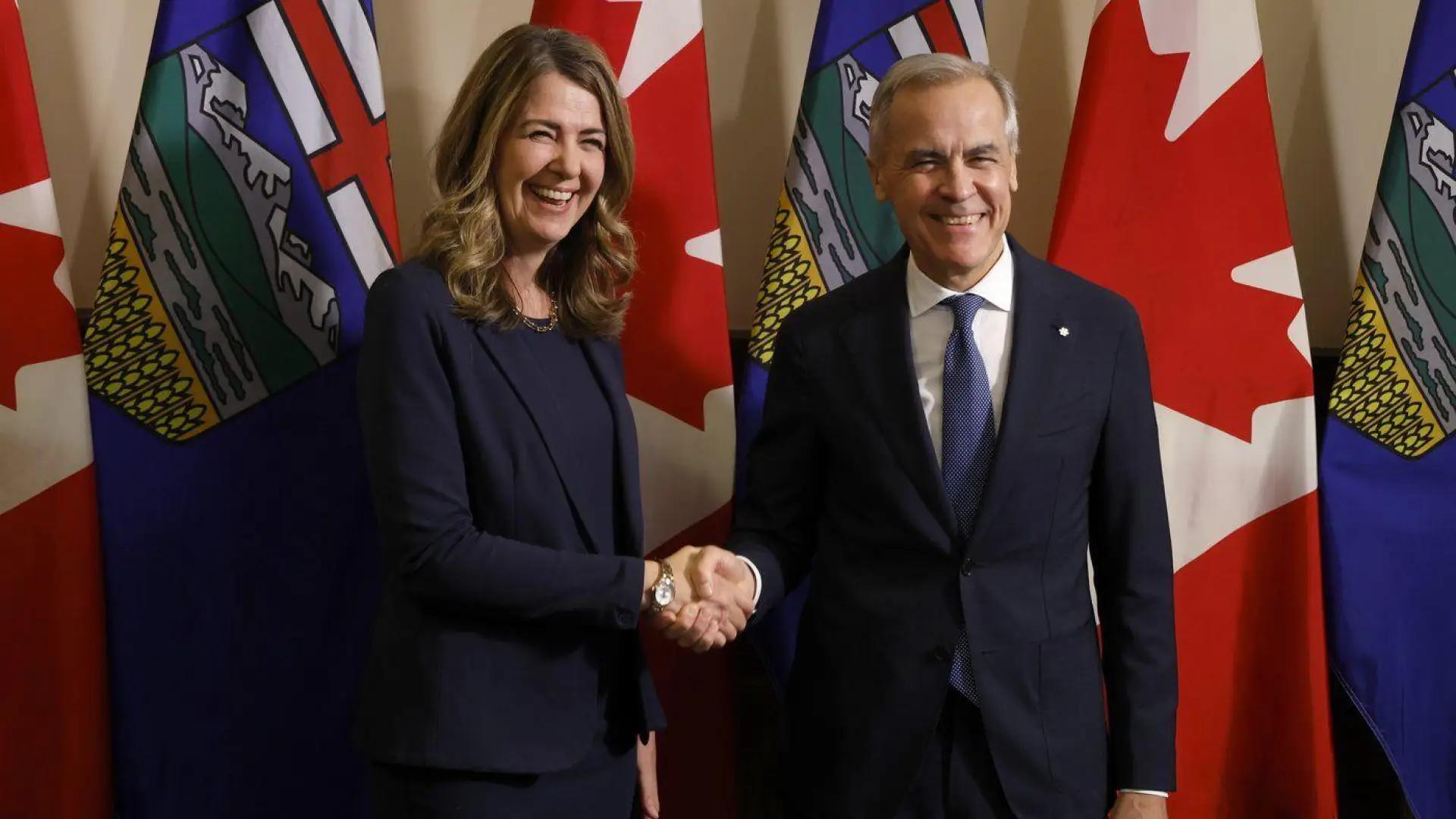
Prime Minister Mark Carney and Alberta Premier Danielle Smith said Friday they're eyeing a fall 2027 start date for construction of a new bitumen pipeline to the West Coast.
It's part of a plan to accomplish the remaining steps of the landmark energy deal they signed last fall.
There is to be a new scheme for carbon emissions pricing in Alberta, and a commitment from Carney to declare the pipeline as being in the national interest by October of this year.
Alberta's effective industrial carbon emission price is to rise to $130 per tonne by 2040. And its headline price would rise to $140 per tonne also by 2040 from the current $95 per tonne.
The effective price refers to how much carbon credits are sold for on the market, while the headline price refers to how much companies pay the province to comply with emission limits.
Carney and Smith, meeting in Calgary, said the implementation plan shows Alberta and Canada are serious about supporting and expanding the energy sector.
And they said it shows Ottawa and Alberta can work together while some in the province are pushing for separation.
"We're much closer to attaining our joint ambition to make Canada into a global energy leader and a trusted supplier of responsibly produced lower emissions energy in the world," Smith told reporters.
"We've accomplished a lot together in less than six months."
The prime minister said the pipeline remains dependent on the Pathways carbon-capture project in Alberta getting built.
That means the next step is reaching a mutual agreement with the Oil Sands Alliance, the consortium of major oil players behind the project.
There also needs to be consultation with First Nations on the pipeline, and Smith and Carney said they will continue engaging with British Columbia.
"Earning trust, as we all know, it requires more than just ambition," Carney said. "It requires partnership and requires co-operation, co-operation that respects our duty to consult and ensures Indigenous economic benefits and opportunities for co-ownership exist in every project."
B.C. Premier David Eby, who has criticized Ottawa for advancing the pipeline, said Carney is "rewarding bad behaviour."
"It cannot be the case that the projects that get prioritized in Canada are those where a premier threatens to leave the country."
Alberta has also committed to facilitate investment in renewable energy projects. And both governments are forming a working group on achieving a net-zero electricity grid by 2050.
No private company has come forward or been announced to build and own the pipeline.
Alberta has been acting as the proponent so far, undertaking initial planning and consultations. Smith has said an initial proposal would be submitted before July.
Alberta officials said the province hopes to see oil start flowing through the pipeline in 2033 or 2034.
A headline carbon emission price of $140 per tonne by 2040 for Alberta means Ottawa is permitting a much weaker pricing scheme, as the current federal backstop price is scheduled to reach $170 per tonne by 2030.
Briefing materials shared by Ottawa said the current carbon policy in Alberta hasn't been working effectively due to an oversupply of carbon credits.
The flooded market has led to credits trading for $40 per tonne — last year reaching as low as $17 per tonne — far below the current federal headline price of $110 per tonne.
"This $70 gap means that decarbonization is not being incentivized as effectively as it should be," says a briefing document.
The announcement commits Alberta to bring in a minimum price for credits that companies buy and use to fulfil emission requirements. It says the minimum transfer price would be set at $60 starting in 2030 and gradually increase to $110 by 2040.
The deal is likely to force Ottawa to be more lenient with other provinces following the federal price. The Supreme Court of Canada ruled in 2021 that all jurisdictions need equal treatment for carbon pricing.
Carney said Ottawa will be consulting with other provinces and the intention is to have consistency across the country.
Oil and gas industry leaders have said in recent weeks that Ottawa's carbon policy is putting Canada at a competitive disadvantage, especially compared to oil-exporting nations that don't have carbon pricing.
Others, including Nancy Southern, chief executive officer of ATCO, have said Canada's industry can afford a higher price.
Federal Conservate Leader Pierre Poilievre criticized Carney for mandating a carbon price scheme at all.
“Conservatives want a pipeline without a carbon tax, not a carbon tax without a pipeline," said the Opposition leader.
"His industrial carbon tax alone will drive costs up and jobs south."
Environmental groups, and federal NDP leader Avi Lewis, were quick to condemn the carbon price plan. They said it puts Canada's net-zero ambitions out of reach and represents a country bowing down to the oil industry.
Chris Severson-Baker, executive director of Pembina Institute, a clean energy think tank, said he was expecting stiffer prices from Carney, considering other environmental concessions have already been made as part of the pact with Alberta.
Smith said the $130 per tonne price is a concession from her government.
"If I had my druthers on what it would be set at, it would probably be somewhere around $50 (per tonne)," Smith said, adding she believes the lower figure would still incentivize emissions reduction.
Carney pushed back against environmental concerns. He said the deal would put an end to Alberta's existing carbon market allowing credits to be sold for the bottom dollar.
"This is climate action," he said.
He also touted expected benefits of the Pathways project, saying it would take the equivalent of emissions from 90 per cent of cars in Alberta out of the atmosphere every year.
Smith and Carney agreed their deal might not be enough to entirely stomp out the separatist movement in the province.
"It may not be the deciding factor for everyone," said Smith. "But it's going to, I believe, convince a few more people that Canada is worth fighting for."
Smith has said she supports a sovereign Alberta in a united Canada but also that Albertans are frustrated with Ottawa and deserve to be heard.
Earlier this week, an Alberta judge threw out a petition seeking to put separation to a referendum, ruling it should have never been issued and that Smith's government neglected its duty to consult First Nations.
Smith has said the province will appeal.
On Friday, she criticized the judge directly. "I just don't simply believe that an unelected judge should be able to run roughshod over all of these democratic provisions."
Two Alberta First Nations, in a letter to Carney, called on him to pause further pipeline development until Smith rules out a separatist referendum.
Carney said he's focused on making sure Albertans and other Canadians see that the country can work together.
"Co-operative federalism, coming together, making an agreement, moving forward, creating a better future for our kids and grandkids, including ... with respect to the environment.
"Because this is climate action, alongside providing energy security."
This report by The Canadian Press was first published May 15, 2026.
— With files from Dayne Patterson in Calgary
2027