

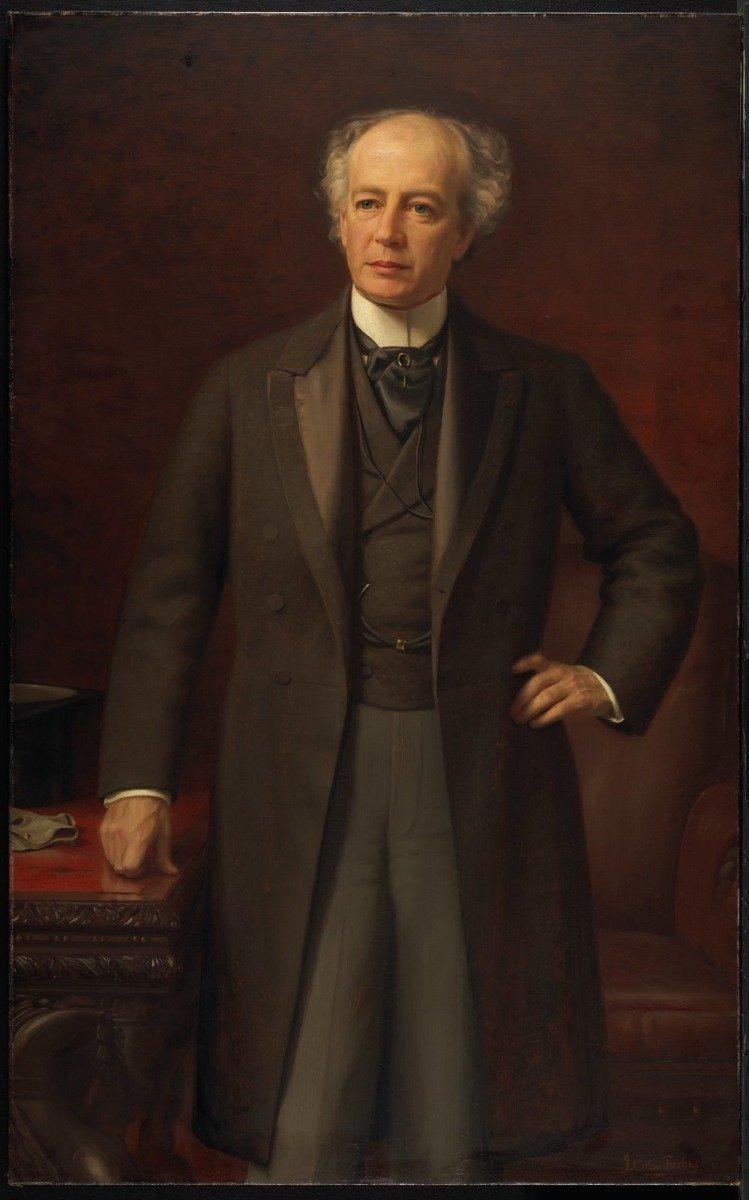
MPs of all party faiths paused on this date in 1902 to pay tribute to Sir Wilfrid Laurier in rare ceremony that took place on the floor of the House. Liberal supporters of the great man had arranged for the PM to be presented with a portrait of his own likeness. In the sort of non-partisan spirit we need more of in Ottawa these days, Leader of the Opposition Robert Borden eagerly attended. Laurier later donated his portrait to the National Gallery in Ottawa. You can read Sir Wilfrid’s address below.
Sir Wilfrid Laurier: It is with a very sincere heart indeed that both in my own name and in the name of my wife, I accept from the unknown friends—unknown in the sense that their names are not known to me at this moment—this memento which is the work of a great Canadian artist. It is a gift which would be most acceptable to me under all circumstances. Under existing circumstances, it is doubly precious.
It is precious in that this is the work of a great Canadian artist. The name of Mr. Forbes is well known throughout Canada and throughout the Motherland and is somewhat also in the land to our south.
It is with a sense of regret that we must acknowledge that although Mr. Forbes is Canadian, he has taken his abode in another land. He has done so I am sure not from any choice of his own. Had the choice remained with him he would have stayed in Canada and brought up his family in the land of his birth. Unfortunately, Canada, which is still a young country, has not afforded to artists all the help it might have given in the past. I trust that in the future Canadian artists and talents will receive more encouragement from the Canadian people than they have received hitherto. For my part, it is with some regret, I acknowledge that perhaps the government might have done more than it has for the encouragement of native, artistic talent.
There is a scheme which long have I had in my mind to encourage Canadian artists. Perhaps if we were to propose something in the near future, to have these walls adorned by paintings reporting Canadian history and commemorating the names of Canadian artists, such a proposition would meet with universal favour. (Cheers) I venture to hope that the government brings forward such a proposition, and my friend Mr. Borden, for whose presence I am especially grateful, will find it possible to second such a motion.
Some 200 years ago, the government of the French monarchy instituted a way of encouraging native talent by establishing a ‘grand prix de Rome’ under which prizes are given to the best students in painting, sculpture, architecture and music. They are sent to Rome for four years, there to study the art to which they are especially to devote themselves. Perhaps this would be too ambitious a scheme for young Canadians to undertake. But if we were to do something of the kind, I think the Canadian people would respond generously.
With regard to the sentiments which you have expressed in this address, I have only one fault to find. That is, they are already too flattering to me. It is now fourteen years since I assumed the position of Leader of the Liberal Party and I have endeavoured since that time to the best of my ability [perform] the duties then entrusted to me.
Of course, we all know that in matters of this kind we cannot all feel alike. On this side of the House, we hold one set of views and on the other side they look at matters from a different standpoint. Nevertheless, we differ only in means. We do not differ in purpose either on one side or the other. What we aim at is the prosperity and the glory of our country and the great empire to which we belong.
In the discharge of my duties it has been my lot, of course, to have to differ from those to whom I was opposed. Nevertheless, I have endeavoured to carry on the warfare, at all events so far as I was concerned, by methods directly inspired by those of the British Parliament – that is to say treating opponents not as enemies, but as friends. In this matter I sometimes have perhaps transgressed, although I am not conscious of having done so. If I have done so I hope the example will not be followed by anyone. On the contrary, I take this occasion, since we are all here on the floor of Parliament, to extend to my fellow citizens who occupy the seats that were long held by gentlemen on this side, the cordial hand of fellowship and hope that notwithstanding all our differences we shall always behave as patriotic Canadians. (Cheers).
You were kind enough to allude to the part which I have endeavoured to play insofar as I am a Canadian to promote harmony and peace amongst us. This is indeed a very congenial task, and there should be no other one in the Parliament or throughout the broad Dominion. We cannot unmake the history of the past. We have a future we should look [towards] rather than to the history of the past. As to the history of the future, I hope it will continue to be what it is today, that is prosperity, cordiality, good fellowship and goodwill amongst those whose privilege it is to be inhabitants of this good land of Canada.
You were kind enough to refer to my previous visit to the Motherland. I am conscious that in this I shall have thrust upon me perhaps more than ever a severe task and a very important one. I can’t hope to perform that task to the satisfaction of all. I cannot hope to be free from mistakes. But you can rest assured that I shall endeavour to discharge the duties which are imposed on me not simply as the leader of the Liberal Party, but in a matter that befits the Premier of Canada, that is to say, speak for Canada as a whole.
Please accept my own thanks and the thanks of my wife for this souvenir. It shall occupy a prominent place in my house. I am sorry indeed to say I have no children to leave it to. I wish it were otherwise, but I must accept fate as it is. Someday I hope it will be in a national museum, not with a view of remembering me to posterity, but for the glory of Mr. Forbes, the artist who painted it. Once more accept my sincere thanks and my sorrow that I cannot find expressions adequate to convey to you as I wish in the fullness of my heart. (Cheers)
[Mr. Borden said this was one occasion when the Opposition had no amendment.]
Arthur Milnes is an accomplished public historian and award-winning journalist. He was research assistant on The Rt. Hon. Brian Mulroney’s best-selling Memoirs and also served as a speechwriter to then-Prime Minister Stephen Harper and as a Fellow of the Queen’s Centre for the Study of Democracy under the leadership of Tom Axworthy. A resident of Kingston, Ontario, Milnes serves as the in-house historian at the 175 year-old Frontenac Club Hotel.