

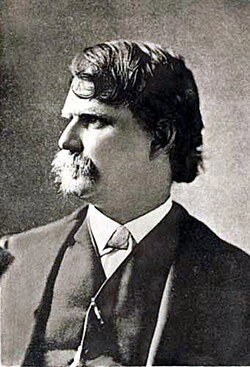
Editors, reporters and publishers from across Canada were in Toronto on this date in 1910 for the annual meeting of the Canadian Press Association. A highlight of the event was the keynote address delivered by legendary journalist Col. Henry Watterson, the famed editorialist whose editorials from the Louisville Courier-Journal were often re-published to great acclaim in newspapers across America.
A Canadian reporter, his or her name lost to history, described the distinguished visitor and the address he delivered. The article is worth quoting at length.
“A rugged-faced man, with twinkling eyes, shaggy eyebrows, and a little goatee, a massive head well poised on a body erect and soldierly, this was Colonel Henry Watterson… as he faced an audience of two hundred fellow-craftsmen,” the journalist wrote. “Breezy and buoyant in manner and speech, delicately feeling his way through ponderous sentences without ever losing himself in the mazes of involved speech, illuminating weighty statements of logic experience with homely similes and mirth-provoking sallies, ‘the last of the great personal editors’ won his way into the affections of his audience. It was hard, indeed, for one in the audience, as he felt the compulsion of an alert, disciplined and cogent mind, to realize that seventy years of strenuous life sat upon the speaker.. The occasion was rendered more significant by the presence of Sir Mackenzie Bowell, an ex-Premier of Canada, and a Past President of the Canadian Press Association.
"I used to think I was quite a veteran in the business until I met Sir Mackenzie Bowell, but now I feel I'm just a kid." said Col. Watterson in commencing. “He tells me he started in the business in 1835, whereas I didn't start till 1856, twenty-one years later. Continuing he told of how he first ‘toyed with the types’ on a little paper in a Tennessee village, working at everything in turn, from galley boy to lead writer. The speaker expressed his abhorrence of the kind of journalism that proclaims ‘the scoop’ to be the thing, and that has no appreciation of the efficient, orderly and unexaggerated record of the day's events.
"We hear a deal about yellow journalism. It is much like the pot calling the kettle black. Offences against decency are more or less relative and qualified. More and more will newspaper owners and makers discover that integrity and cleanliness| pay the best dividends. The scandalmonger will, in time, be relegated to the category of the unprosperous as well as the disreputable, and the detective be driven out of the newspaper service, where he should have no place, to the company of the police, where he alone belongs.”
“We can as little expect that each newspaper worker shall be a gentleman as that each lawyer and each doctor shall be a gentleman; but manly conduct and aspiration should fix the rule, the brutal and vulgar the exception, the journalistic brand no less accepted and honorable than that of physic, divinity and jurisprudence. "The newspaper is the history of yesterday. It is made to sell, assuredly; but it is not a commodity, like dry goods, pork and beans, hardware and cutlery. It may not care to have any opinions.
“But, in case it does, it should seek and aim to be a keeper of the public conscience, an example and counsellor, not a corner groceryman; level of head and kindly of heart, upright and elevated, always sincere and truthful, avoiding, as it would avoid pestilence and famine, the character of a common scold.”
The account concluded with brief mention of some of ex-PM Bowell’s memories from his own days in journalism’s trenches.
“My hand is still calloused from the old Washington hand press, and my fingers crooked with setting type," Bowell said as great cheers from the audience filled the hall.
Arthur Milnes is an accomplished public historian and award-winning journalist. He was research assistant on The Rt. Hon. Brian Mulroney’s best-selling Memoirs and also served as a speechwriter to then-Prime Minister Stephen Harper and as a Fellow of the Queen’s Centre for the Study of Democracy under the leadership of Tom Axworthy. A resident of Kingston, Ontario, Milnes serves as the in-house historian at the 175 year-old Frontenac Club Hotel.