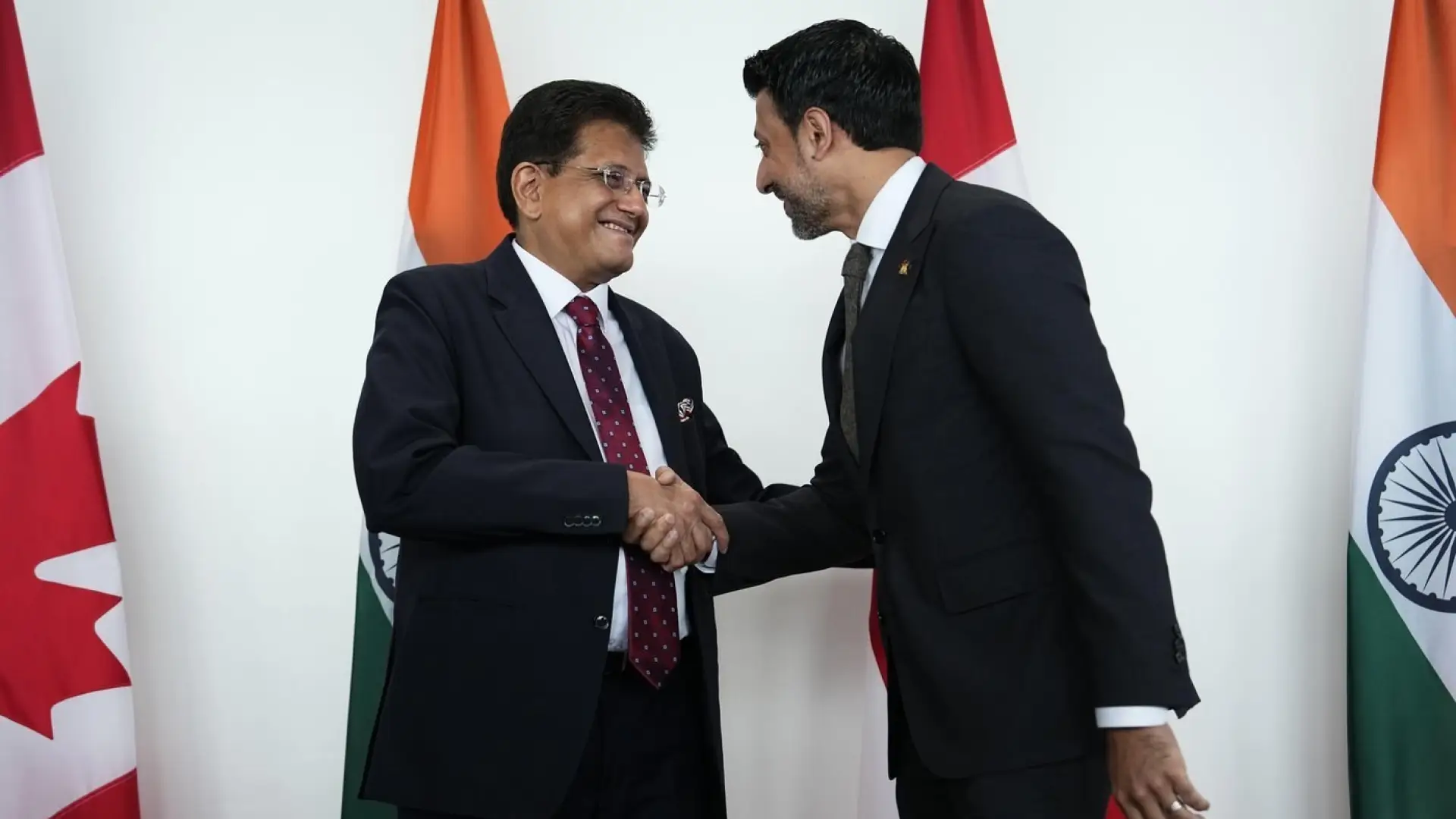
OTTAWA -- India's Commerce and Industry Minister Piyush Goyal says Prime Minister Mark Carney's recent visit to his country paved the way for a complete overhaul of the Canada-India relationship.
Goyal is in Canada for meetings on trade and investment this week and met Monday with International Trade Minister Maninder Sidhu.
Goyal said before the meeting the relationship between Canada and India will be very important in the coming years. He said both countries are keen to reach a free-trade agreement in 2026.
Canada and India have been in trade talks since 2010. Talks were shut down by Ottawa in 2023 after the federal government accused New Delhi of playing a role in the assassination of Canadian Sikh activist Hardeep Singh Nijjar in Surrey, B.C.
Carney, who made resetting relations with India a priority after he became prime minister in 2025, visited Mumbai and New Delhi in March. It was the first visit by a Canadian prime minister in eight years.
That trip concluded with a meeting with Indian Prime Minister Narendra Modi and the signing of a series of agreements — including a $2.6-billion deal to supply about 22 million pounds of uranium to India for nuclear energy generation, along with 10 commercial agreements worth more than $5.5 billion.
Ahead of his international visit, some Canadian Sikhs called on the government to take a firmer stand on India.
Sikhs for Justice held a rally on Parliament Hill in February; one member called it an effort to push the government to demand accountability and justice for Nijjar's murder.
B.C. Liberal MP Sukh Dhaliwal, who represents the riding where Nijjar's murder took place, said at the time he shared his constituents' concerns about Carney's trip.
A Canadian delegation was in New Delhi for trade talks earlier this month and another Indian delegation is planning to return to Canada to continue discussions later this year.
"I think this is a partnership that is being reset very, very rapidly," Goyal said Monday.
The minister said Carney's visit "completely changed the way Canada and India looked at each other."
"It has set in motion the pathway to a complete overhaul of this relationship, setting new agendas, new goals," he said. "I can clearly see the speed and intent of both sides, Canada and India, is phenomenal when it comes to working together."
On top of the goal of securing a free-trade agreement by the end of this year, Goyal said the countries are also working to triple their trade to US$50 billion by 2030.
Goyal is being accompanied on his trip by more than 100 senior business representatives from such industries as mining, energy, automotive and aerospace. India is calling it its largest-ever business delegation to Canada.
During his visit to Ottawa, Goyal met with Carney and Foreign Affairs Minister Anita Anand. While in Canada, he is also set to meet with CEOs of leading companies, startups and pension funds.
Sidhu said the countries have been engaging in what he called "WhatsApp diplomacy" and said Canada will be sending a delegation to India to continue trade talks later this year.
"There's a lot of excitement to do more with India in terms of our economic partnership," he said. "It's going to be building on the meetings that we're having over the next 48 hours."
The Liberals have set out to double non-U.S. exports over the next decade and have boasted about signing 20 strategic trade and defence agreements around the world in the last year.
Carney has travelled to 25 countries on 17 international trips since March 2025.
Sidhu has said the government is looking to sign two other major trade deals before the end of the year — with the South American trade bloc Mercosur and the Association of Southeast Asian Nations.
Vina Nadjibulla, vice-president of research and strategy at the Asia Pacific Foundation of Canada, said in an interview that there is political will on both sides to move as quickly as possible on a free trade agreement.
She said both countries are looking to diversify their relationships and reduce their dependence on the United States. India recently signed trade deals with the European Union, the United Kingdom and New Zealand.
"With the U.S. becoming unreliable, India is now pivoting to Europe as well as to other Western economies like Australia and Canada to be able to meet its needs for capital, technology and innovation," said Nadjibulla.
Nadjibulla said India offers Canada a huge market and a complementary economy. Canada, she said, can offer India oil.
Nadjibulla said India was hit hard by the disruptions in the Strait of Hormuz due to the war in Iran, adding that India is the third largest importer of oil in the world.
"It also is completely dependent on exports of gas and (liquefied petroleum gas) and about 50 per cent of that comes from the Middle East and by way of Hormuz," she said. "India is very much in the market now to find other sources for its energy needs."
Nadjibulla said India is already buying some Canadian oil but there's "a lot more potential." She said India is also interested in Canada's uranium, critical minerals and renewable technology.
"I think energy can absolutely be an anchor when it comes to building this new economic partnership," she said. "Historically, India has been much more price sensitive … But now, given everything that's happening, I think energy security and diversification becomes even more important.
"There's an issue reliable supply and that is exactly how Canada is positioning itself in Asia … we are a source of reliable supply which will go to through Pacific Ocean without any choke points."
Nadjibulla said Canada is already a big supplier of lentils, peas and potash. She said India also would like to develop technology partnerships in AI and quantum, and to attract Canadian investment.
"We're seeing a fundamental reset in the relationship," she said. "This has been a dramatic change to where things were even two years ago and certainly on the Indian side, they're crediting Prime Minister Carney with his leadership for the reset."
This report by The Canadian Press was first published May 25, 2026.
—With files from David Baxter
1831