

Joe Clark is one of the few Prime Ministers awarded the unofficial title of “House of Commons Man.” He served as a backbench MP, Leader of the Opposition, Prime Minister, Leader of the Opposition again, a senior cabinet minister under Brian Mulroney, and then, in his final parliamentary chapter, he led his party once again.
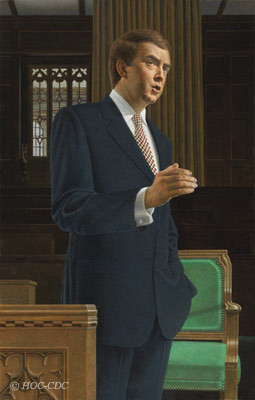
When it came time for his portrait to be painted, it was no surprise that Clark chose to depicted on his feet in his beloved House of Commons. An edited version of the 16th Prime Minister’s remarks at the ceremony are found below.
The Rt. Hon. Joe Clark: (My family and I) are honoured to be here today but so many are family, are friends, my colleagues in the community of Parliament, my partisans, whatever party they happen to be in now, and public servants, who served me and who serve our country with such a dedication and such sacrifice and such skill. We, our family, we are in your debt, and we are in the debt of thousands of people not here, for your help, for your friendship, your belief in our country…
We are all aware that this ceremony has been a long time coming. The rule is that former Prime Ministers are to hang in the order that we served, and I suspect that my delay caused some anxiety among some of my successors about waiting in the queue, about waiting in my queue, I mention no names, but I wanted to be clear that that was not my motive. Hanging is so final. And since I became Prime Minister as a virtual teenager, I didn’t want to foreclose my options...
I first came to this building 51 years ago, almost to the day, on a program sponsored by the Rotary Club called an Adventure in Citizenship. And it has been that (an adventure).
I have been privileged to win a national election, against reasonably competitive adversaries, to introduce changes in physical management and freedom of information and partnerships in Canadian federalism, and in the response to refugees, all of which, all of those initiatives, lasted longer than our government did.
The privilege of presiding over a federal, provincial (and) Aboriginal negotiation, which achieved unprecedented unanimity, and was then enthusiastically rejected by the people of Canada in a Referendum. And to be instrumental in one of Canada’s most creative periods of international initiative. In (the ridings I represented) Rocky Mountain, Yellowhead, Kings Haunts, and Calgary Centre and across the country. I was privileged to enter into the lives of millions of our fellow citizens.
In the name of the privileges that I have received in being immersed in different parts of the country. I come from a region and I believe I belong in a generation, but I was given the possibility of learning French, so I had to learn a language at work by travelling in Quebec, New Brunswick, St. Boniface, and by doing so I learned to better understand the culture and the hopes and aspirations of Francophone communities in Canada. My respect for this culture never gave me many votes, but it made me fully aware of this traditional diversity that characterizes our country. And one day, jokingly of course, a newspaper even said about me, and I quote, “Monsieur Clark is a much better communicator in French than Mr. Trudeau. He uses words that are less complex.” …
I don’t intend today to evoke nostalgia, nor even to offer much advice. Although I will reflect on some lessons learned consecutively, from my Parliamentary, my work at External Affairs, and my constitutional roles.
One is about Parliament as a national institution. There was a time when I was obsessively interested in the procedures of Parliament; how to keep the bills ringing ... How to ask a question, and as a Minister, how to avoid answering a question.
But in the place which Parliament occupies in our sense of who we are as a country, and how we move forward together. This is not about tradition. Traditions change as the country does. And our young country has changed, is changing, profoundly. A consequence is that we, more than most countries, need national institutions with the vitality, and with the legitimacy, to draw our disparate communities into common cause. In my domain, of Parliament and of parties, in 1979, each of the Progressive Conservatives, the Liberals, (the) NDP could be seen as national parties, acting genuinely to integrate the whole Canadian community. Try though they might, it is hard to see any party playing that national role today. But Parliament still can. In fact, it may be our only national institution whose roots reach everywhere.
A second lesson concerns our role in this great world. Some people say we exaggerate the influence and we exercise on the international stage. On the contrary. We live at a time that is characterized by danger and changes and the role of Canada can, more than ever, influence world events. Despite our growth and our innovation, Canada is less influential in trade and commerce than it is in the field of politics and diplomacy. The economic power reflects the size. Diplomacy depends more on creativity, on flexibility and mutual respect. In a world where the differences between religions, cultures, and economies continue to increase, the multilateral complexities (all) become very relevant. The possibility of bringing together diverse groups, of forging alliances and finding common ground, of managing diversity, of inspiring confidence, those are the qualities that were the mark of Canada. And we must use this more vigorously.
The role that may have been most important, was the one I least wanted, as Minister of Constitutional Affairs. Who, in their right mind, would want to be a Minister of Constitutional Affairs? Well voters, appropriately, had the final word, the negotiators of the Charlottetown Accord proved that with enough will, with enough goodwill, with ingenuity, that this country’s leaders can find agreement on some of our most elemental and difficult challenges.
But it takes a certain reproach to one’s colleagues, one moment is lodged in my mind. Rosemary Kuptanna was then the president of the Inuit Tapirisat, she had asked to speak at one of our continually endless conferences in Edmonton. She had asked late in a long day, and then she had agreed, patiently, to allow a couple of other interventions, which became animated, and as the chair, I forgot to come back to it. I was about to adjourn the reading, she raised her hand again, I gave her the floor, and she said, “We’re all tired, I’ll raise you tomorrow, but a little respect would go a long way.”
I think that’s a fundamental lesson about this country. Perhaps the fundamental lesson about this country. We are a country of immense diversity; we are going to have our clashes. We have to try to understand the origins of the point of view of others. We have to show them a respect that is based upon the sense of worth that they bring.
Now, one last word. Mine is the figure in this portrait, but more than many public careers mine has been shared. Maureen wrote in her autobiography that she hoped she would be judged to have been brave. Well, brave and much more.
Arthur Milnes is an accomplished public historian and award-winning journalist. He was research assistant on The Rt. Hon. Brian Mulroney’s best-selling Memoirs and also served as a speechwriter to then-Prime Minister Stephen Harper and as a Fellow of the Queen’s Centre for the Study of Democracy under the leadership of Tom Axworthy. A resident of Kingston, Ontario, Milnes serves as the in-house historian at the 175 year-old Frontenac Club Hotel.