
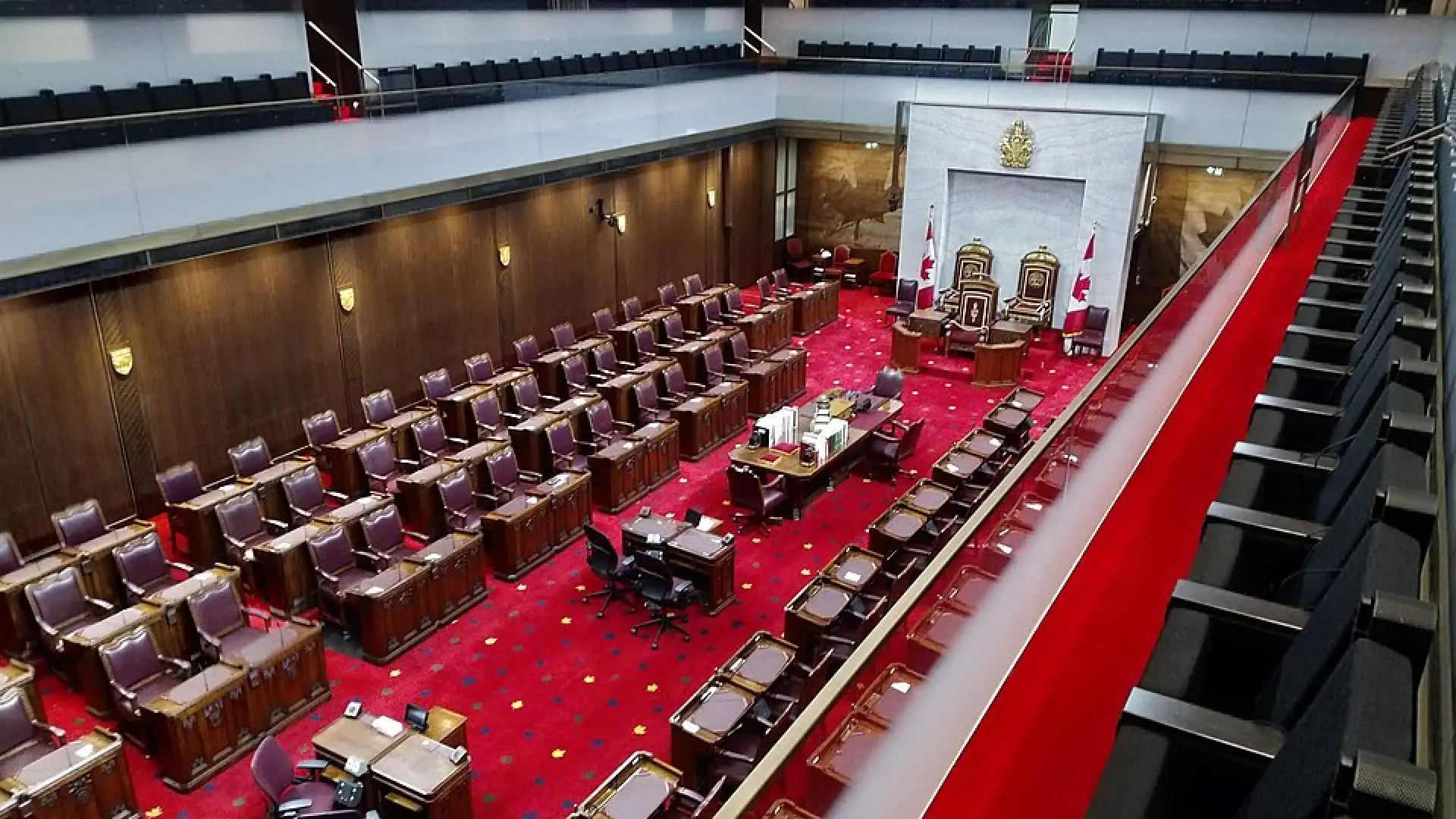
To keep the Senate non-partisan or go back to partisan is a question that has had a lot of chatter in recent months. And for the first time, a few weeks ago Prime Minister Mark Carney confirmed that he would continue with the independent advisory body that reviews applications.
There are currently ten vacancies in the 105-member Senate of Canada and the Prime Minister needs to start making appointments in the near future. Another five senators will be retiring in this calendar year.
So, there is much chatter these days about what he should do.
And in the midst of this debate comes a interesting public opinion poll, done by Nanos Research, commissioned by Senator Donna Dasko, a well-respected pollster herself. An astounding 79% of Canadians like the current system of choosing independent senators and a paltry 5% want a return to the partisan system. Rarely does any federal policy get such high support. When the format of government institution, which a key part of our democratic process, gets that kind of support, that is surely the one to support and grow – with some constant self-reflection of course.
On his last day as Prime Minister, Justin Trudeau made the last of his Senate appointments, getting to the high watermark of 100 appointments in all, surpassed only by Mackenzie King in the middle of the last century. His appointments transformed the Senate in a significant way. (71 are still in office, as others have retired.)
Unprecedented Senate Reform. Here’s the issue. When Trudeau took office in 2015 he announced he would take the unprecedented approach of appointing independent senators only. To be more specific, he would appoint senators to sit as independents and not be part of a party caucus, whether or not they came from a partisan background. Most did not have any party origins. A risky move for a prime minister, who could have stacked the Upper Chamber with 100 card-carrying Liberals instead!
This was a broadly popular move, after there had been considerable scandal in the Senate around expenditures. In fact, so fed up was Prime Minister Stephen Harper with the Senate, that he left 22 seats unfilled when he left office, a decision that till today drives many Conservatives to despair.
In the end, Trudeau’s change, became the most significant Senate reform since the institution was created back at Confederation. All proposals in the past have required constitutional change, and it is next to impossible to get agreement by the provinces. (The other major changes were including appointment of women in 1929, introducing a retirement age of 75 in 1965, and increasing the number of seats as each province and territory joined confederation.)
Critics, primarily Conservative ones, have alleged that Trudeau’s appointments were Liberals masquerading as independents – wolves in sheep’s clothing! Many of his appointees would disagree and many would not have accepted an appointment if partisan loyalty was expected of them. But it is fair to say that he appointed Canadians who had a broadly centrist world view or set of values, and who tended to support much of his legislation, although they felt free to make amendments to government bills. Some were certainly more to the right and some to the left of Trudeau.
From within Liberal circles the critique was that Trudeau needed to appoint senators who could be relied on to pass Liberal legislation….and then there was the party issue. Numerous Liberal partisans resented that they were seemingly ineligible for an appointment to the Upper Chamber, because in the early going Trudeau did not appoint any Liberal activists. Further, some pointed out that in the dark days of Liberal fortunes, the Harper days, it was the Senate Liberals who kept the party alive and helped it rebuild.
The unspoken truth for both parties, is that there was a history of several senators and perhaps their offices, being an extension of the political parties. Not just party presidents, but key strategists, fundraisers and organizers. So, some Liberals feel Trudeau gave up a key partisan asset.
Advantages and Disadvantages. To be fair there are advantages and disadvantages to an independent Senate. As an appointee of the non-partisan process, it should not be a surprise that I am a fan of it, although I do recognize the shortcomings.
Likewise, there are advantages and disadvantages to a partisan Senate too.
Preferring a non-partisan issue for me is more on an “on-balance” issue but weighted considerably in favour of the non-partisan format.
So, the independent Senate. I would suggest that it is now exactly what was intended by the Fathers of Confederation. In Sir John A. Macdonald’s words, it was to be the chamber of “sober second thought” applied to legislation passed by the partisan House of Commons. The best way for that to happen is to have Senators who do not mirror the members of the political parties in the House, who do not caucus with them every week and who do not take instructions from their party leadership in the Commons. Sober and independent.
Over the ten years of Trudeau’s reforms, there have been at least two patterns.
First, the Senate has amended as much as 27% of the bills passed by the House in some years, which may sound like a lot, or even too much for an unelected Chamber. But here’s the thing. The House has accepted the vast majority of the amendments that the Senate has sent back to the House. And here’s one more thing. The Senate has accepted all bills when they came back on the second round even when the House had not accepted the Senate’s amendments. While the Senate does have the constitutional right to play ping-pong and keep sending it back till it gets its way, the thinking consistently is – and this is the core of sober second thought - that the Senate has provided the best advice to the elected chamber and accepts what they send back in the second round.
The amendments by the Senate and the wide acceptance by the House (and the cabinet), is the most important clear evidence that the Senate has played a very useful role that the elected members accept - and value. It has been a complimentary Chamber to the House and not a competing Chamber. It continuously improves legislation.
The notion of a complimentary chamber has been highlighted on key occasions by Senator Peter Harder, the first Government Representative in the Senate appointed by Trudeau in 2015.
Columnist Andrew Coyne recently said that a key reform should be for the Senate to disallow itself the right to veto legislation coming from the House. I kind of agree as a matter of principle and think it would make an important statement, but feel it is not relevant in the contemporary context. In recent years the Senate has never gone there. It has not vetoed a bill in decades. Amended, yes. Vetoed, no. So, the change Coyne is suggesting would have a symbolic value, but make no difference to how the Senate exercises its responsibilities, and in fact by accepting bills on the second round it has in practice done what Coyne is promoting.
By the way, worth noting that in the mother Parliament, the House of Lords in the United Kingdom, frequently amends bills and even vetoes bills passed by the House, between 20 and 100 a year. Horrors! We are a group of well-behaved girl guides and boy scouts in comparison, unless you are of a view that vetoing bills is what the Senate should be doing more.
An illustrative example is Bill C-11, the Online Streaming Act, in the previous parliament. The Senate made 26 amendments, far more than normal. The House accepted some 20, and when it came back to the Senate, we accepted the House’s determination (although a few did still vote against the House decisions). We, the complementary Chamber, had done our job and the elected Chamber accepted most of our considered advice. Time to defer to their determination and move along.
In the partisan cut and thrust of the House, sometimes bills come through in unintended ways that can make awkward law. On occasion, Senate review can become something like a clean-up stage.
And the second pattern: In the last year of the previous Parliament, which had a minority government, the House of Commons had descended into extreme partisanship, disfunctionally so. So, we generally refrained from amending bills, as it became clear that sending a bill back to the House would kill it, since almost no legislation was moving in that Chamber. It would literally amount to vetoing it. Reluctantly, we made few amendments. Instead, we made “observations” that were attached to bills, which had no legal effect, but were a public message to the government of any concerns, conceivably to be addressed another day or by regulation which are put into place by ministers after a bill becomes law. This is where we exercised what might be called responsible restraint.
I point to one bill on cybersecurity which did have a serious technical flaw when it came to us. We had no choice but to send it back to the House in November 2024. It died. We are planning to adopt the new version of the bill (C-8) by the end of June 2026.
When I tell people about that 27% number on amendments, to a person, they say that this is exactly what the Senate was designed for and what it needs to be doing. An independent Senate making thoughtful, realistic, responsible amendments, and improving bills for the good of the country, not for the good of any party. I get that these are subjective adjectives, but that is the nub of what is expected of senators, to exercise good judgement, and yes, as individual senators without the whip of party discipline.
I would venture to guess that it is this balanced non-partisan approach which gets the independent Senate appointment process the 79% approval rating.
Committee hearings are better in the Senate. I often ask witnesses at our committees how our hearings compare to the House. Also, to a person, they will say they much prefer appearing before a Senate Committee as we ask them straightforward constructive policy questions, devoid of the rancorous partisanship of House Committees. Often times, witnesses to House committees find themselves caught in the crosshairs of partisan debate between the parties, whether it be on sharp policy differences or administrative shenanigans. They get a better hearing at the Senate where they can put forward their views in full sentences, and answer questions without considering the partisan considerations of every word they utter.
I am on the steering committee of two Senate committees, and part of our role is to identify witnesses. If it’s an economic issue, I start with saying we need to invite the Canadian Chamber of Commerce and the Canadian Labour Congress and a number of others in between. (In fact, at the National Finance committee, we did invite just such a range of economists at the start of this Parliament before the bills started arriving, so we could have a broad discussion on the economy.) In comparison, in the House, it is usually each party pushing for witnesses who reflect their partisan perspective while trying to limit those who disagree with them.
This means in the Senate we end up doing more substantive hearings and assessment of bills thus adding to the useful role a non-partisan chamber operates – sober second thoughtful consideration! I dare say a re-politicized Senate may go the same way as the House in this regard.
Trudeau’s experiment was a big risk. There is no question that we could have gone off half-cocked playing havoc with the bills that come from the House. The reality is that when Canadians are appointed to the Senate they tend to take their mandate very seriously and responsibly. This group of Senators who have each built their credibility in full professional lives, also know that the most important asset they have is their reputations, and that is the most effective self-censoring factor. I would argue that when left on our own, without management by party leaders, we end up being rather tame, rather restrained! Don’t rock the boat if its sailing well.
The late Senator Ian Shugart, a former Clerk of the Privy Council, made a pivotal speech in 2023 when he urged senators to use restraint despite the enormous powers we do have. This is a speech that is often referred to as a self-imposed guideline we need to follow.
In a recent editorial, the Globe and Mail called for Carney to return to a partisan Senate so that Senators could be accountable to their parties. It seemed they were arguing for their parties to control Senators like they do their MPs. But here’s the thing. Back in the partisan days when senators ran into trouble, be it financial, political or ethical, misbehaving senators were swiftly expelled from their party caucuses, so as to excise the poison as fast as possible, thus leaving problematic senators unaccountable to parties. By the Globe’s logic, that was the key moment when the party should have kept them in their caucus, under lock and key, punish them and reform them.
I would argue that partisan senators are more determined to vote along party lines a lot more than people who are not part of a party – and who had to apply for the position, outlining the policy background they would bring to the job, rather than their blind loyalty to a party. To be clear, I am not saying all partisans are blindly loyal, but a far greater number of them will naturally be so, in part because they continue to be part of that party and their parliamentary caucus 24/7/365.
Trudeau’s appointees and a Conservative government. Would a 100 Trudeau-appointed independent Senators have been voting against a Conservative government led by Pierre Poilievre? That was the question often asked before the last election. I would argue less so than a 100 Trudeau-appointed Liberal partisans. When a new party comes to office, after many years, they have always faced a hostile Senate appointed by the outgoing government – Mulroney, Chretien, Harper, Trudeau, all had that challenge which takes years of retirements to overcome. A new prime minister would have a much better time with an independent Senate which did not caucus and conspire with the party in the House of Commons that just got defeated.
In the case of a new prime minister with the same party, but with a different direction, read: Mark Carney, it is possible to see the Senate as bump in the road on occasion (not a road block). What they are getting is a Senate that continues to be intent on taking its job seriously and hearing from Canadians, sometimes particularly on issues the House rushed through. Over the past year the record will show that while we have had robust debates, we have approved most bills and have amended very few on the first round, and accepted the House determination on the second round.
As the Carney government moves from being a minority to a majority government, it will expect legislation to move faster in the House of Commons. It would seem the Senate would continue to move bills at its usual pace – often accommodating the government’s wishes to move certain bills fast, and as normal, work toward deadlines like passing certain bills before the summer or winter break. The Senate has recently also voted to start reviewing three major bills in “pre-studies’ in May and June – that is begin committee hearings on a proposed bill which is still under consideration in the House. This is generally not a preference in the Upper Chamber, in large part because the House may yet amend the bill significantly that we have begun to review in its original form.
There is one advantage to a pre-study though. If we find problems in our examination we can signal that to the Government who can amend a bill while it is still in the House. On one occasion in 2024 we in effect, amended a budget bill (usually avoided at all costs as budget bills determine confidence in the Government), by pointing out a problem during our pre-study while the House Finance Committee was still examining it, and they fixed the problem.
The pattern of the Senate with the Carney government so far is one of guaranteed sober second thought, occasional amendment, but overall cooperation on timing of bills and final outcome. They are the elected government elected on an agenda.
Defining an Independent Senator: How does an independent senator differ from a partisan one? This is a question we are frequently asked.
Here are my Ten Commandments of being an independent senator, with tongue only partially planted in cheek. As independent senators:
- We are not members of a political party.
- We do not caucus with any party caucus in the House of Commons.
- We are not told by a party about how to vote or not to vote.
- We are not told by a party about what to say or not to say, in the Senate or with media.
- No one hands us speeches, statements or questions to ask.
- We do not require the permission of a party to introduce a Senate Public Bill (similar to the Private Members’ Bill in the House), to launch an Inquiry (a debate), or to speak to any bill or other issue..
- We do not attack Senators, MPs or Ministers for political advantage, especially at the behest of any party
- We do not use (or create) video content from the Senate Chamber or committees for fundraising or other partisan purposes.
- No party determines which Senate Committees we sit on, or who the committee chairs are.
- We do not participate in matters of political parties such as fundraising, organizing, outreach, election readiness, canvassing or strategy development, nor in party nominations or leadership campaigns; and we do not attend or take our spouses to party conventions on the Senate’s dime – the taxpayers’ dime (ok, that’s a bit catty, but true).
All that said, senators are free to join a political party and contribute funds to any party or candidate, federal, provincial or municipal, but importantly they remain separate from the House partisan caucuses and all that involves.
It should also be clear that policy-oriented interaction and conversations with MPs and Ministers of the government and all parties is totally possible, acceptable within the idea of independent senators. And in my view, desirable.
Also, while ministers or MPs from the government do not dictate how we should vote, they can talk to us, come to committees or lobby us, just like every lobbyist, interest group or ordinary Canadian citizen. And as senators appointed to the age of 75, the government really does not have much to hold over our heads – which is perhaps the key reason we are appointed to that age.
It’s worth mentioning that for committee membership, we pick our committee ourselves through a process of discussion or negotiation within our groups. By comparison, MPs in the House may get to express their interest in which committees they prefer, but it is the party leadership who makes the decision, often using the selection as carrots and sticks to keep caucus in line.
The Conservative leader recently used the term “Liberal dominated Senate”. While this is mischievous political name calling, it perhaps has more to do with his request to the Prime Minister to appoint Conservatives to the Chamber. Turning up the heat! If one were to accept his nomenclature, Carney would have to appoint some 40 Conservatives to change that and make it a Conservative-dominated Senate.
The Senate and the Carney Government: We are not the opposition! In recent months we have been getting a lot of messages from the public to amend certain legislation that was passed by the House. “You are the last remaining hope”, we are often told.
Here’s the fine line as I see it. We are the Chamber of sober second thought. We are not the opposition to the elected government.
The real opposition parties sit in the House of Commons and if they can’t stand up to the government, we are not meant to be the last line of hope. It’s a fine and nuanced difference, but in my view, one we have to keep very much in mind. Especially as independent senators, I see our role as one to review not to oppose. If we go back to a partisan role, then it’s fairer game to see the role as one of opposition. Currently, the Conservative caucus in the Senate is styled as “the Opposition”, so yes, their role is to oppose. But I would argue that for the rest of us, we are the sober-second-thought gang.
While the two approaches may come to similar general conclusions on say, an amendment to a bill, the mind-set is different and would guide what we do and what that specific amendment might be.
I recognize that there is a lot of nuance to this point.
The lack of a progressive opposition in the House. There is something unique about this particular Parliament. The lack of a progressive opposition party in the House has placed new pressures on Senators. Since election 2025, we have a Liberal government who many would characterize as centre/centre-right, in stark difference to the Trudeau government which was considered centre-left. The main opposition party, the Conservatives, are to the right of the Liberals, and the Bloc Quebecois which in its earlier days was fairly progressive, even social-democratic, is now largely singularly focused on the interests of its home province, on any and all issues, without there being a philosophical/ideological lens on a right-left continuum. This was most evident on a recent bill that dealt with immigrant and refugee issues. Left wing they were not. The NDP, now with five members, just is not able to have the influence it has had for decades, to raise progressive issues on the national and media agenda. In the previous Parliament with the governing accord between the Liberals and NDP, they had considerable clout.
This then leaves interest groups to turn to the Senate for help, more than usual. “You are the last remaining hope”!
Even though the new NDP leader, Avi Lewis, does not have a seat in the House, his communications skills may allow him and his small caucus to punch above their weight. As a side issue, he may need to unify the membership of his party a bit more so as to be influential. Time will tell.
A partisan Senate. The Senate dominated by Senators from the party in power follows the lead of the House and does not throw road bumps or roadblocks in the way of the elected government in the House. Yes, go through the motions of the three readings on each bill, hearing from witnesses in committee, etc. but in the end, vote with the government 100 per cent or something very close to that. Some may question why you have this expensive institution if all it does is obediently rubber stamp what the government sends forward. (The annual budget of the Senate is some $160 million, and the House around $760 million.)
When you consider the Carney government, having to operate in this very turbulent world, and planning many mega-projects to keep the economy moving forward, on the one hand you may not want an uppity Senate throwing bumps in the road, and certainly not road blocks. But a bit of sober second thought for bills that are moving fast in the House, is not a bad thing either, for the cause of good public policy.
One of the advantages of a partisan Senate is that Senators and MPs meet weekly in their party caucuses and generally work closely together. Supporters will argue that this allows Senators to work constructively with their House counterparts and Ministers and provide feedback on legislation, before a bill is introduced and can get differences resolved before a bill is introduced and is public.
There may be some merit to this, even though my experience is that the real trouble spots usually only emerge when the public sees a bill, after it is introduced or when it is being examined in public at the committee stage when witnesses make detailed submissions.
Those who were around when both Houses were in the Centre Block, before the major renovation, will tell you they interacted with counterparts in both Houses regularly which allowed for more working together. Currently, with the House Chamber in the West Block and the Senate Chamber in the old railway station, it appears we have created the longest half-kilometre in the country between them.
Partisan caucuses have at least one key advantage and one key disadvantage on the same issue. Advantage: a party helps guide an individual parliamentarian on how to vote. Disadvantage: a party orders an individual parliamentarian on how to vote.
As independent senators we have the incredible and humbling responsibility to decide how to vote on one’s own, but it does create a heavier burden to research each and every bill to make that decision. There is no one to guide you.
Senators and hobby horses Senators are sometimes accused of focusing too much on their own hobby horses and their own bills.
The House has “Private Members Bills” and generally there is a lottery that determines the order of when an MP introduces a bill and they only get one per parliament. In the Senate, senators can introduce any number of “Senate Public Bills”, although most senators introduce none. There is a misunderstanding that these bills delay government bills. In fact, they do not, and if they do it is negligible. Government bills always get priority every day in the Chamber, before individual bills get on the agenda, and much the same goes for committees which are the master of their own agendas and decide their own priorities so can hold back Senate Public Bills when they wish.
Senate Public Bills have covered everything from designating a heritage month for an ethnic or cultural group in Canada to tackling forced sterilization of women, honoring veterans, ending isolation in prisons, changing competition policy to lowering the voting age to 16 – the latter was rejected for study. Full disclosure, I introduced my first bill on May 7, a bill to create a national framework on food allergy.
When a government bill arrives in the Senate, there is a discussion among leaders who do their best to accommodate the government’s timelines, unless they are completely unreasonable. So, if a bill has taken a year to clear the House, a request to fast track it in a week might not be that well received. Partisanship aside, as noted earlier, senators usually take their responsibility of sober second thought rather seriously, and you will find in most cases the Conservative opposition will work with the government to accommodate timeframes.
Hobby horses that some senators may have are not a whole lot different than those of MPs. One tends to like or dislike them based on whether they line up with one’s own priorities. On balance, I would argue it is better to have senators that have deep convictions about certain public policy issues than ones who have no convictions at all! Further, with the passage of time, senators who come into the Senate with say, one priority issue, will soon find others that become priorities as they broaden their scope of interest.
While MPs have a lottery system for deciding who gets to introduce individual bills, and at most they get one per Parliament, Senators can introduce bills when we like and as often as we like. Oooosh you might say. But I would guess less than a quarter of the senators ever introduce a bill, certainly not more than one bill in their careers, and a handful have introduced more than say five in their time in the Senate.
So, the issue gets lots of smoke, with very little fire.
How are Groups different from Parties? I find that one of the issues that observers find confusing about the new Senate is our Groups, rather than Parties. To understand the new system one needs to understand that groups are fundamentally different to parties and that they are designed to be different. Don’t even try to understand groups through the lens of parties! A couple of the groups might have origins in parties, but any historical connections have dissolved over time.
Parties come together on the basis of philosophy in some way – be it on the right-left continuum (Conservatives, Liberals and NDP) or a regional basis (BQ) or a particular perspective (Greens). Further, parties run for office on a common platform and generally vote in blocks.
Groups come together primarily for administrative purposes, and do not have a common philosophic purpose. They do not vote in blocks. Each group gets seats on committees and speaking time on certain things such as Question Period, based on the size of the group. Within our groups we work out specific committee membership, speaking time, delegation spots, etc. While Groups do caucus each week, the discussion is largely around the Senate agenda in the week ahead. The groups sit together in the Chamber, but when there is a standing vote, we all look around to see how colleagues are voting and there are always surprises. Unless a senator has indicated their position, such as in a speech, we don’t know how each other will vote. In a chamber of 105, membership also gives you a smaller Senate family who help each other in various ways. But that said, we all develop close work and personal friendships in any or all groups.
In committee we do not sit together by group, but are scattered along the two long sides of the committee table. This further removes a sense of partisanship in the committee context, and offers us a chance to sit besides senators from any and all groups, thus enhancing overall amicability.
It is important to note that the Conservative Party decided clearly from the start if the Trudeau reforms, that they would not be part of it, and have maintained their status as a party and do all the things that parties have done since Confederation, including working closely with their House counterparts.
All of this makes the Senate of Canada, Conservatives included, one of the most congenial, amicable and respectful legislatures in Canada and indeed the world. While we sit with our Groups in the Chamber, in committee we sit anywhere, along the two long sides of a committee room, and this underscores the independent system. While a few senators may have their favourite corner, you end up sitting where there is space which usually means beside any senator whether or not they are in your group. This also enhances the non-political nature of committee work.
I would add that the diversity of the Senate also contributes to the congeniality. We are one of the few legislatures in the world that has gender parity, in fact a little over 50% are women, in addition to significant presence of Indigenous Peoples, racial minorities, LGBTQ members, and of course the historic and required regional and linguistic diversity. As senators, you really get a sense that this is the reality of Canada.
When senators are appointed we sit as both Independent (from political parties) and unaffiliated (from Senate groups). Over a few weeks or months we meet with each group and decide which one to join. Decisions are made on one’s own criteria which may include size of the group, people we like, leadership of the groups, etc.
To clarify when we affiliate with a group we cease to be unaffiliated, but continue to be independent (again, independent of political parties, unless we join the Conservative Party in the Senate).
The five groups as of late May are as follows (with five retirements later this year these numbers will change month by month:
- Government Representative Office (5):
- Conservative Party (the Opposition) (9):
- Independent Senators Group (40)
- Canadian Senate Group (19)
- Progressive Senate Group (17)
Note to those who interact with the Senate – citizens, MPs, ministers, interest groups. The Groups do not have critics or spokespeople who can pass your message on to others in their groups. So, if you want to get your point across to all Senators you need to communicate with them all, or you can target the some for whatever good reason you may determine, such as membership on a certain committee.
How would the Senate perform if it was back to a partisan Chamber?
There is a path for Mark Carney to create a Liberal caucus in the Senate, with his new appointments combined with a few incumbent senators, But I would suggest he may only get some 20 to 30 people in total in this calendar year, and it could set in motion a more polarized senate rather than one that – for the most part – works in a collegial and cohesive manner, to efficiently review and process government legislation coming from the elected House.
A Liberal caucus would be expected to vote with the government in lock step. They would want the witnesses to be pretty similar to those called by the House committees, rather than the Senate practice of hearing from some same and some different witnesses, so we would ensure those not heard earlier would be given a voice.
Conceivably, they would do things that party caucuses do: defend party policy, not challenge ministers, minimize hearing from opponents of bills, rush through bills when requested (more than we do now), and in the end approve what they receive from the House - what some have called rubber stamping.
And then the question really is: why have a Senate at all?
If one’s starting point is that the Senate is a necessary evil to be managed or a millstone around the government’s neck to be tolerated, (because there is no consensus about whether to abolish it or reform it in the constitution) the analysis will be to minimize its usefulness and contain its abilities. If however, the starting point is to positively regard the ability for “sober second thought” with a sense that we can serve Canadians well by reviewing and improving legislation, then the challenge is to constantly improve what it does. My view is the way to do that is to keep appointing Canadians with high levels of expertise in a range of areas, regardless of their partisan backgrounds.
Now, for the Conservatives, let’s say they win an election in three to seven years from now, they would really be facing a solid Liberal caucus, hell-bent on thwarting their plans to change federal policies, rather than a more independent group who would have a more open mind and be less concerned about defending the outgoing party’s record. That’s the strongest point for why opposition parties should find an independent Senate to be more conducive to smooth governance.
Further, given Mark Carney’s broad networks that appear to go well beyond the political realm, it is quite possible that some of the people he could attract to the Senate may prefer to be independent, not belong to a political party and not want to be in a partisan caucus, and not ordered around by party operators. Indeed, I have many current colleagues who would never join a partisan caucus of any kind.
How to advance the current system? Perhaps what is needed to make things work more smoothly is to increase formal and informal interaction between parliamentarians from both Houses. A consistent charm offensive is always a good idea, in both directions. That way members of both Houses can work on their concerns in person more consistently.
Both Houses sit some 26 weeks a year. There should have at least one ministerial question period every week in the Senate Chamber, that means only 26 ministers would have to spend an hour answering questions in the Chamber. Perhaps a roster could be set up so all ministers attend Senate QP each year - and they can guaranteed that the sessions would be more constructive than QP in the House. OK that’s a low bar!
May be we should invite the leaders of all opposition parties to come to QP or at least have a conversation once a year.
Ministers also come to committee with each bill that comes to the Senate. So, if there are 20 bills in a year, 20 ministers will come and add another 10 who come for policy studies we are doing, and that is a good base for interaction between the Chambers. I would argue for doubling that number, in addition to informal meetings with small groups of senators. Every minister should attend at least one QP a year.
Recently, the National Finance Committee called on the government to stop sending massive omnibus bills on the budget that had large sections that were not budgetary. It is one way the Senate is pushing back, I would argue, in a constructive way. Calling for a better policy process between the two Chambers.
In that report the committee also called for the Government Representative in the Senate to be appointed as a member of the cabinet, the way it has been at various times. Harper discontinued the practice part way through his mandate and Trudeau and Carney have continued that approach. Senators are looking for better coordination and cooperation between the executive and the Senate. (Full disclosure, I am a member of that committee.)
Appointing Conservative senators….recently Conservative leader Pierre Poilievre called on Carney to appoint some Conservatives to the Senate as he felt it was not representing the way Canadians voted in the last election. I have some sympathy for that argument as I watch the Conservative caucus reduced to eleven members, two of whom are in fact Trudeau appointees who joined the Conservatives in recent months.
But to appoint Conservatives, to sit in the Conservative caucus, would negate the plan for an independent Senate, independent of partisan direction and control. Perhaps a solution would be for Carney to appoint some Conservatives who would sit as independents – although once appointed they may well decide to join the Conservative caucus. I think I agree with Poilievre’s sentiment at least, that the Senate would benefit with some more small ‘c’ conservatives in the Chamber.
The success points
To eschew the political tradition of every prime minister before him, it was certainly a bold move on Justin Trudeau’s part in 2014 while in opposition. Ending the tradition of Senate Liberals caucusing with House Liberals was a move to cleanse the renewed Liberal Party under his leadership, following the expenditure controversies which touched several Senators, most notably Harper appointees. Once he was in office, he was building the new Senate plane while it was in flight. The credit for the success of the new Senate goes to many Senators who Trudeau left to their own devices to design the new system and make it fly. It turns out his choice of veteran public servant, a one-time Mulroney Conservative, but latterly a senior non-partisan public servant, Senator Peter Harder, was a brilliant one. And he worked with many new appointees and grudgingly, some veteran Liberal senators, who devised new systems and drastically reformed the expenditure accountability. The Conservative leader of the time Claude Carignan also deserves credit for restraining his colleagues who could have been vetoing the new Liberal government on every bill with their sizeable majority.
The other important group was the Independent Advisory Board for Senate Appointments, headed by veteran deputy minister Hugette Labelle. Since 2015 all applicants, me included, have applied to them online, and it is this group that evaluated the hundreds of applicants that they received, and gave the prime minister a short list of five names for each vacancy that came up.
And here’s how the new system differed from the old. In the past, the prime minister of the day picked nominees on his or her own or from the scads of unsolicited applications, accompanied with often intensive lobby campaigns. No application, no real stated criteria. As the saying went, there was nothing more powerful in the prime minister’s hands than an unfilled Senate seat. Trudeau gave that all up.
The new system required filling out a detailed application which outlined the criteria which included things like knowledge of the legislative and government system and local community involvement. Three references. No lobbying.
There is often a sense, perhaps true for some, but certainly not for all, that in the old system senators arrived in the Senate after a full career, planning to coast till retirement day. Fairly or unfairly, it was seen as a pay off for service to the party.
In the new system, where we had to state our credentials and truly apply for the position, we all arrive there at whatever age, ready for a new vigorous career. We arrive with some world experience eager to get on with the incredible new opportunity we have been offered. There’s not much appetite for coasting.
Which gets us back to the point of what is our role. It is that fine balance between being enthusiastic about this powerful role we find ourselves in, yet being restrained, given our enormous constitutional position. “Curb your enthusiasm” can be a good motto!
My thought is not only to Liberals to maintain the non-partisan system, but to ask the Conservatives to re-consider their position to abandon it. If a non-partisan Senate is causing greater confidence in one part of our legislative system, in our governing institutions, it surely is worth keeping.
Andrew Cardozo is an independent senator from Ontario, and a member of the Progressive Senate Group, appointed on the advice of Prime Minister Justin Trudeau in October 2022. He has been an adjunct professor of communications and political science at Carleton University.