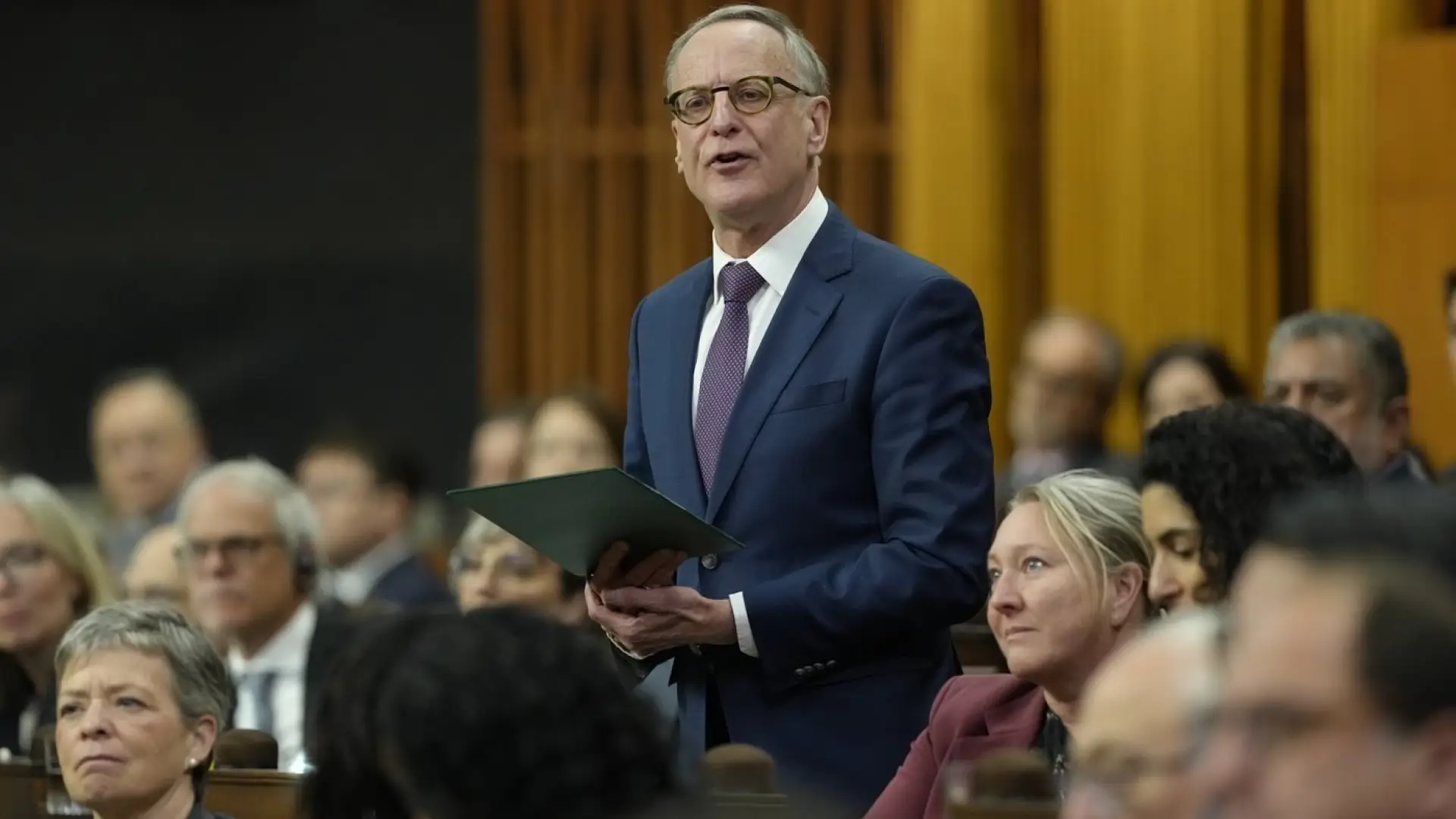
OTTAWA -- The federal government tabled a bill Friday to change the way Canada bars imports of products made with forced labour following an American tariff threat.
Foreign Affairs Minister Anita Anand was in Paris with Prime Minister Mark Carney as the legislation was tabled by her parliamentary secretary, Rob Oliphant.
"This will be a made-in-Canada solution to an international problem," he told reporters on Parliament Hill.
Oliphant said the bill would create a public list of products that have been linked to forced labour in specific regions, based on intelligence from embassies and other authorities.
The bill would require importers to prove that specific products from listed regions were not made through slavery.
He said Bill C-35 should address the concerns of U.S. President Donald Trump, whose administration is mulling new tariffs targeting Canada and other countries over imports made through forced labour.
The legislation would shift away from the current practice of Canadian officials inspecting containers. Instead, Oliphant said, officials would be provided with a list of higher-risk products to inspect.
The bill also looks to put Canada in line with Mexico and with rules the European Union is currently crafting.
"We do not want dumping of cheaper materials, cheaper goods into Canada that are produced with forced labour," Oliphant said.
The bill will require study and consultation and the House of Commons is expected to rise for the summer next week.
Conservative ethics critic Michael Barrett said he would examine the legislation but criticized the government for previously saying the existing system had been weeding out products of slavery.
"They're introducing legislation, saying that it's going to do the very thing that they said they were already doing," he told reporters Friday before Oliphant tabled the bill.
Oliphant insisted the bill was not tabled solely due to American pressure. He said the Liberals promised changes in late 2024 -- shortly before then-prime minister Justin Trudeau suspended Parliament and resigned.
"That is not the principal reason we are doing this now," he said of American tariffs.
Under the Canada-United States-Mexico Agreement, Ottawa changed the wording of a customs law on forced labour rules in 2020 to prohibit imports of goods "that are mined, manufactured or produced wholly or in part by forced labour," putting Canadian tariffs in line with CUSMA rules.
But the White House says there is little evidence that Canada has stepped up enforcement.
United States Trade Representative Jamieson Greer's office recently recommended an additional 10 per cent tariff on multiple countries -- including Canada, Mexico and the United Kingdom -- it claims are not doing enough to enforce domestic bans on forced labour.
The Trump administration must launch further public consultations before it can impose the tariff. Carney said last week Canada already has a very strong forced labour regime but legislation would be introduced to crack down on it further.
Advocates have long argued Canada does a poor job of enforcing existing rules meant to bar products made through slavery, a point Carney acknowledged Thursday.
"We have ... a very strong framework and responsibilities -- legal framework and standards and responsibilities. We've been ... less effective in fully enforcing those, and some of that relates to how the responsibilities are structured legally, some of it relates to resources," he told reporters in Toronto.
A recent report by Greer's office said the Canada Border Services Agency does not appear to publish official information about its enforcement efforts and cited numbers suggesting enforcement is weak.
The report also noted an analysis by the Coalition Against Forced Labour that said Canadian border officials intercepted only 50 shipments on suspicion of forced labour, and just two shipments were turned away.
CBSA has said it has intercepted and detained 50 shipments over concerns about forced labour since 2020. Two shipments were found to have been produced using forced labour -- a 2024 shipment of textiles and one in 2025 containing frozen seafood.
Former Liberal MP John McKay, who championed a 2023 law to bar slave products, has pointed out the U.S. allows private firms to produce exports using prison labour. He has accused the Trump administration of letting enforcement slide on a law to weed out Uyghur forced labour from China.
Advocates have accused Ottawa of failing to adequately enforce its 2023 legislation. While Ottawa can issue fines and launch investigations under the law, it hasn't used it to access private companies' records or issue penalties for non-compliance.
On Thursday, Carney also his government is eliminating a watchdog position responsible for investigating allegations of human rights violations committed by Canadian companies abroad.
The Canadian Ombudsperson for Responsible Enterprise (CORE), introduced under the Trudeau government, was tasked with investigating potential abuses, including the use of forced labour. Carney said the office hasn't been effective.
On March 25, however, Foreign Affairs Minister Anita Anand said the position "remains important" and suggested work was underway to fill the role. The UN Human Rights Committee has urged Ottawa to do so.
In March, the government faced criticism for not directly stating whether Uyghur forced labour is underway in China.
That month, Energy Minister Tim Hodgson said the Liberals are opposed to forced labour but are "focused on where we do agree" with China, adding Ottawa can discuss human rights behind closed doors with Beijing.
Beijing vehemently disputes claims that it is using Uyghurs for forced labour, arguing China has addressed terrorism threats while offering economic opportunities to minority populations.
This report by The Canadian Press was first published June 12, 2026.
-- With files from Kyle Duggan and Craig Lord.