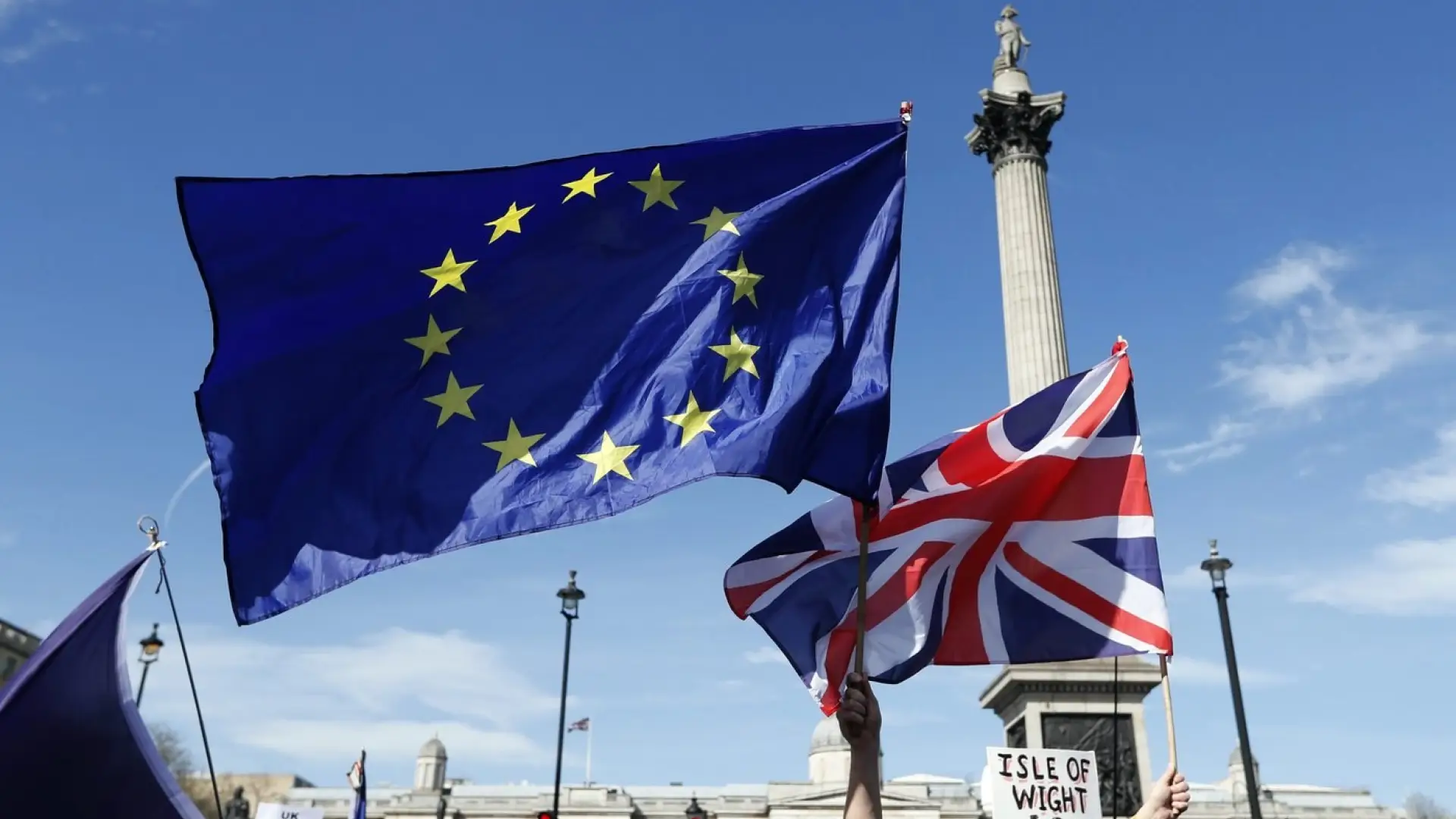
CALGARY -- Ten years ago this week, the United Kingdom voted to quit the European Union, setting off years of political turmoil and economic pain that persist to this day.
Richard Barfield was working at consulting giant PricewaterhouseCoopers around the time of the Brexit referendum, advising financial services clients on risk and regulatory matters. He considered himself "reasonably well-informed," but even he had a tough time parsing out accurate information in the public discourse.
"Like a lot of people in my world, I assumed that the outcome would be the sensible outcome for the economy of the U.K.," said Barfield, now a mostly retired independent consultant.
"With hindsight, I didn't pay the referendum as much attention as I should have at the time."
The United Kingdom's messy divorce from the European Union has been cited as a cautionary tale as Albertans prepare to vote this fall on whether to remain in Canada or hold a separation referendum at a later date. Experts on both sides of the pond say Albertans would be well served by a thorough and clear-eyed accounting of what a split from Canada would truly entail -- well before any vote takes place.
Barfield recalls how effective the Leave campaign was at pressing "emotional buttons" and labelling those who raised concerns about the economic fallout as fearmongers.
It eventually became clear to Barfield that vital information about the upcoming referendum was not registering with the general public, so he and a friend put together a presentation for friends and neighbours, "not necessarily promoting a particular point of view" but laying out hard facts and figures. He's been publishing analyses and articles tracking what has transpired since on his Brexit FactBase website.
The last 10 years haven't been pretty, but estimates vary.
A working paper published in November of last year by the U.S.-based National Bureau of Economic Research found that by 2025, Brexit had reduced the U.K.'s gross domestic product by six to eight per cent compared to what would have been the case if it had stayed in the EU. Investment slipped by an estimated 12 to 18 per cent, and employment and productivity each by three to four per cent, the paper said.
"These large negative impacts reflect a combination of elevated uncertainty, reduced demand, diverted management time and increased misallocation of resources from a protracted Brexit process," the paper's authors wrote.
A 2020 forecast from the U.K. Office of Budget Responsibility has estimated a four per cent loss of potential GDP over 15 years relative to what would have been the case under existing trade agreements.
"Either way, the numbers are enormous," Barfield said.
"And when you're struggling to fund social services and health and all the rest of it, these numbers really matter."
William Bain, head of trade policy at the British Chambers of Commerce, said referendums have a tendency to become "incredibly polarized."
He should know. He represented a Glasgow constituency in the British Parliament for the Labour Party, which aligned with the "no" camp that ultimately prevailed in the 2014 Scottish independence referendum. In the general election the next year, he lost his seat -- along with all but one of Labour's 41 MPs in Scotland.
Cue 2016, the Brexit vote. Bain has since become deeply acquainted with the fallout from the EU split, advising on trade and economic files in the private sector.
"What we experienced a decade ago was the lack of a shared assessment of the facts," he said.
The time between the Brexit vote and the U.K.'s ultimate departure from the EU in 2020 was messy as policy-makers wrangled over the terms of the divorce, Bain recalled. There was a "constant whirlwind" among businesses trying to navigate the political drama taking hold in the country.
"That started the process of reduction in investment and a reduction in trade, even at that point, even before the terms of the final trade deal," he said.
The British Chambers of Commerce has calculated that trade deals the U.K. has inked since Brexit have clawed back just one-tenth of the GDP loss the Office of Budget Responsibility predicted would be caused by the split.
The Alberta government has commissioned a study and tabbed an expert advisory panel to weigh potential costs of quitting Confederation.
Premier Danielle Smith, who has said she counts herself in the "stay" camp, shared some preliminary math at a news conference earlier this month.
An independent Alberta would have to take on its share of Canada's national debt, along with NATO commitments to defence spending and programs like Old Age Security and the Child Tax Benefit. And then there's the infrastructure for a national pension program, employment insurance and border control. Trade agreements would need to be renegotiated. Alberta would need its own postal service, along with regulators for telecoms, railways and banks.
All told, Smith said transitional costs could tally up to around $400 billion, with $25 billion to $50 billion in ongoing annual costs.
Separatist leaders disagree, saying an independent Alberta would come with no more than $5.7 billion in startup costs and would post surpluses once tax revenue stops flowing to Ottawa.
Lennie Kaplan, a former senior manager in the provincial finance department, has been seeking an economic assessment from the government for going on a year. His Freedom of Information requests on what estimates his former department had drawn up came up blank.
"When I was there, we used to do a lot of risk assessment," said Kaplan, who was executive director of a panel on Alberta's finances under former premier Jason Kenney.
"It's sort of puzzling to me why they wouldn't have done some prep work earlier."
In the meantime, Kaplan has been crunching his own numbers. The figures Smith provided for transitional and ongoing costs are in the same ballpark as his assumptions, while he says the separatist camp does not appear to have taken into account trade and other expenses.
In broader economic terms, Kaplan estimates a $39.1-billion hit to Alberta's GDP, or a 7.2 per cent drop, over business-as-usual. That would translate into a 4.8 per cent contraction in disposable household income in 2028, potentially the first year of an independent Alberta. Trade costs would rise 12 per cent, Kaplan predicted, as current agreements would need to be renegotiated.
"They're probably not going to be on as favourable terms as Canada has now," Kaplan said.
"That's going to have an impact on consumer expenditures. That's going have an effect on business investment. That's going to create uncertainty in the economy."
This report by The Canadian Press was first published June 21, 2026.