

It was a somber Stephen J. Harper who marked the 25th anniversary of the worst terrorist attack in the nation’s history on this date in 2010. The 22nd Prime Minister spoke at an event paying tribute to the 329 victims of the Air India bombing that had taken place in June of 1985.
“They perished that day, when a bomb planted in the hold of their aircraft exploded,” Harper said. “Meanwhile, a similar bomb intended for another Air India flight, detonated at Tokyo's Narita airport, killing two baggage handlers. It was an atrocity committed by cowards, motivated by extreme hatred.”
You will find an edited version of Harper’s address to the victims’ families below.
Prime Minister Harper: Most of those on Flight 182 were our fellow citizens, Canadians going to India for business or pleasure. Or, family reunions. Eighty-two of those aboard were children, no doubt to be received and shown off with happy pride.
But, that day the innocence, the pleasure, the anticipation - all of it - was snuffed out by an act of grotesque violence and malevolence. And you who are left, you were handed this heartbreaking loss, the burden of which it is all but impossible to calculate. Severed bonds that still ache with the burning sadness of love remembered in empty silence. This was evil, perpetrated by cowards. Despicable, senseless and vicious.
I will make no attempt to make any sense of it.
Nor will I speak of roads to healing. Some wounds are too deep to be healed even by the remedy of time.
What I can tell you is this. Your suffering is our suffering. Your mourning is our mourning. And, as the years have deepened your grief, so has the understanding of our country grown. Your pain is our pain. As you grieve, so we grieve.
Canadians who sadly did not at first accept that this outrage was made in Canada, accept it now. Let me just speak directly to this perception. For, it is wrong, and it must be laid to rest. This was not an act of foreign violence. Canadians understand now that this terrorist act was conceived in Canada, executed in Canada by Canadian citizens, and the victims were for the most part their fellow citizens. We wish this realization had gained common acceptance earlier.
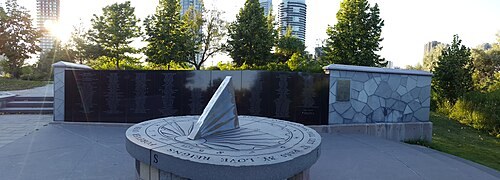
However, it is this understanding which guides the actions of our government today. So, we have encouraged the building of more memorials such as the original one in Ireland that I had the honour of visiting in 2005, and this one here in Toronto.
That's why the Government of Canada made June 23 the National Day of Remembrance for the Victims of terrorism.
Six days ago, (Supreme Court Justice John) Major issued his second report. It is, finally, a thorough examination of events, and deeply disturbing. For, although Major's report runs to 3,000 pages, although it summarizes the testimony of hundreds of witnesses, although it shines a light on institutional processes that Major referred to in some cases as a "dysfunctional focus on self-justification," and in others as "slow, intermittent, and acrimonious," it can still be reduced to a few words: This should not have happened.
This tragedy should not have happened. And 329 people saw their lives cut short, in the sky, on a day in June, in the south of Ireland.
It is not enough to say that the system failed. It did of course. But, this is to sanitize with words a succession of woeful inadequacies that Major calls "a cascading series of errors."
No, that is not enough. Major delivered a damning indictment of many things that occurred before and after the fact. Things, ladies and gentlemen, that this government of Canada cannot defend, has no wish to defend.
And, Major finds that, to make matters worse, the families of the victims were for years after treated with scant respect or consideration by agencies of the government of Canada.
That's why the Government of Canada - which ordered this inquiry - is offering an apology today. It was its duty, and honour required it.
These are things for which honour and duty require that the Government of Canada - the government that called this inquiry - now apologize.
I stand before you therefore, to offer on behalf of the government of Canada, and all Canadians, an apology for the institutional failings of 25 years ago and the treatment of the victims' families thereafter. The protection of its citizens is the first obligation of government. The mere fact of the destruction of Air India Flight 182, is the primary evidence that something went very, very wrong.
For that, we are sorry.
For that, and also for the years during which your legitimate need for answers and indeed, for empathy, were treated with administrative disdain.
Ladies and gentlemen, Major has made many important recommendations. We are in the course of reviewing them and have already begun the vital work of improving safety and security at our airports. It is a matter of the utmost importance to our government that such a thing never happens again.
Sadly, we have no way of knowing when, if, or how, we may once more be attacked. Or by whom. We know only that terrorism, is an enemy with a thousand faces, and a hatred that festers in the darkest spots of the human mind.
And we fear that when we invite from around the world those who share our aspirations for a better life, others also come. Those who see in our Canada, not new bridges to a hopeful future but only another chance to travel the old roads to the blood-feuds of the past.
Politicians of all stripes must marginalize extremists, not embrace them.
Whoever would lift up a perverse ideology by casting down the innocent - we must learn how to thwart them. The finest memorial we could build for your loved ones is to allow them to travel in peace.
Arthur Milnes is an accomplished public historian and award-winning journalist. He was research assistant on The Rt. Hon. Brian Mulroney’s best-selling Memoirs and also served as a speechwriter to then-Prime Minister Stephen Harper and as a Fellow of the Queen’s Centre for the Study of Democracy under the leadership of Tom Axworthy. A resident of Kingston, Ontario, Milnes serves as the in-house historian at the 175 year-old Frontenac Club Hotel.