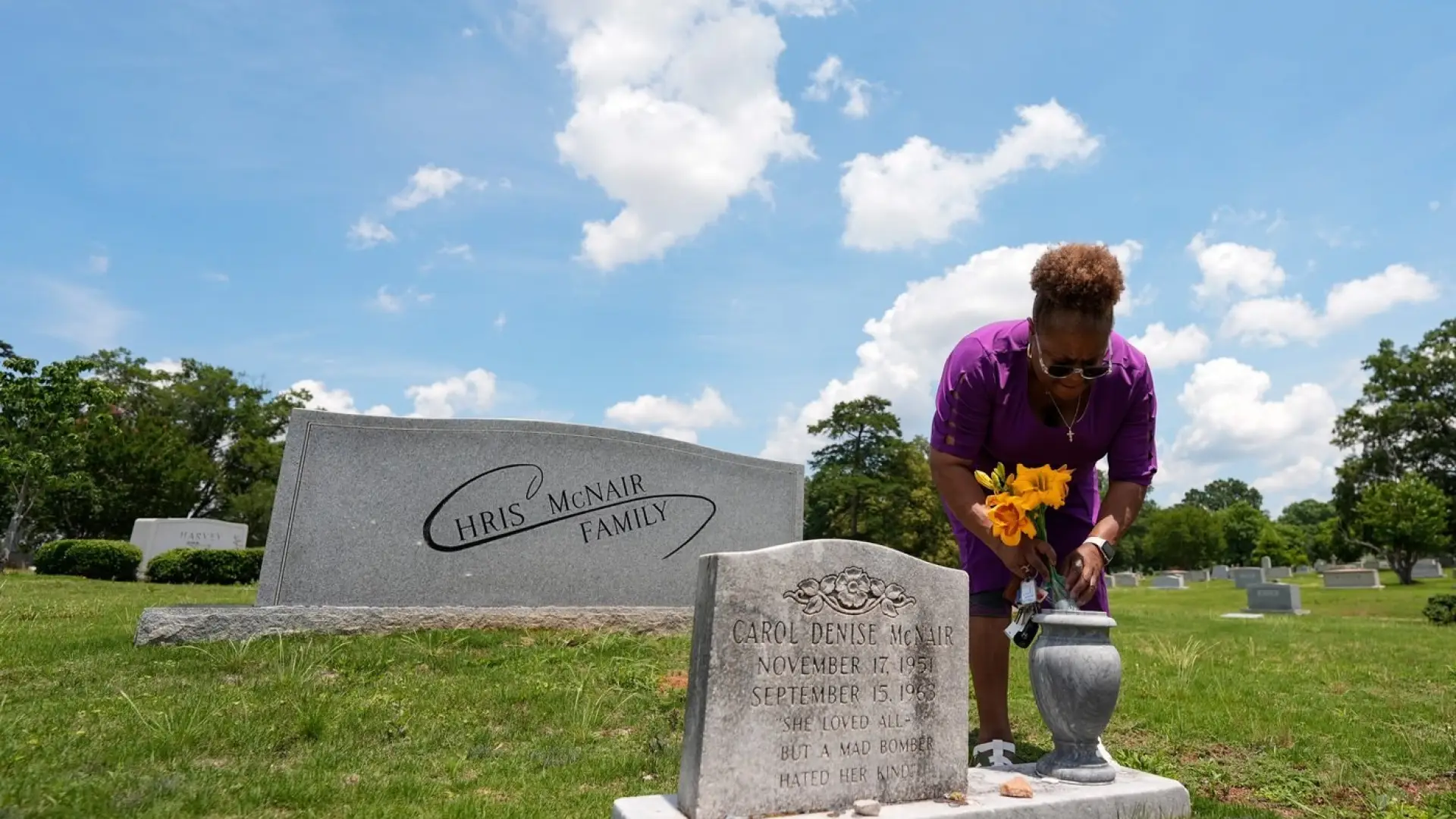
WASHINGTON (AP) -- Holiday gatherings and major life events have come with an empty seat. Certain dates on the calendar meant time at a cemetery, standing before granite stones.
They are a relatively small group of people, scattered across different states, but they share a common bond that stretches back decades: Each had a family member die violently in the struggle for voting and civil rights, victims on a long and difficult path marked by blood that ended when the country seemed to mature into the nation of its creed.
But 61 years later, and as the country approaches its 250th anniversary, those sacrifices are in question. In a series of decisions over the past dozen years, including one in April, the Supreme Court has effectively dismantled the law that their family members died to see enacted, the Voting Rights Act of 1965.
"My mother's blood is on that bill. We were always proud of that, and now it's gone," said Anthony Liuzzo, whose mother, Viola Liuzzo, died on an Alabama highway between Selma and Montgomery while driving marchers in 1965.
Critics of the law argue that times have changed, a point Chief Justice John Roberts made in a 2013 decision that was the first major step in rolling back the law.
Survivors of lost loved ones disagree, pointing to the speed with which Republican-led state legislatureseliminated majority-Black congressional districts after the court's April ruling, which severely weakened a section of the law that had protected voting rights for minority communities. They feel anger and sadness that a milestone political victory decades ago has been reversed, but they are committed to keep fighting.
A church bombing and a chunk of concrete
Lisa McNair was born Sept. 19, 1964. Her older sister, Denise, died in the Sept 15, 1963, bombing of the 16th Street Baptist Church in Birmingham, Alabama. The church had been a central organizing point for civil rights protest.
The explosion killed Denise McNair, 11, Addie Mae Collins, 14, Carole Robertson, 14, and Cynthia Morris Wesley, 14. Nearly two dozen others were injured. Three Klansmen were convicted years later.
One of Lisa McNair's early memories of her sister was of the box that their grandmother kept from the funeral home. It included Denise McNair's shoes, a purse and a rock-sized piece of concrete that had been embedded in her skull.
The crime brought the civil rights struggle onto the national stage and outraged Democratic President John F. Kennedy.
The times were tumultuous, McNair said, but it seemed the nation was heading in the right direction. Most of her life, "I've seen advances" on television, in commercials, with interracial marriages, civil rights and voting rights, "a plethora of rights that we got over the greater part of my lifetime." But that has changed, she said.
McNair, 61, said she is "physically sick" about the Supreme Court decision and subsequent actions by lower courts and legislatures.
"I am constantly working to pray my way through it, so I can get up and go to work in the morning and do what I need to do. But I just want to ask every white person I see, What more do you want?" she said. "Why do you hate us so?"
They left for Freedom Summer and never came home
Michael Schwerner, known as Mickey, came from a family in which human rights activism and challenging social norms were expected. He was in Mississippi in 1964 as part of Freedom Summer when he, Andrew Goodman and James Chaney vanished one day in June while investigating a bombing at a Black church.
Their bodies were found weeks later, buried in an earthen dam in a rural area of Neshoba County. Schwerner, 24, and Goodman, 20, were white; Chaney, 21, was Black.
Stephen Schwerner, who died earlier this year and was a social activist in his own right, told The Associated Press in a 2023 interview that as soon as the family heard his younger brother and the other men were missing, they knew they were dead.
"Our family was very out front in the media that the only reason there was international attention was two of the young men were white," said Stephen's daughter, Cassie Schwerner. "Had all three of those young men been Black, they would have ended up absent from our history and our narrative."
The executive director of Morningside Center for Teaching Social Responsibility, Cassie Schwerner, said her family has followed voting rights through their ups and downs. That includes the 2013 Supreme Court decision that allowed states and counties with a history of discriminatory voting rules to make changes without prior approval from the Department of Justice.
The court's April decision, she said, brought rage "and a good deal of sadness -- not for me and my family, but for this country." There is, she said, work to be done on multiple fronts.
Rights paid for in blood turned out to be fragile
Tamara Orange said among her many thoughts when she heard of the Supreme Court decision in this year's Voting Rights Act case, there was relief -- "relief that my dad is not here to see that; that Jimmie Lee Jackson is not here to see it; that Viola Liuzzo is not here to see it," she said. "I'm relieved for them because to me, it's as though the sacrifices that were made were done in vain."
Her father, James Orange, was working with the Southern Christian Leadership Conference to organize voting rights protests in Marion and Perry County, Alabama, in 1965. When juveniles joined the effort, he was arrested for contributing to the delinquency of minors. Concern arose that Orange was going to be taken out of the jail and lynched.
A protest to intervene ended with Jackson, a 26-year-old Black church deacon, being shot in the stomach by a state trooper while Jackson tried to shield his mother and grandfather.
His death was the catalyst for what became the Selma to Montgomery march and "Bloody Sunday."
Orange stayed in the movement all his life and died in 2008, Tamara Orange said. But even after the Voting Rights Act passed, "He would say, be careful or we're going to lose it."
'We got bad news for you'
Anthony Liuzzo had just turned 10 when his mother, 39, left their middle-class neighborhood in Michigan and headed for Selma, Alabama. She had cried as she watched scenes from "Bloody Sunday" on television.
Viola Liuzzo participated in a portion of the second march and then helped drive other civil rights protesters around the Black Belt region of the state. On March 25, 1965, she was driving one protester between Selma and Montgomery when a vehicle pulled alongside and fired into the car.
The phone call came around midnight. Anthony Liuzzo remembers the caller asking his dad, "Is your wife Viola? We got bad news for you. She's been shot." When his father asked whether she was all right, the caller said "No, she's dead," and then hung up.
An informant for the FBI quickly identified members of the Ku Klux Klan as her killers. The three men charged would escape conviction on state charges but be convicted in federal court.
Anthony Liuzzo and his siblings lived with the lost birthdays and other missed milestones. His comfort was that the voting rights she had died for had become a reality. But the April ruling by the Supreme Court and the subsequent rush by Republican-led legislatures in several Southern states to eliminate congressional districts represented by Black lawmakers left him angry and distraught.
Even so, he said he is still proud his mother had the courage to go to Selma "when others sat in their pretty little houses."
One morning, the Klan returned
The inscription at the bottom of Vernon Dahmer Sr.'s tombstone reads simply: "If you don't vote, you don't count."
It is a message that embodies his life's work and the story behind his death.
Even after Democratic President Lyndon Johnson signed the Voting Rights Act, not every state was eager to implement the new law. In Mississippi, it came with a "poll tax." The amount was $2, but in a world where a farmworker's wages might only be $5 a day, that was substantial, said Dahmer's son, Dennis Dahmer Sr.
The elder Dahmer, 57 at the time of his death, was a successful businessman who owned a store, sawmill and farm near Hattiesburg. He also was a civil rights leader and NAACP president in Ford County. He offered to pay the $2 for Black residents who wanted to register to vote.
He had already been under scrutiny by the local Ku Klux Klan. There was harassment and there were threatening phone calls. The windows were shot out of his store, but no one challenged him directly because his sons were always present and armed.
That seemed to trail off after Johnson signed the law.
"The Klan quit calling," Dennis Dahmer said. "They quit shooting out the windows, so my family thought that all of this was behind us."
That changed in the early hours of Jan. 10, 1966, when two carloads of Klansmen showed up. They firebombed the house and adjacent grocery store and began shooting at the house. The elder Dahmer shot back, using his ample arsenal to fight off the attack.
His wife and the three children who were home survived, but he suffered severe injuries from inhaling the smoke and fumes from the flames. He died later that day.
Dennis Dahmer was 12 as he stood next to his dad's hospital bed. He wondered why some people wanted his father dead just for trying to help Black people vote.
A former Imperial Wizard of the Ku Klux Klan, Sam Bowers, was convicted in 1998 for the attack and sentenced to life.
Like the families of other survivors, Dennis Dahmer's family has witnessed the methodical dismantling of the Voting Rights Act.
"Finally, they basically turned it into a relic," he said.
His plan now is activism, to speak out and promote the need for a massive voter turnout. He also wants to remind people of the price that certain families paid for everyone to have the right to vote and be represented by someone of their choosing.
"We're living in a time when America has a lot of the same characteristics of the 1960s that I grew up in," he said. "People say, are we going back? Hell, we're already there."