

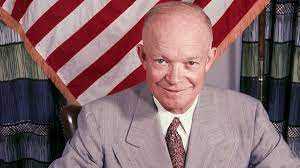
U.S. President Dwight Eisenhower was only a few days from an official visit to Ottawa on this date in 1958 and his officials were busy preparing briefing materials for him ahead of talks in Ottawa with Prime Minister John Diefenbaker. Canadians had handed Dief a remarkably strong majority mandate three months earlier that saw the PCs win 208 seats in that year’s general election.
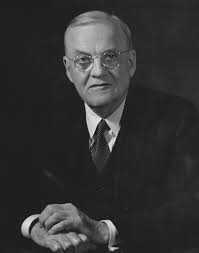
With this fact in mind, our American friends wanted to build on an already successful bilateral relationship. Secretary of State John Foster Dulles was chief amongst those briefing the President. You will find part of the recommendations he sent up the line to the Oval Office on July 3, 1958 below.
John Foster Dulles: “I conceive the general purpose of your visit to Ottawa to be the improvement of our relations with Canada under its Conservative Government. We seek to establish the same mutual confidence and close working relationship with the new government that we enjoyed with the Liberal Government for 22 years. The attainment of that relationship is, however, somewhat impeded by the existence of vocal, widespread criticism of the United States and its policies. In large part this criticism owes its origin to Canadian nationalism. It has been further nourished by the election campaign as well as by the current recession in Canada.1 A major manifestation of this has been a tendency to assert Canada’s independence of the United States. Some members of the government have been prone to play upon the emotional response that such assertions evoke and to try to make the United States the whipping boy for many of Canada’s ills. It will be important during your visit to convey to members of the government a sense of the importance of interdependence among independent nations, and of maintaining harmony and unity among allies confronted with a common danger.
We would like to persuade the Canadians that (a) United States policies are reasonable; (b) far from taking Canada for granted, the United States prizes its intimate relationship; and (c) the United States recognizes that problems exist in our relations and is determined to find constructive solutions on the basis of mutual give and take. In general I think frankness should be the key note, with a forceful presentation of the United States case wherever our policies are imperfectly understood.
The text of your speech to Parliament sets a good perspective for the public aspects of your visit. Your private talks with the Canadian Ministers could emphasize the common global responsibilities of Canada and the United States. They would be interested in a broad-brush treatment of the United States appraisal of Soviet trends, with particular reference to disarmament, and the possibility of a Summit meeting.
It will be well to be wary of tendencies on the part of some of the Ministers to go into specifics and even become contentious. As you note in your speech there is a multiplicity of established mechanisms through which the two Governments can give their problems the full attention they require. Also, I shall have opportunities for separate meetings with the Minister of External Affairs, Mr. Smith. I am enclosing a memorandum that suggests ways to handle specific subjects which, within the foregoing context, are likely to be discussed.
You can read the entire Dulles’ memo at this link: https://history.state.gov/historicaldocuments/frus1958-60v07p1/d280

Arthur Milnes is an accomplished public historian and award-winning journalist. He was research assistant on The Rt. Hon. Brian Mulroney’s best-selling Memoirs and also served as a speechwriter to then-Prime Minister Stephen Harper and as a Fellow of the Queen’s Centre for the Study of Democracy under the leadership of Tom Axworthy. A resident of Kingston, Ontario, Milnes serves as the in-house historian at the 175 year-old Frontenac Club Hotel.