

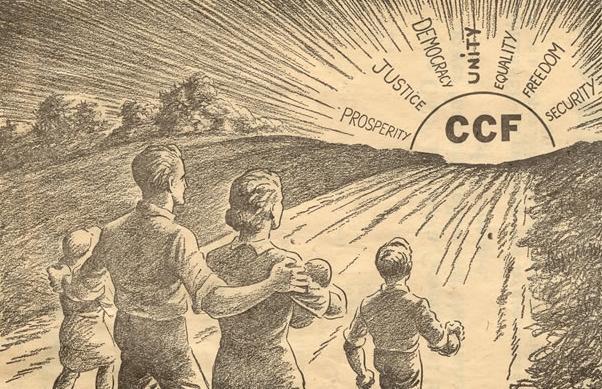
Leading intellectuals, representatives of farm and labour workers and other advocates for a more progressive Canada were in Regina on this date in 1933. It was a year after many of the same men and women had founded the Cooperative Commonwealth Federation (CCF), which was, of course, the legacy party of today’s NDP. This time, they held the first-ever convention that brought rank and file party members together as one. Most importantly, the CCF officially issued the famed Regina Manifesto which, as it main authors (and intellectuals) F.R. Scott of Quebec and Frank Underhill of Toronto proclaimed, “When private profit is the main stimulus to economic effort, our society oscillates between periods of feverish prosperity in which the main benefits go to speculators and profiteers, and of catastrophic depression, in which the common man’s normal state of insecurity and hardship is accentuated. We believe that these evils can be removed only in a planned and socialized economy in which our natural resources and principal means of production and distribution are owned, controlled and operated by the people.”
You can read more about this important document from Great Depression-era Canadian politics at this link from the on-line version of Historica’s Canadian Encyclopedia, a resource for students of Canadian political history that is invaluable: https://thecanadianencyclopedia.ca/en/article/regina-manifesto-1933
Arthur Milnes is an accomplished public historian and award-winning journalist. He was research assistant on The Rt. Hon. Brian Mulroney’s best-selling Memoirs and also served as a speechwriter to then-Prime Minister Stephen Harper and as a Fellow of the Queen’s Centre for the Study of Democracy under the leadership of Tom Axworthy. A resident of Kingston, Ontario, Milnes serves as the in-house historian at the 175 year-old Frontenac Club Hotel.