Experts warn the latest tariff threats from the United States will hit some provinces harder than others — and could test the united Team Canada front.
U.S. President Donald Trump signed a series of executive orders Monday to impose 50 per cent tariffs starting Aug. 19 on a range of Canadian exports, including honey, liquor and hockey sticks.
University of Calgary professor of economics Trevor Tombe examined which provinces are most exposed to the new tariffs as a share of their total exports.
British Columbia could be hit the hardest by the latest tariff volley, he said, mainly because of high-value electrical component boards made in the province.
Tombe estimates 13.7 per cent of B.C.'s exports would be hit by the new tariffs if they take effect. Quebec's share of exposed exports stands at 10.8 per cent, followed by Ontario's at nine per cent.
Other provinces have much lower levels of exposure. Alberta and Saskatchewan would see roughly one per cent of their total exports affected by the latest U.S. tariff list.
Tombe said the explicit exclusion of energy and potash from the proposed tariffs means the Prairie provinces get off relatively light.
Nationally, the new tariffs would affect roughly five per cent of total exports. Tombe said that could shave half a percentage point off Canada's annual gross domestic product.
He said that would be "big, but not the kind of recession-inducing tariff shock that we were contemplating back in February of 2025, for example."
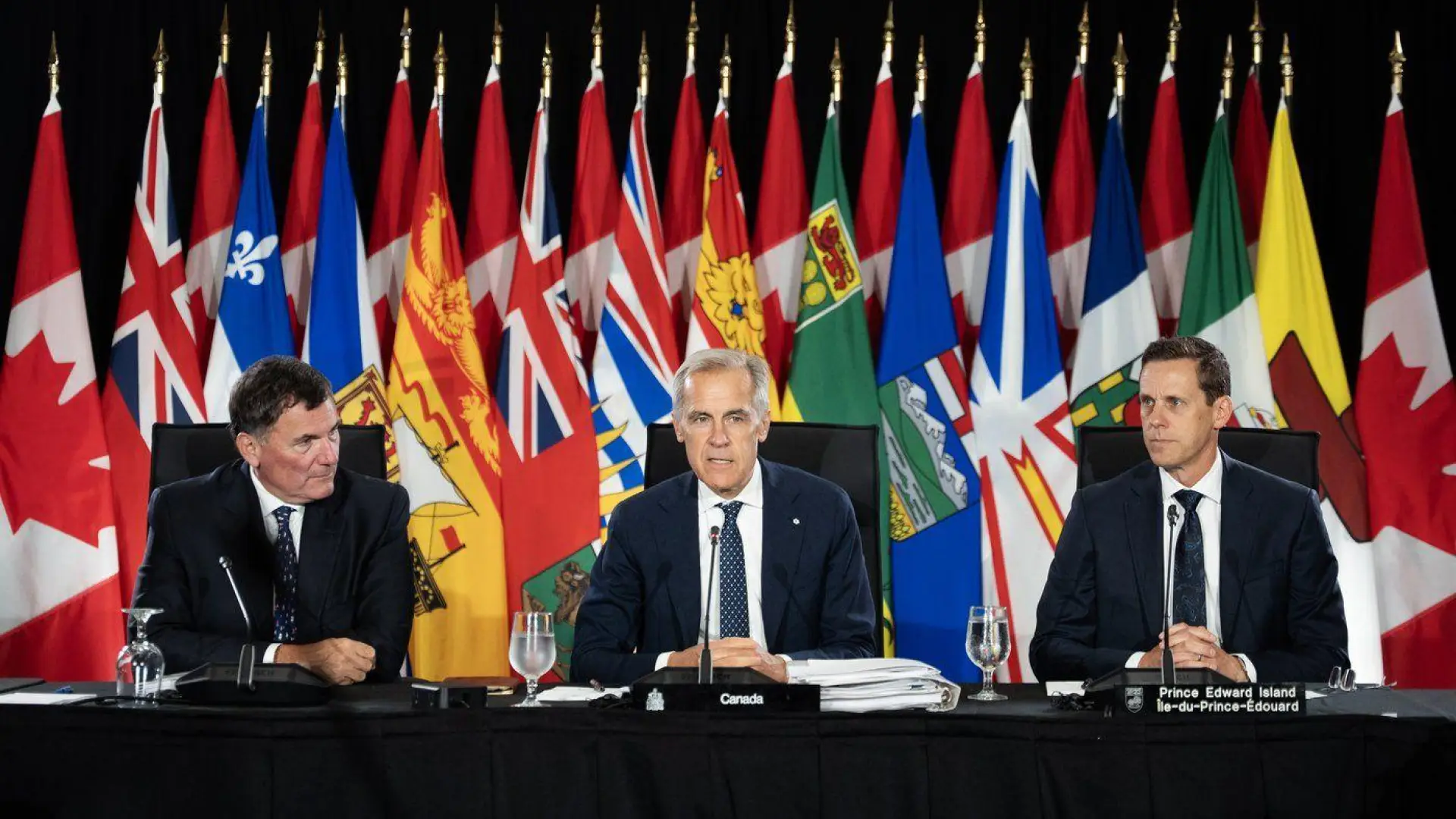
Premiers huddled with Prime Minister Mark Carney in Charlottetown on Thursday to debate their response to the latest trade assault from south of the border.
On Tuesday, Ontario Premier Doug Ford called for retaliation in the form of tit-for-tat tariffs and suggested the provinces could "dismantle the U.S. if we wanted to" by exerting pressure through energy exports.
Ford also said he wants to see more support from the other provinces for actions pushing back against Trump's tariffs.
"It can't always be Ontario. It has to be a Team Canada approach and that's my message to my premier friends, that we have to stay united," he said.
Mahmood Nanji, Ontario's former associate deputy minister of finance, said Ford has a solid case for arguing that his province is getting hit relatively hard in the trade war, along with Quebec and B.C.
Nanji, now a fellow with the Ivey School of Business at Western University, pointed out that White House communications made a point of stating that there would be no tariffs on energy or potash in the latest round of duties.
Nanji said that with some provinces facing sharper tariff consequences than others, he wouldn't put it past the Trump administration to try to exploit those divisions.
"(The premiers) need to offer a united front and be supportive of their colleagues," he said. "This can't be a divide-and-conquer thing."
Alberta and Saskatchewan are the only provinces which have so far fully lifted restrictions on sales of U.S. alcohol — one of the irritants cited by the Trump administration to justify the new tariffs. Other American gripes include quotas on some American vehicles and Canada's supply-managed dairy regime.
While Alberta Premier Danielle Smith acknowledged Wednesday that her province has escaped the worst impacts of the trade war, she expressed support for her provincial colleagues' efforts to get all duties removed from critical sectors.
Saskatchewan Premier Scott Moe told reporters Thursday he and Ford agree on the need to support the federal negotiating team as it pursues a renewed trade agreement with the United States — though he acknowledged there "may be different views on how we get there."
Nanji said negotiating an end to tariffs will be a balancing act for Carney and the Canadian negotiating team.
He recalled efforts earlier this year to get Chinese tariffs removed on canola — a thorny issue for growers in Alberta, Saskatchewan and Manitoba. The deal to remove those duties ultimately involved an agreement to import a quota of Chinese-made electric vehicles, a move that hampers Ontario's auto sector.
Carney has not indicated whether Canada would retaliate with counter-tariffs or other actions against the newest round of tariffs. Ottawa has dropped most of the initial retaliatory duties imposed in spring 2025 but has maintained counter-tariffs on steel and aluminum and some automotive inputs.
The question of whether retaliation is the right response to the Trump administration is open to debate, Nanji said.
He said if Canada does go that route, the Prairie provinces could be called on to impose export restrictions that would hit the United States where it hurts most.
"The things that the United States needs from Canada are energy, critical minerals, potash, and that's our leverage," he said.
Nanji said that if Canada chooses to use that leverage in negotiations with the United States — potentially by limiting exports or putting surcharges on energy sent south of the border — the big question will be whether all provinces are willing to put their interests second to Canada's.
Open dissent among provinces would undermine Canada's position at the bargaining table, he argued.
"The premiers will have views, should have views and should express those views behind closed doors. But I think in public, you've got to speak with one unified voice," Nanji said.
Tombe said he isn't convinced the Trump administration meant for its new tariff threat to drive a wedge between provinces and the federal government. He said that because the goods being targeted are largely discretionary purchases like liquor or hockey equipment, the tariffs appear to be politically motivated rather than an effort intended to deal economic damage to Canada.
"That, I suspect, is a bigger part of what explains why certain items are being tariffed and not others," he said.
Tombe also pointed to the 30-day window before the tariffs are implemented, which could suggest U.S. officials are using the threat of levies to shape negotiations on the Canada-U.S.-Mexico Agreement on trade.
This report by The Canadian Press was first published July 23, 2026.