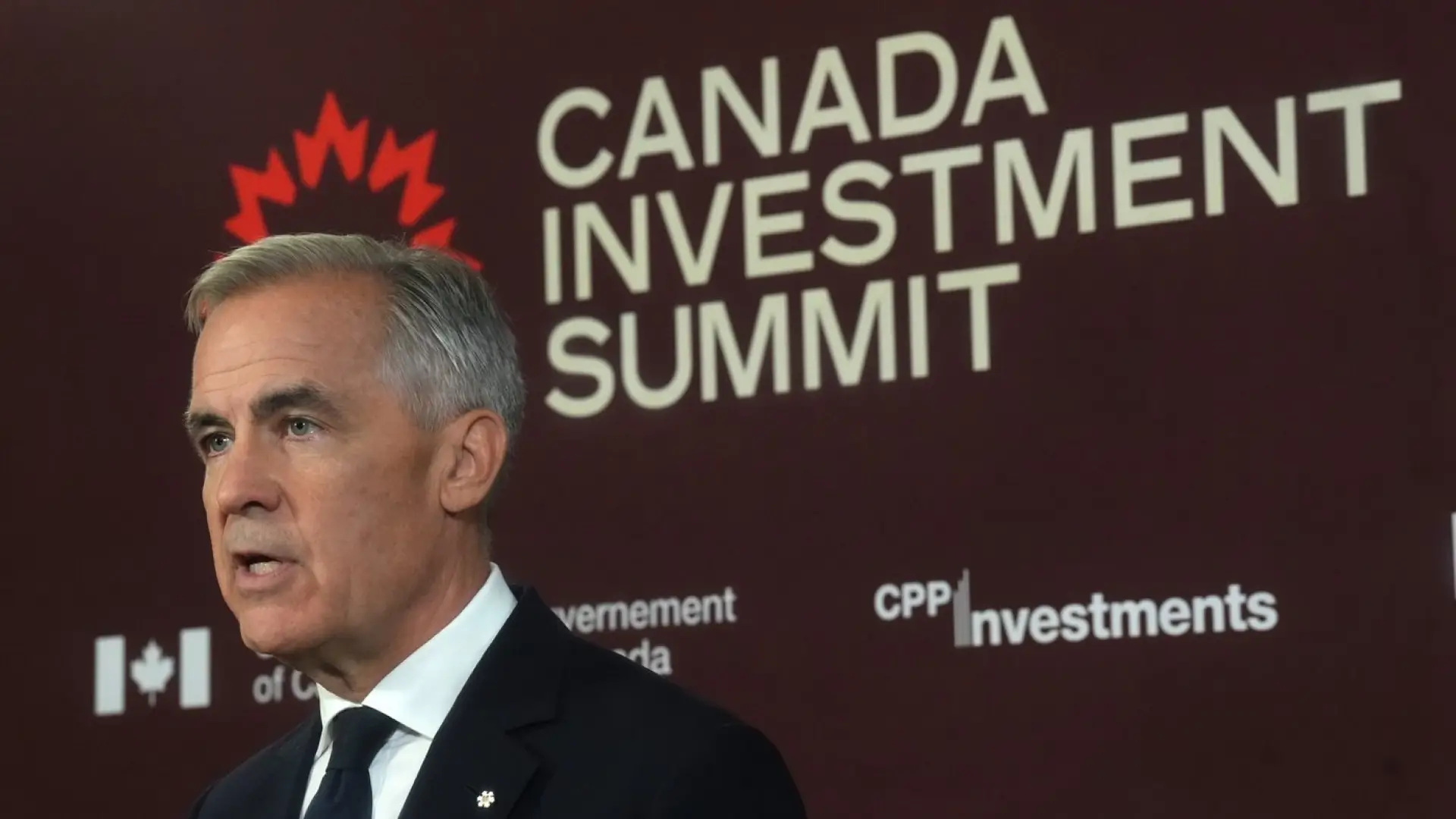
TORONTO -- Prime Minister Mark Carney said Tuesday that while Canada is "ahead on incentives" in the race with the United States for investment, it still has a lot of ground to make up.
At a news conference in Toronto at Canada's first-ever national investment summit, Carney announced plans to court private investors to run major Canadian airports and to bring in tax reforms to spur foreign investment.
Carney's government is lowering the marginal effective tax rate to 6.4 per cent from 13 per cent, which could make the country a more attractive place to invest. It will also lower the government's revenue in the near term.
U.S. President Donald Trump moved to sharply lower the United States' own marginal effective tax rate with the One Big Beautiful Bill Act passed last year. According to the Canadian government's calculations, that rate now stands at 16.9 per cent south of the border.
Carney defended the move when asked by The Canadian Press whether the change offers only a short-term competitive edge against other countries, which might reduce their own tax rates in response.
"The incentive for companies to invest in Canada is twice as high as it is in the United States," Carney said, referring to the tax measure.
"If we're in a race … we're ahead on the incentives, but we have ground to catch up. And what does this mean for Canadians and catching up to that ground? It means more jobs. It means a stronger country. It means more resilience, more independence, more sovereignty."
Ottawa is lowering its marginal effective tax rate by expanding the kinds of capital investments eligible for immediate expensing. This lets a business write off an investment in the first year it's in operation, encouraging it to spend on equipment and machinery that can boost productivity.
Carney said that while taxes will still be paid on these investments, they'll be paid later on, which can have the effect of accelerating investments.
Ottawa pegged the cost of the expanded deduction at $36 billion over five years.
Carney announced a series of other changes to Canada's investment landscape on Tuesday, including a move to open up Canada's four major publicly owned airports to private investment.
The prime minister drew praise from the corporate community for his efforts to stimulate investment in Canada after a long period of stagnant business spending on capital.
But not everyone is enthusiastic about offering tax breaks to businesses or opening public infrastructure to privatization.
Organizers behind a protest march outside the investment summit in Toronto on Monday said in a news release that Tuesday's announcements validated their warnings about a "fire sale" of Canada's assets.
The summit has been criticized by some Indigenous leaders, environmental groups and union leaders who said they worry about the future of public services, pipelines and arms manufacturing in Canada.
The prime minister also announced Tuesday that the federal government will balance the operating side of its budget next year, a year earlier than planned. Ottawa will continue to run deficits on capital spending.
Carney said the federal government will introduce legislation during the fall session of Parliament that will expand Ottawa's "one project, one review, one year" framework to include infrastructure proposals beyond those designated as major, "nation-building" projects.
He said the government will not compromise its high standards for projects.
"Speed, certainty, predictability themselves are competitive advantages. Investors should know that when Canada says it wants something built, Canada will get it built," Carney told attendees at the summit.
Jon Gray, a panellist at the investment event and president of the Blackstone asset management group, told the crowd at the summit that Canada had been a "sleeping giant" for a long time but now appears to be waking up.
Regulation, permitting and taxation had slowly built up in Canada over the past decade, Gray said, making it hard for global capital to find a business case.
"We're now at a moment where Canada's really focused on its economic independence, and at the same time, this massive infrastructure is needed for the future," he said.
"I think the potential growth rates here are much higher than most people would expect."
This report by The Canadian Press was first published Sept. 15, 2026.
1741