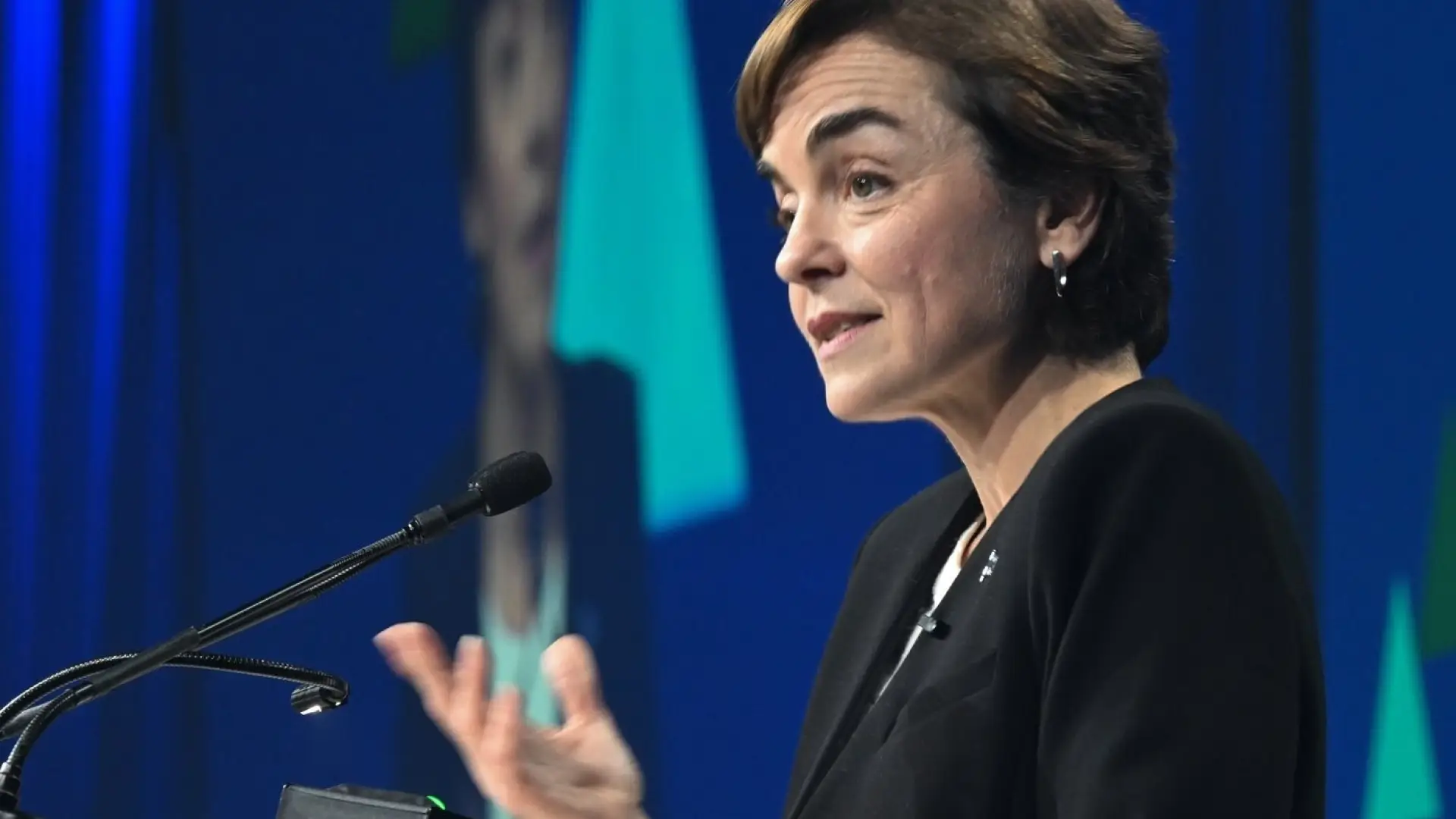
MONTREAL -- Allegations of political interference from the United States dominated the 30th day of Quebec's election campaign on Friday as Coalition Avenir Quebec Leader Christine Frechette expressed concerns that Americans were trying to help sovereigntists take control of the province.
Her warnings were met with skepticism from her political rivals, but Frechette said the threat was serious enough for her to request a meeting with Prime Minister Mark Carney and for her party to approach the Canadian Security Intelligence Service.
"I want help from the federal government to shed light on the issue," she said Friday morning, saying that it was up to Quebecers to choose the next government.
Five parties are expecting to win seats in the Oct. 5 election, Frechette's CAQ, the Parti Quebecois, the Quebec Liberals, the Quebec Conservatives and Quebec solidaire.
Frechette spoke to journalists twice on the campaign trail on Friday about the allegations. Her office also issued a statement later in the afternoon to clarify that she was only publicly talking about the allegations due to a news report by Quebecor media.
The report quoted two unnamed sources from Frechette's government who said American government officials had attempted to negotiate tariffs with Quebec directly. The news report also noted how a U.S.-based think tank, the Defense Analyses and Research Corporation, published an essay in February calling for Americans to destabilize the Canadian federation.
The essay urged Americans to support the election of sovereigntists in Canadian elections and to "weaponize" reconciliation between Canada and First Nations to "slowly nudge" the country on a path toward the end of history.
Frechette confirmed that American officials had reached out to her Coalition Avenir Quebec government in the spring "to reach an agreement with Quebec regarding sectors related to CUSMA."
"When my team told me about it, I shut the door on it right away. Because, as far as I'm concerned, it's unthinkable that Quebec could sign an agreement with the United States," she said in the afternoon.
Frechette's subsequent statement, sent by a spokesperson in the premier's office, said that her team informed her last Saturday about essays published by the U.S. think tank. Frechette said this prompted her to inform Ian Lafreniere, her government's interior security minister. She also said the party contacted CSIS on Tuesday, which led a meeting with the federal intelligence agency on Wednesday.
The statement added that Frechette's team had received no information confirming any interference in the election campaign.
CSIS did not immediately respond to a request for comment.
Canada's foreign affairs minister, Anita Anand, said at a news conference in Ottawa that the federal government is taking the latest allegations very seriously.
"Protecting our democracy is of the utmost importance to our country," she said.
She added that she doesn't believe that there is anything affecting Canada's democracy at this time, but that when she "sees something," she raises it with her counterparts, including U.S. Secretary of State Marco Rubio.
"Right now I do not have proof," she said.
PQ Leader Paul St-Pierre Plamondon said his party was not contacted by American officials, and that he has not seen proof of interference. The PQ leader has promised on the campaign trail to hold a referendum on sovereignty if his party forms a government -- but not before President Donald Trump leaves the White House.
He told journalists that he finds the timing of the news about alleged foreign interference "weird" as Quebecers can vote in advance polls starting Sunday.
"I'm told the information was available as of January. We're talking about events that might have taken place in early September," he said. "And we're only hearing about this two days before voting begins."
Earlier in the campaign, the PQ leader accused the federal government of electoral interference by strategically announcing major investments in Quebec and of "anxiety-inducing" messaging concerning the trade war with the United States.
But St-Pierre Plamondon urged Quebecers on Friday to head to the polls "with peace of mind" and to not allow the federal and American governments to "kidnap" the election.
Frechette's rivals demanded more transparency from the premier.
"What is she telling us? After she meets Carney, it's crucial that she informs all Quebecers of the nature of the interference, if there was interference," said Quebec solidare co-spokesperson Ruba Ghazal.
She suggested that the American government may have an interest in separatist parties in Quebec and Alberta.
"It's not up to Donald Trump to choose who will be elected, either in Quebec or in Alberta," Ghazal said.
Liberal Leader Charles Milliard agreed, saying Trump would benefit from political instability in Canada with the PQ promising a referendum on separation in its first mandate, if elected.
He added that Frechette should have contacted all party leaders as soon as she found out about the allegations.
This report by The Canadian Press was first published Sept. 25, 2026.