

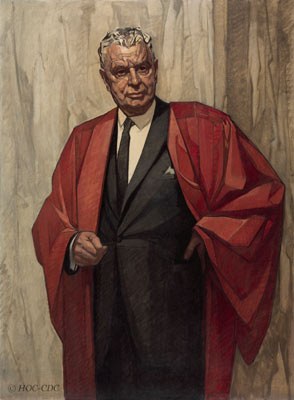
Former Prime Minister John Diefenbaker was honoured on Parliament Hill on this date in 1968. Prime Minister Pierre Trudeau, Leader of the Oppositon Robert L. Stanfield and other dignitaries gathered as one as Dief’s commanding official Parliament Hill portrait was unveiled. You can read Mr. Diefenbaker’s address that historic day below.
The Rt. Hon. John Diefenbaker: I am deeply touched by what has been said here today. It makes Parliament what it is. To the Prime Minister (Pierre Trudeau), may I say I was greatly taken by your observations when you were in Regina and visited my parents’ humble home. I think it was an aphorism which will last for a long time. It was spontaneous, courteous, and humorous: “Sometimes when he is in the House, I wish he were living here”.
However, I want to tell the Prime Minister that from now on until further notice I am going to be the soul of moderation and I am going to await the arrival of the several ministers in absentia. I will do all this with that customary moderation that I always endeavour to display, but in greater form than heretofore, until I give further notice.
After the kinds words that have been spoken here, I think of the fact that in the years ahead each of those who has been prime minister will have a monument on Parliament Hill.
The Prime Minister mentioned my boyhood home. My father was a teacher who, in his day and generation, taught two who eventually become Prime Ministers of Canada, the Right Hon. Mackenzie King and me. History will tell in which case he did the worst job!
I think of the unveilings which will take place in the years ahead, and if the spirit that is present here today becomes translated into sculpture, I can see the Prime Minister and me arm in arm with Lafontaine and Baldwin on Parliament Hill.
I understood originally that the Right Hon. Lester B. Pearson was also to be present on this occasion but circumstances have prevented his being here. Perhaps it would have been better if he had been here, since it may well be that the words of Benjamin Franklin uttered in 1775 may apply, where he said, “If you do not hang together, you will hang separately”.
The present occasion, for one in my position, is a touching experience. In the spirit of the occasion, we see a manifestation of the spirit of parliament. Those who know not parliament do not realize that in the cross-fire of daily parliamentary life we, and I am speaking for all of us, form an immense admiration for those who sit opposite us. We may disagree on the course that should be followed; our views on many matters may differ, yet there is one matter on which we all agree: There is no institution to compare with parliament for the preservation of values and truth.
It is not for me to judge the quality of Mr. Horne’s portrait or to offer my opinion about it. I may say that, considering the subject matter the artist had available to him, he did a magnificent job.
I thank the Prime Minister for his courtesy. It may be appropriate to say that perhaps some measure of masculine pulchritude made it possible for the placing of my portrait here. The efforts of those who in the past produced portraits, drawings and caricatures of me will be obliterated by the realistic skills that Mr. Horne has brought to bear in producing the portrait that is before us.
Parliament is the place where we form deep and abiding affections for those who sit opposite us. We know the contribution they are making and the responsibilities they bear. I want to say to you, Mr. Prime Minister, that though you, who in common with 14 other men who have been termed prime minister of Canada, are adept at asking questions, in the last few weeks you have shown an adeptness at answering them that does honour to you, and perhaps not so much to those of us who have put the questions.
I wish to thank all who are present here, our leader for his kind words and Mr. Speaker for the capacity which he possesses in such abounding measure – his kindliness and courtesy. To you again, Mr. Prime Minister, from the bottom of my heart, I express my appreciation.
After all, we are here for one purpose, whether we were raised in humbleness, or in circumstances which no one could expect would lead to the highest office of state. Whatever our background, to sum up the situation in a way which appeals to me, each of us in this country without regard to race, religion or colour, has an opportunity for service. It is up to us in our day and generation to play our part in bringing about a greater, more wonderful Canada such, as in our imaginations, we can see today.
Mr. Speaker, allow me to thank you for your cordial welcome.
Arthur Milnes is an accomplished public historian and award-winning journalist. He was research assistant on The Rt. Hon. Brian Mulroney’s best-selling Memoirs and also served as a speechwriter to then-Prime Minister Stephen Harper and as a Fellow of the Queen’s Centre for the Study of Democracy under the leadership of Tom Axworthy. A resident of Kingston, Ontario, Milnes serves as the in-house historian at the 175 year-old Frontenac Club Hotel.