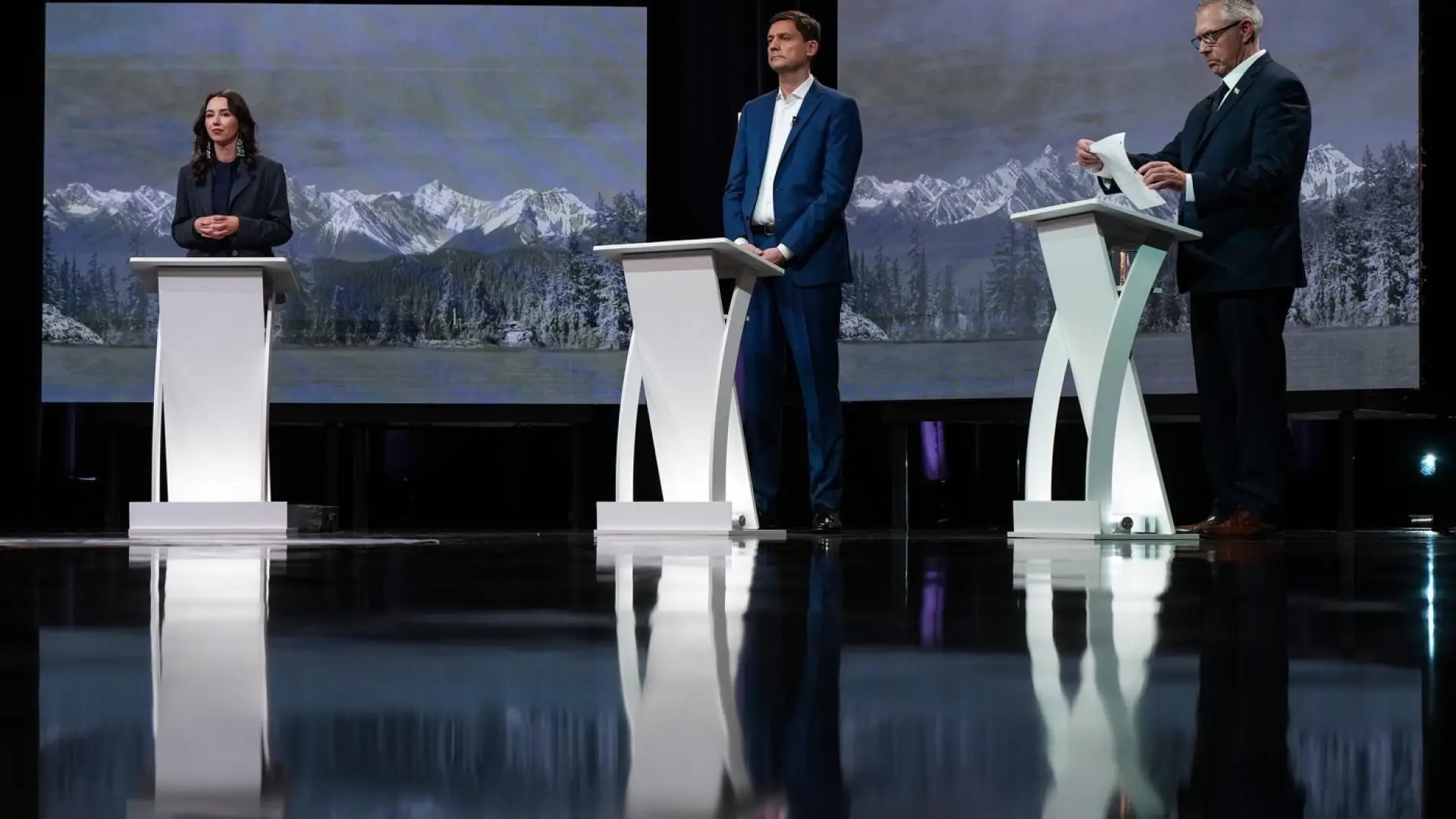
VANCOUVER -- British Columbia NDP Leader David Eby repeatedly acknowledged his government's imperfections in a debate where his B.C. Conservative and Green rivals railed against his record on the economy, health care and Indigenous rights.
Eby told the debate that he'll never seek to balance the province's budget "on the backs of British Columbians," as the province faces a record deficit of $14 billion.
He says in apparent reference to previous BC Liberal administrations that their "so-called balanced budgets" came at the expense of school land being sold off, and instead he is focused on growing the economy and addressing wasteful spending.
The only leaders debate ahead of the Oct. 24 election came hours after the NDP released the costings for its platform, showing a $2 billion reduction of the province's deficit by 2028 -2029.
Eby tried to defend his economic record, but interim B.C. Conservative leader Lorne Doerkson says nobody believes him anymore, while Green Leader Emily Lowan says it is "staggering" that 1.2 million British Columbians do not have access to a family doctor.
There was a surprise at the end of the event when the leaders of CentreBC and OneBC -- who moderator Shachi Kurl says did not qualify for the debate because they did not have enough candidates -- delivered brief statements.
The debate was carried on all major television and radio networks.
It got off to a fractious start, with Eby interrupting Doerkson's response to a question about his plans to ask why Doerkson had not removed his campaign director Katy Merrifield over online posts about Islam that he likened to "the worst corners of the dark web."
Doerkson called Merrifield a survivor of sexual violence and said she "acted out in a moment of trauma."
He said he was shocked Eby would go after Merrifield.
"The fact is that I've given her grace, I would have hoped that you might have too," he told Eby, adding later that he would "always stand against hate," while pointing to allegations of antisemitism in the NDP caucus from former MLA Selina Robinson.
But the debate swiftly shifted to the state of the province's economy and the deficit under Eby.
Doerkson, whose Conservatives are the only party yet to release a costed platform, said Eby had "promised a $7-billion deficit just a few years ago."
"It's at 14. The reality is that doesn't account for the things that you promised. So, while you challenge my thoughts on growing an economy -- and trust me when I say this, British Columbians will see a fulsome plan (from the Conservatives) before they go to the polls -- but the problem Mr. Eby is you cannot continue to attack the residents of British Columbia through taxation."
Lowan said her party had a "fully costed, credible plan" to deal with the deficit.
"We've launched a tax on B.C.'s ultra wealthy and mega corporations," that she said would generate $22.2 billion in its first year and around $5.4 billion in subsequent years.
Major differences were revealed in all three leaders' approaches toward the Declaration on the Rights of Indigenous Peoples Act. Kurl pointed to concerns about its impact, and fears over private property rights.
Eby said that while there had been "challenging" court rulings in relation to Indigenous rights, and the government was appealing them, the only path forward was in partnership with Indigenous people.
"We cannot afford to have major projects tied up in the court," he said, pointing to the need to work with Indigenous stakeholders.
But Doerkson said he was committed to overturning the act, known as DRIPA, saying it had created division and "it has to be repealed."
Lowan said the Greens took advice from First Nations leaders and they have been "unequivocal" about the need to implement DRIPA. When Doerkson said the province was "at odds" as a result of DRIPA, Lowan called his conclusion "ridiculous."
The NDP's costings show a deficit of about $12 billion by 2028-2029, down from a forecast of about $14 billion this fiscal year, built largely on $1 billion in new revenue from income tax increases on the "top 3.88 per cent" as well as $730 million from "targeted economic growth."
The costings show a "platform surplus" of $581 million by 2028 -- 2029, which would combine with previous forecasts to reduce the deficit by just over $2 billion.
The Green Party released its costed platform for the election on Tuesday, promising new initiatives in health care, education and other social services worth almost $9.3 billion per year over the next two fiscal years, with new revenue coming from the one-time tax on "excessive wealth."
The Greens say their fiscal plan would raise an additional $9.14 billion in revenue from 2028-2029 through higher taxes on the wealthiest British Columbians and nobody "who works for an income" would pay a single dollar more in tax than they currently do.
Toward the end of proceedings, Kurl introduced CentreBC leader Elenore Sturko and OneBC leader Dallas Brodie, who were not in the debate auditorium and gave remarks by video. Both are former B.C. Conservatives, from different ends of its ideological spectrum.
Sturko said she was not asking British Columbians "to pretend that CentreBC will form government."
"I'm asking them a different question. Who will hold the next government accountable? CentreBC is a socially progressive, environmentally pragmatic, and fiscally responsible party. Divisiveness and extremes on the left and on the right aren't helping British Columbians," she said.
Brodie said OneBC would push for a 25 per cent income tax cut for both individuals and corporations, and a two per cent cut in the PST.
"As well, we will fight against these land back giveaways that are being done by the current government. We will read the treaties and let you know what is going on. We will stop the greed and corruption of the reconciliation industry in British Columbia and put B.C. back in the hands of British Columbians," she said.
This report by was first published Oct. 14, 2026.