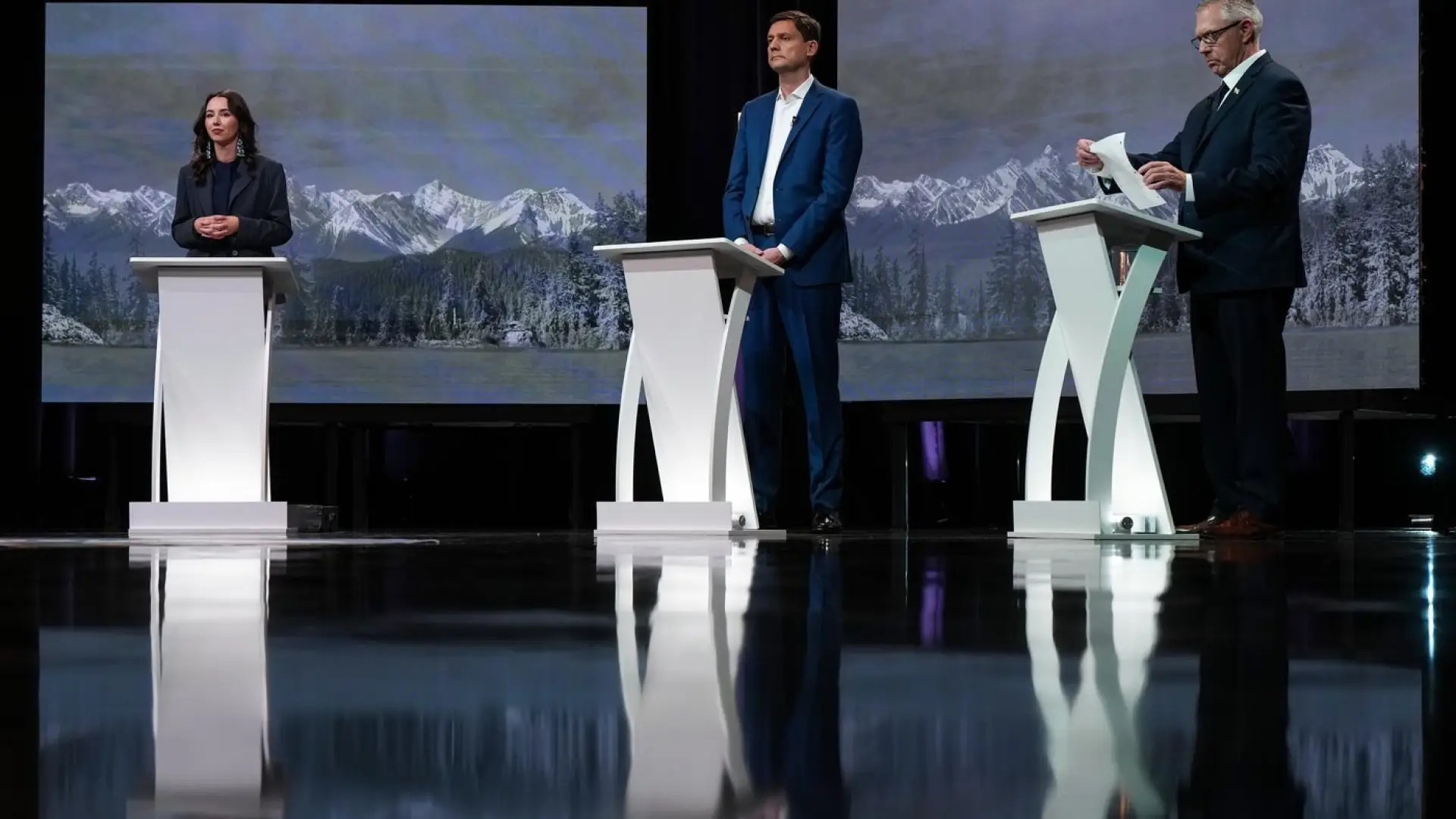
British Columbia NDP Leader David Eby repeatedly acknowledged his government's imperfections in a debate where his B.C. Conservative and Green Party rivals railed against his record on the economy, health care and Indigenous rights.
"Look, I'm not perfect, but I will always act in the best interests of British Columbians, and that's my commitment to you and your family," he said Wednesday.
He repeated his statement during a later question period with reporters, saying he held himself "accountable to British Columbians."
His acknowledgment was in response to questions from Conservative interim leader Lorne Doerkson and Green Leader Emily Lowan about his party's record after nearly a decade in government.
"We are here because David Eby called a snap election," Doerkson said. "He called a snap election, because he saw opportunity for himself, and I see opportunity for British Columbians."
Asked why he called a snap election less than two years into his mandate, Eby said he needed a stronger mandate, noting the Conservatives tried to bring down his government 13 times.
"This was not a government that was able to deliver the big swings that you and your family need government to be taking for you," he said.
The debate, held 10 days before the Oct. 24 provincial election, was carried on all major television and radio stations Wednesday and is the only one between the three leaders.
There was a surprise at the end of the event when the leaders of CentreBC and OneBC each delivered brief statements.
Moderator Shachi Kurl said neither party qualified for the debate because they did not have enough candidates.
While the debate covered a range of issues, including housing, public safety, and health care, the three leaders frequently returned to economic issues.
Doerkson said his party would "supercharge" the provincial economy, without raising existing taxes or introducing new ones. He also promised to cut taxes and bureaucratic bloat, while fully funding public health care.
He told reporters after the debate that he was committed to releasing a fully costed-out platform before residents have the opportunity to vote.
Advance voting begins Friday.
Eby questioned Doerkson's campaign promises, saying they could only mean "dramatic cuts."
Eby said he'd never seek to balance the province's budget "on the backs of British Columbians," as the province faces a record deficit of $14 billion.
In an apparent reference to previous B.C. Liberal administrations, he said their "so-called balanced budgets" came at the expense of school land being sold off.
Instead, he is focused on growing the economy and addressing wasteful spending, Eby said.
"We know what Conservatives do when they need money," he said. "They cut ... and they will do it again."
Doerkson responded by saying Eby was guilty of fearmongering.
"The reality is you refuse to talk about your own record in this province, which is one of devastation," he said.
The debate came hours after the NDP released the costings for its platform, showing a $2 billion reduction of the province's deficit by 2028-29.
When Eby tried to defend his economic record, Doerkson said nobody believed him anymore, while Lowan said it was "staggering" that 1.2 million British Columbians do not have access to a family doctor.
"Your record has been marred with broken promises," she said. "This year's election bribes are next year's broken promises."
The Green leader also accused the Conservatives of being unclear about their financial plans. She promised to push for electoral reform if her party held the balance of power.
"A voting system where we're not caught between lesser evils, where we are choosing between broken promises or service cuts, and I think we can find that system in proportional representation," she said.
There have been three previous attempts in recent decades to change B.C.'s first-past-the-post system. They failed to gain public support.
The debate got off to a fractious start. Eby interrupted Doerkson with a question about why he had not removed his campaign director Katy Merrifield over online posts about Islam that he likened to "the worst corners of the dark web."
Doerkson said Merrifield was a survivor of sexual violence and that she "acted out in a moment of trauma."
He said he was shocked Eby would go after Merrifield.
"The fact is that I've given her grace, I would have hoped that you might have too," he told Eby, adding that he would "always stand against hate."
He pointed to allegations of antisemitism in the NDP caucus from former legislature member Selina Robinson.
The debate swiftly shifted to the state of the province's economy and the deficit under Eby.
Doerkson, whose Conservatives are the only party yet to release a costed platform, said Eby had "promised a $7-billion deficit just a few years ago."
"It's at 14. The reality is that doesn't account for the things that you promised," he said. "You challenge my thoughts on growing an economy.
"The problem Mr. Eby is you cannot continue to attack the residents of British Columbia through taxation."
He added that British Columbians would see a fulsome plan from his party before they go to the polls.
Lowan said her party had a "fully costed, credible plan" to deal with the deficit.
"We've launched a tax on B.C.'s ultra wealthy and mega corporations," she said, adding it would generate $22.2 billion in its first year and around $5.4 billion in subsequent years.
Major differences were revealed in all three leaders' approaches toward the Declaration on the Rights of Indigenous Peoples Act. Kurl pointed to concerns about its impact and fears over private property rights.
Eby said while there had been "challenging" court rulings in relation to Indigenous rights and that the government was appealing them, the only path forward was in partnership with Indigenous Peoples.
"We cannot afford to have major projects tied up in the court," he said, pointing to the need to work with Indigenous stakeholders.
Doerkson said he was committed to repealing the act known as DRIPA, saying it had created division.
Lowan said the Greens took advice from First Nations leaders and they have been "unequivocal" about the need to implement DRIPA. When Doerkson said the province was "at odds" as a result of DRIPA, Lowan called his conclusion "ridiculous."
Toward the end of proceedings, Kurl introduced CentreBC leader Elenore Sturko and OneBC leader Dallas Brodie, who were not in the debate auditorium but gave remarks by video. Both are former B.C. Conservatives from different ends of the party's ideological spectrum.
Sturko said she was not asking British Columbians "to pretend that CentreBC will form government."
"I'm asking them a different question: Who will hold the next government accountable?" she said.
"CentreBC is a socially progressive, environmentally pragmatic, and fiscally responsible party. Divisiveness and extremes on the left and on the right aren't helping British Columbians."
Brodie said OneBC would push for a 25 per cent income tax cut for both individuals and corporations, and a two per cent cut in the PST.
"As well, we will fight against these land back giveaways that are being done by the current government. We will read the treaties and let you know what is going on," she said.
"We will stop the greed and corruption of the reconciliation industry in British Columbia and put B.C. back in the hands of British Columbians."
This report by The Canadian Press was first published Oct. 14, 2026.