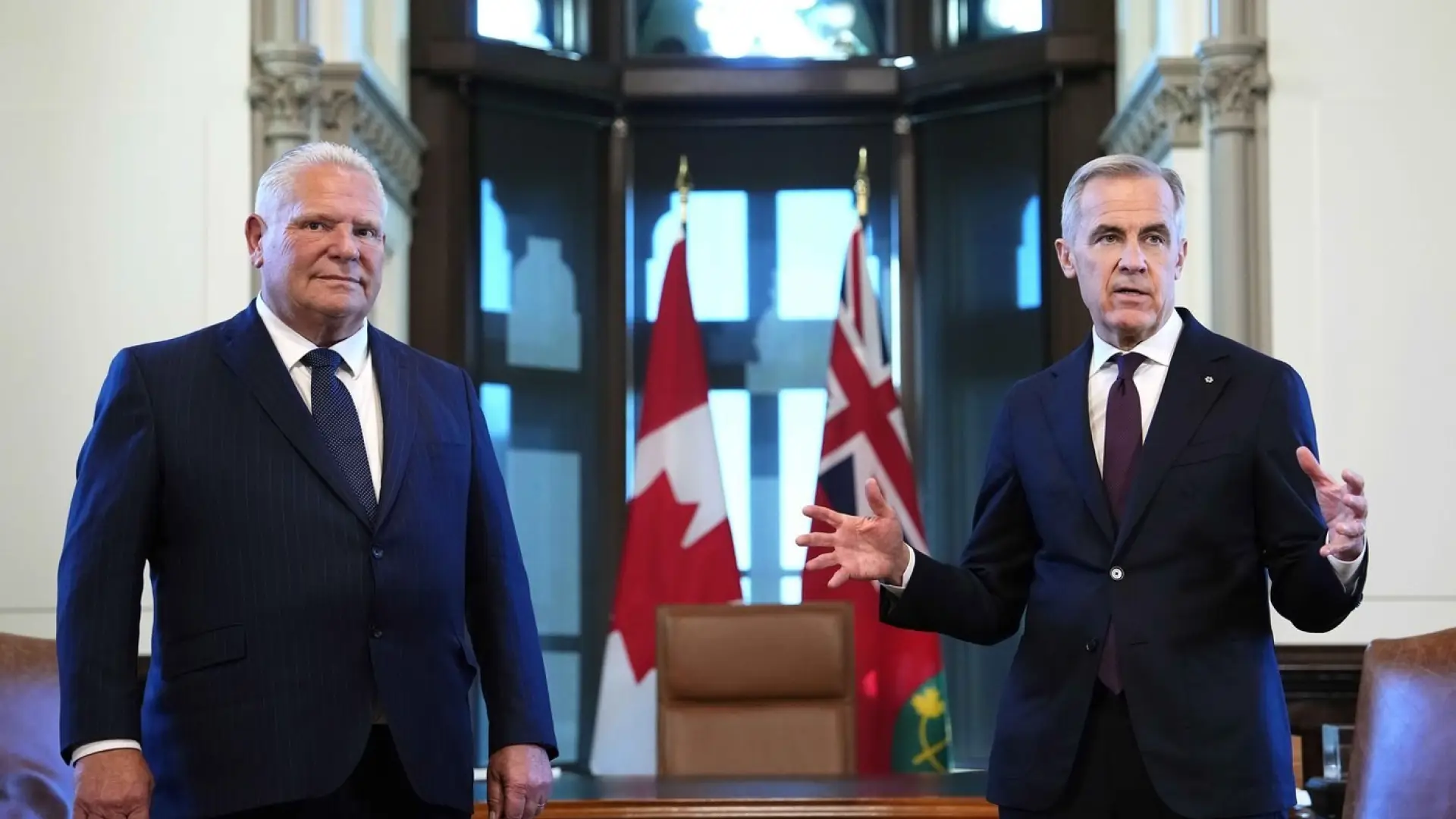
OTTAWA -- The federal and Ontario governments are putting billions of dollars on the line to help bolster the province's key sectors — steel, critical minerals and auto manufacturing — as they continue to manage the fallout of tariffs from the United States.
Prime Minister Mark Carney said the $8.7-billion plan goes hand-in-hand with changes the Liberal government is making to speed up project reviews and push forward major projects, which will create massive demand for critical minerals and manufacturing capability.
"More jobs, more opportunity, more prosperity, more sovereignty, so we can live our lives as we choose," he said.
Ontario Premier Doug Ford, standing alongside Carney during the announcement in Ottawa on Wednesday, called the plan transformative.
Ford said it's clear the Canada-U.S. relationship has changed permanently.
"No matter what happens in the midterms, no matter who sits in the White House, we're not going back to the way things were and we need to plan accordingly," he said.
The plan includes a new steel action fund, with $3.5 billion in funding from Canada and $1.7 billion from Ontario over five years, to help steel companies expand the types of products they make.
Canada is spending billions more on defence procurement over the next several years. Protectionist policies brought in after the U.S. imposed tariffs on Canadian steel are also expected to bolster demand.
"At present, our steel companies rely heavily on the auto sector. In the future, pipes, rail, ports, defence will be increasingly important sources of demand," Carney said.
He said the funding is expected to protect roughly 100,000 jobs in the sector and comes with a pledge to ramp up protections against foreign steel dumping through stronger border enforcement and other measures.
The move to protect jobs comes as the clock ticks down toward a deadline for the U.S.-based owners of Stelco to respond to Industry Minister Mélanie Joly, who wrote to them last week to demand they uphold job commitments made when they bought the Ontario company.
Stelco announced plans in September to lay off up to 500 workers in its Hamilton and Lake Erie facilities, citing the ongoing trade crisis, weak demand and continued import pressure.
Its owner, Cleveland-Cliffs, made legally binding commitments when it bought Stelco in 2024 to maintain at least the same number of unionized workers, and most of its non-unionized workers, for five years.
On Wednesday, Carney did not directly address questions about whether the federal or provincial governments would try to purchase Stelco to keep the plant open.
"When you make a commitment with the Government of Canada, you respect that commitment, and the government will hold companies to (that) responsibility," he said.
The Canadian Steel Producers Association called the announcement an important show of support and applauded the measures to address steel dumping.
Another $1 billion in federal funding over three years will go toward building infrastructure — particularly roads — that will enable mining of critical minerals in the Ring of Fire region in northern Ontario. That matches an earlier spending pledge from Ontario.
Carney said the governments will create a working group with local Indigenous communities, some of which are opposed to development in the region. A government press release said that work will include "studying options for conservation and/or Indigenous protected areas" as development begins.
The province and federal governments also agreed to create a co-ordinated process for permits to streamline approvals.
"Canada will always be a country of high standards, but high standards do not mean decisions have to be slow," Carney said.
The overall plan also includes $2.5 billion for the automotive sector, with the federal government chipping in $1.5 billion. Carney said that is aimed at helping automakers pivot to meet the growing demand for electric vehicles.
U.S. President Donald Trump's trade war has dragged on for more than a year and a half, causing a double-digit decline in auto exports on both sides of the border.
Carney said he spoke with Trump Wednesday morning "for quite some time" and Canada remains ready to sit down and negotiate with the White House when the administration is ready.
On Tuesday, Canada-U.S. Relations Minister Dominic LeBlanc told reporters that there are ongoing conversations with the Americans, though he did not say there were negotiations.
"We’re going to find a deal with the United States at some point that’s in the interests of the entire Canadian economy, and that’s the work we continue to do," he said.
This report by The Canadian Press was first published Oct. 21, 2026.
1834