

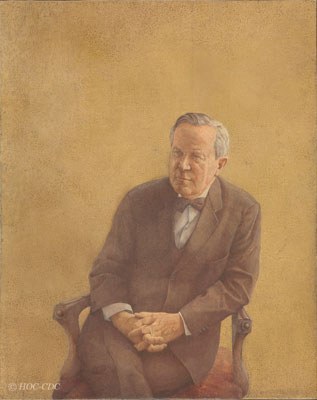
Yesterday we celebrated a great day in Kingston in 1894 when Sir John A. Macdonald’s commanding statue was dedicated. And today, we are celebrating another Prime Minister, Lester B. Pearson, as his official Parliament Hill portrait was unveiled and dedicated on this date in 1968. It had only been a few months since Mr. Pearson turned the keys of 24 Sussex over to his successor, Pierre Trudeau. Tributes of Mr. Pearson’s life of public service were delivered by Prime Minister Trudeau and Leader of the Opposition Robert Stanfield at the historic event. You will find former PM Pearson’s address below.
The Rt. Hon. Lester B. Pearson: Mr. Speaker, Mr. Prime Minister, Mr. Stanfield, Mr. Diefenbaker and ladies and gentlemen. I must begin by thanking the Prime Minister (Pierre Trudeau) for his very kind and generous words, and for unveiling me. I thank him also for being here with us this evening. I think of him, however, not always as a prime minister but as a man who used to be my parliamentary secretary when I was prime minister, and whom I had on duty three days a week. Those were the days when the rosters were informal and unofficial.
I should also like to thank Mr. Stanfield for his courteous and friendly observations, which were balanced eloquently by caution and generosity. But I should have told him in advance that he really had nothing to worry about; that is, it is possible for him to praise me if he so desires, because I have forever left politics, at least Canadian politics. Indeed, one commentator was unkind enough some time ago to say that nothing became my political life like the leaving of it.
It is a great and rather intimidating pleasure to be on this platform with my successor and predecessor. But I am delighted and honoured to have on this platform my predecessor, Mr. Diefenbaker, with whom I have been associated a long time. Our association seems to become friendlier and more intimate now as the days go by. I have not yet come across him walking in Rockcliffe Park, because I probably get up a little earlier than he does. I want to tell him how sorry I was not to have been able to be present two weeks ago for reasons about which he knows, when a similar ceremony was held to honour him as a prime minister. It would have been rather nice, as I believe he indicated himself, if we had been able to hang together. I think perhaps we ought both to congratulate ourselves that, if we have not done so yet, at least we have not hanged separately.
This of course is my first hanging. I have been at other ceremonies of this kind here, but this is the first time I have been hanged myself. I should like you to know that the condemned man enjoyed a hearty breakfast this morning.
My sense of pleasure and honour in being here is increased by the fact that I see around me so many of my old parliamentary colleagues and friends.
I do not know whether I should comment on the picture. I am of course a well-known art critic. I might say that as you go around the halls and look at the other pictures of prime ministers you might say that this is sort of half way between the sober and sedate of the past and the swinger of the present. Between the sober and the swinger, you have the sloucher. But I assure you, this is the way I wanted it done and this is the way the artist – and I should like to pay my tribute to him – insisted it should be done. He wanted to paint me not as Cromwell was painted, not warped, but wrinkled and old. He caught me in that easy pose where I am preparing to do what comes naturally – perhaps going out and rake the leaves, which is much better than being raked over the coals.
In referring to the costume and the picture generally, I might say that this was done by design on my part, as well as on the part of the artist. This reminds me of an American lady journalist – and when I tell you what she said you will agree that she was no lady – who once wrote a column about me. After giving space to my intelligence, achievement and character she ended up by saying, “As for his clothes, they look as if he speaks to them each morning before he goes to the office, and says ‘if you want to come with me, hang on”. This is the reason I was very careful to wear a short black coat and striped trousers this evening.
As the French say: C’est magnifique, mais ce n’est pas bon.
And I like it this way. It is customary on occasions like this also to say that the artist did wonderfully well considering the material he had to work on. I should like to put it this way: The artist had magnificent material and made the most of it. Anyway, if I do not perhaps in that picture look like a prime minister should, there are those who will say today that perhaps I was only a prime minister by accident. Mr. Diefenbaker would say, happily, I became the prime minister by accident.
Let me say that I like this picture and I want to add my thanks to the artist. I wish he could have been here with us today.
I am going to conclude my remarks by doing something which I think is right on an occasion like this. I am going to quote some poetry. This was written in 1727 by a very well-known man of his day who has had a revival in recent years. His name was John Gay, and he wrote the “Beggar’s Opera”. If Mr. (Edgar) Benson, Minister of Finance) were here, I could safely say that he is well acquainted with him.
John Gay in 1727 wrote a little jingle, about the artist who was asked to paint a picture of some lord, this is what he has the artist say, in poetic form, to the lord before he showed him the picture:
Those eyes, my lord, the spirit there,
Might well a Raphael’s hand require,
To give them all the native fire.
The features, fraught with sense and wit,
You’ll grant are very hard to hit.
But ye: with patience you shall view,
As much as paint and art can do.
Then after the painting was shown to the lord John Gay wrote this about the artist:
“Observe the work”, my lord replied.
“Till now I thought my mouth was wide,
Besides, my nose is somewhat long:
Good man, for me, it seems all wrong”.
“Oh! Pardon me (the artist cried)
In this we painters must decide.
The piece ev’n common eyes must strike,
And warrant it’s extremely like.”
My lord examined it anew,
No mirror now seems half so true.
When thus happily he wrought,
Each found the likeness in his thought.
In my thoughts the likeness is admirable, and the honour of having it hung in the halls of Parliament, as well as the honour of being with so many great Canadians in these sacred Parliament Buildings, is a very great one indeed. It makes me feel both humble and very proud. Thank you.
Arthur Milnes is an accomplished public historian and award-winning journalist. He was research assistant on The Rt. Hon. Brian Mulroney’s best-selling Memoirs and also served as a speechwriter to then-Prime Minister Stephen Harper and as a Fellow of the Queen’s Centre for the Study of Democracy under the leadership of Tom Axworthy. A resident of Kingston, Ontario, Milnes serves as the in-house historian at the 175 year-old Frontenac Club Hotel.