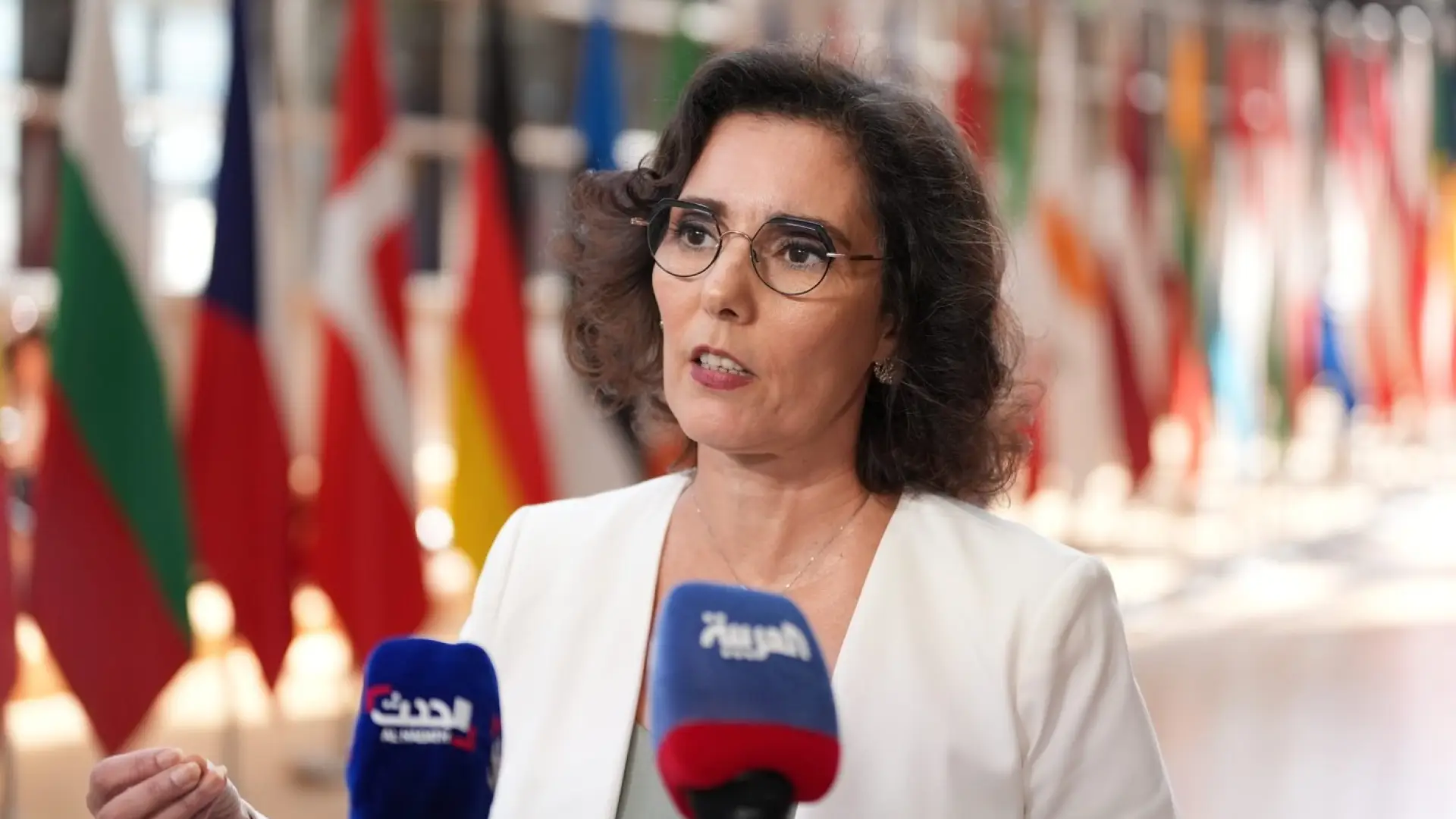
OTTAWA -- The European Union is working more closely with Canada on creating, stockpiling and researching vaccines as the United States pulls back, says a senior official from Brussels.
"Our production, research and development capabilities, and how we communicate about our existing (vaccine) stock, are extremely sensitive matters," European Crisis Management Commissioner Hadja Lahbib said in a French-language interview Monday in Ottawa.
"Canada is the only country outside the European Union with which we do this."
Lahbib said her visit was scheduled before plans were made for the EU-Canada summit that starts Thursday in Montreal. She said the health sector is one of many fields where the bloc wants to work closely with Canada.
"This shows the level of closeness we have today, and of trust. And so, we are now going to begin this work in the health sector, boosting research, in life sciences ... to be stronger together," she said.
The goal, she said, is to "truly secure our supply chain (and) not depend on actors who are becoming less and less loyal, or let's say less and less predictable, in order to be able to confront all the dangers we face today."
In fall 2024, Ottawa launched Health Emergency Readiness Canada, an agency the government said is "dedicated to protecting Canadians against future pandemics and delivering on Canada's life sciences and medical countermeasures readiness objectives."
The agency has had little public visibility and has an interim chair.
In June 2025, the agency's EU equivalent signed an agreement with Health Emergency Readiness Canada to co-ordinate on cross-border public health threats.
Lahbib said that work includes sharing information on chemical, biological, radiological and nuclear threats linked to anything from terrorism to laboratory mishaps to pandemics.
Health Emergency Readiness Canada's agreement could see Europe and Canada work closer together on securing raw ingredients for vaccines and share information on vaccine shortages. Canada and Europe could also link up their supply chains to ensure adequate supplies of masks and other protective gear in a future pandemic.
The two jurisdictions are already co-ordinating research in fields like vaccine development through partnerships such as the Horizon Europe grant program, Lahbib said.
That research might be deployed against future threats emerging from climate change, including viruses trapped in permafrost that could be unleashed for the first time in centuries.
"It truly spans every sector. The efforts are aligned so that, at a technical level, we continue to work together and share the workload," she said. "It's extremely unique."
Lahbib, who is Belgian, noted that the first COVID-19 vaccines to reach Canada came from a Pfizer lab in her home country. Now, a Moderna plant in Montreal is helping European efforts to invent vaccines to combat the Ebola strain ravaging parts of Congo.
"If we work directly hand-in-hand with Canada, it will go faster," she said.
She said both jurisdictions are also planning "stress tests" to assess how well they can respond to major threats.
Lahbib contrasted this approach to border-crossing disease outbreaks to that of the United States under President Donald Trump.
Trump's administration has promoted vaccine skeptics and made it harder to secure COVID-19 shots and childhood immunizations. It has drastically cut back funding for medical research on ideological grounds.
"There have been policy changes in the United States, including in vaccine research, even against measles, with increasingly frequent cases of measles because there is a certain skepticism that has taken hold. It is by no means impossible that we could see cases of measles in Europe as a result," Lahbib said.
"We also have pharmaceutical companies whose research is under threat, and has almost ground to a halt, because of a policy change in the United States. So, where do we welcome them? In Canada? In Europe?
"In any case, we believe in science. We trust scientific research, we share the same values and we believe in multilateralism, too."
This report by The Canadian Press was first published Oct. 27, 2026.