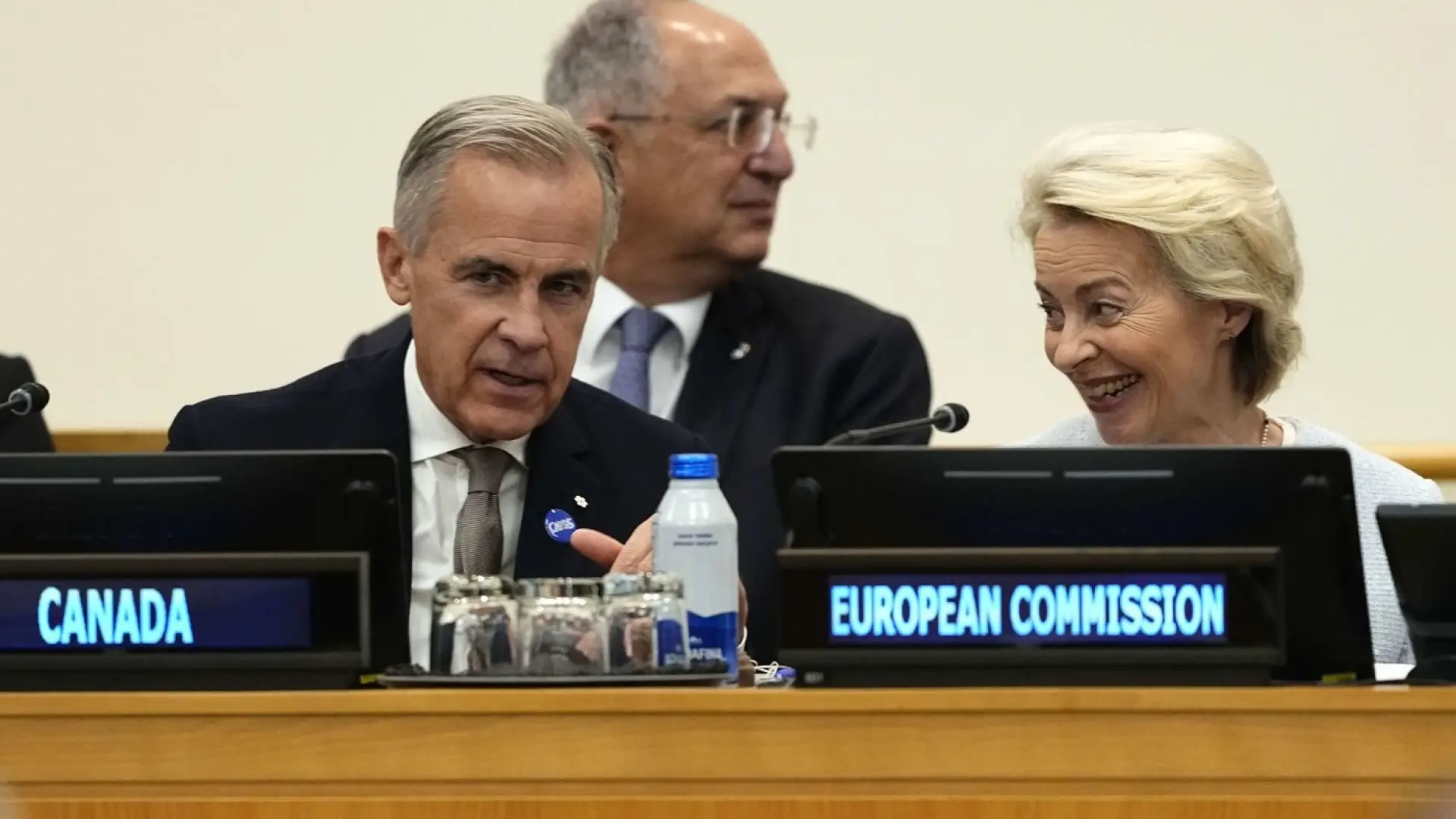
OTTAWA -- A stronger alliance between Canada and the European Union would only include a financial commitment if either side joins specific programs in either jurisdiction, a senior government official said Wednesday.
The next steps in that alliance are expected to be finalized and announced Thursday and Friday, during the Canada-EU Summit in Montreal, and it seems it will not include making Canada an "associate member" of the European Union.
Several European news agencies have reported that idea is off the table, and EU members are looking at terminology around a closer association between the 27-member bloc and Canada.
Prime Minister Mark Carney has repeatedly said the substance of the agreement is more important than the language to describe the evolving relationship. European Commission President Ursula von der Leyen first floated the "associate membership" status invite during her state of the union address to European Parliament last month. Canadian officials, including EU Ambassador Jonathan Wilkinson, immediately played down the use of that term, and said a description for the new partnership had not been decided.
This week, several EU member nations rejected the term as proposed language was floated in documents ahead of the summit. European officials repeatedly used the phrase "alliance for the future" to describe the partnership in a media briefing Tuesday — a phrase embraced by Prime Minister Carney.
A Canadian official briefing reporters on Wednesday, ahead of the summit, said the language being used to describe the partnership is more symbolic than significant.
In that briefing, Canadian officials said the summit will focus on deepening ties in areas like business, technology, defence, critical minerals and energy.
They said the government would only be tied to a financial commitment through the alliance only if it joins a program like Erasmus+, the EU's student exchange program.
The officials did not say specifically which EU programs Canada might join. Carney has publicly indicated a desire for Canada to join Erasmus+.
That program has a budget of roughly $41 billion for its 2021-2027 funding cycle.
The program includes an official welcoming ceremony Thursday followed by a business dinner hosted by Carney. The dinner will gather leaders from various sectors in Canada and Europe alongside top elected officials.
Quebec Premier Paul St-Pierre Plamondon was invited but has said he will not attend because he is not invited to speak at the formal summit.
Several Canadian cabinet ministers are expected to attend: Foreign Affairs Minister Anita Anand, Finance Minister Francois-Philippe Champagne, Environment Minister Julie Dabrusin, Industry Minister Mélanie Joly, Culture Minister Marc Miller, International Trade Minister Maninder Sidhu and AI Minister Evan Solomon.
European officials said this week's summit is meant to advance conversations on deeper ties that can be finalized at the 2027 Canada-EU Summit, a timeline Carney supported in a comment before the weekly cabinet meeting Tuesday.
Canadian officials were less specific when asked about the likely timeline for securing a more formal deal.
Carney has said any deal with the EU would be brought to Parliament for debate and a vote.
This report by The Canadian Press was first published Oct. 28, 2026.
1616