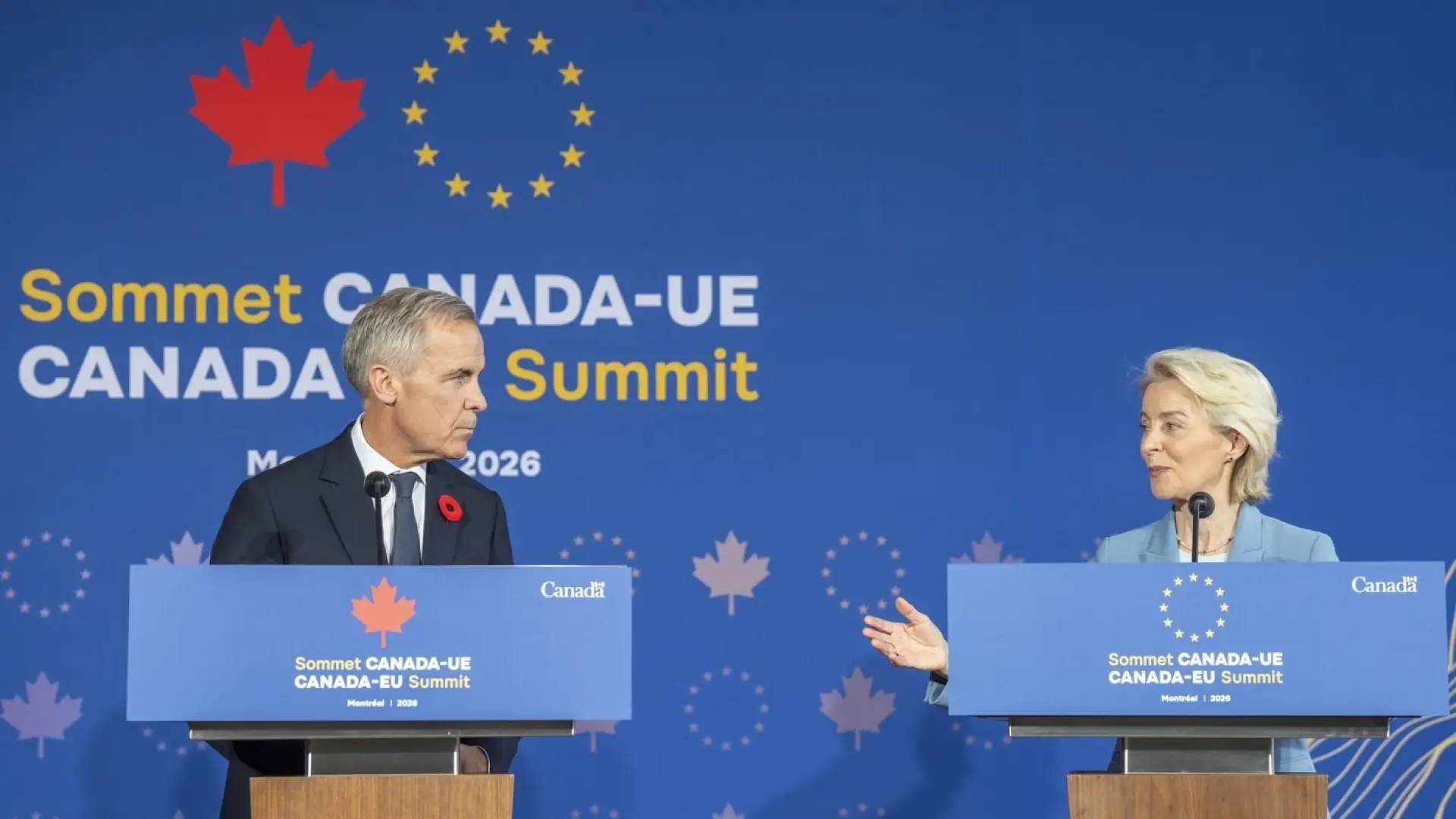
OTTAWA -- Experts in European Union policy say Canada should try solidifying gains with the EU in legal frameworks, particularly as talk of becoming an EU "associate member" continues to cause confusion.
Academics studying EU relations testified Monday to the House foreign-affairs committee after a summit in Montreal last week.
Canadian and European officials praised the EU plan as a historic partnership. The experts were less enthusiastic.
"A lot of these agreements are essentially expressions of intent more than anything," University of Toronto professor Mark Manger testified.
"I'm still waiting for a concrete announcement, of something that is more than more co-operation, better relations, etc., etc.," he said.
Manger argued Mexico already has many of the arrangements with the EU that Canada is now gaining or seeking.
The testimony comes after weeks of confusion over nomenclature, with European Commission President Ursula von der Leyen pitching Canada as an "associate member" of the EU.
Prime Minister Mark Carney originally avoided that phrasing for weeks and instead spoke of an "alliance for the future." He switched last Thursday, saying the goal was associate EU membership — a term that has no official definition.
Achim Hurrelmann, co-director of the Centre for European Studies at Carleton University, said the phrasing was "a bit of a distraction from the policy work leading up to the summit — mainly because the EU, frankly, hadn't really done its homework in defining what this status would mean, and how it could be integrated into EU law."
Still, Hurrelmann said Carney and von der Leyen are "keen to maintain" the buzz around the phrasing.
"I don't think they are really fully attached to the concept of associate membership, but stick to it now because it brings this symbolic attention. Everyone's talking about this," he testified.
Hurrelmann said both sides will need to settle on an arrangement that is somewhere between a mere political declaration and some formal status — which would require complicated amendments to EU treaties and votes in the Canadian Parliament.
"The proposals that we have heard do not require associate membership at all to be realized," he said.
Hurrelmann suggested thinking of associate membership as the "symbolic affirmation" of moving from a common-law relationship to marriage.
Anand Sundar, a transatlantic defence adviser at the European Council on Foreign Relations, testified that "associate membership" seems to be something Brussels is pushing despite strong objections from countries such as Germany.
"It's a very political sort of game that we're seeing," he said. "This might be something in interest of the commission, but not of certain member states."
As MPs on the committee raised concerns about rising far-right movements in Europe that are skeptical of partnering with other countries, Hurrelmann said Canada should move fast to nail down a deal with the EU.
"On the Canadian side it's going to be important to ask how quickly can this agreement be put fully in legal force on the European side," Hurrelmann said.
Hurrelmann also suggested Ottawa consider restructuring its EU trade deal to increase economic gains by changing its status from the current "mixed agreement" that requires individual ratification by each member state.
Of the bloc's 27 members, nine still haven't put the Canadian deal in full force despite the agreement operating for a decade.
Canadians chafe at food regulations that bar many Canadian imports. Europeans complain about Canada's dairy quota and protected-origin phrasing, Hurrelmann noted, such as whether cheeses called feta can originate from anywhere outside a specific region of Greece.
Hurrelmann noted the deal was praised at the time it was signed for innovative clauses on aligning regulations, assessing conformity with rules and recognizing professional qualifications — and that all these have had limited success, resulting in less trade than what was envisioned.
"The joint statement from the summit has some very vague language on that. But I would really encourage both sides to look at the CETA governance structure," he said.
Manger suggested Canada and the EU enhance the existing trade deal with "economic and legal parameters" that make it more appealing for exports and investments.
"In international agreements, it's desirable to have something that is locking in a certain trade relationship, that makes it clear for Canadian firms … that this is a long-term relationship," he said.
"If we were to fully replace a lot of the imports (to) the European Union in terms of raw materials that came before from, say, Russia and parts of the (Persian) Gulf, where we can offer something instead — we can probably double our trade with the EU over 10 years," Manger added.
He suggested Ottawa could allow European mobile networks to set up in Canada in exchange for European countries dropping restrictions on Canadian food imports.
Hurrelmann added that any agreements between Canada and the EU will face complex negotiations to achieve consensus among the provinces and the EU's 28 member states.
He suggested Ottawa focus on projects in areas where the EU has clear jurisdiction, such as research and academic exchanges, while working directly with countries on key issues where they have power, such as defence and energy.
Hurrelmann also said closer ties to Europe will only work if there is cross-party collaboration.
Conservative Leader Pierre Poilievre argues the government has not been clear on its deal with Europe, that the Montreal summit was a waste of time meant to distract from domestic issues, and that Canada risks losing sovereignty to Europe and control of its borders.
This report by The Canadian Press was first published Nov. 2, 2026.
This is a corrected story. A previous version said the European Union has 28 member states.
1827