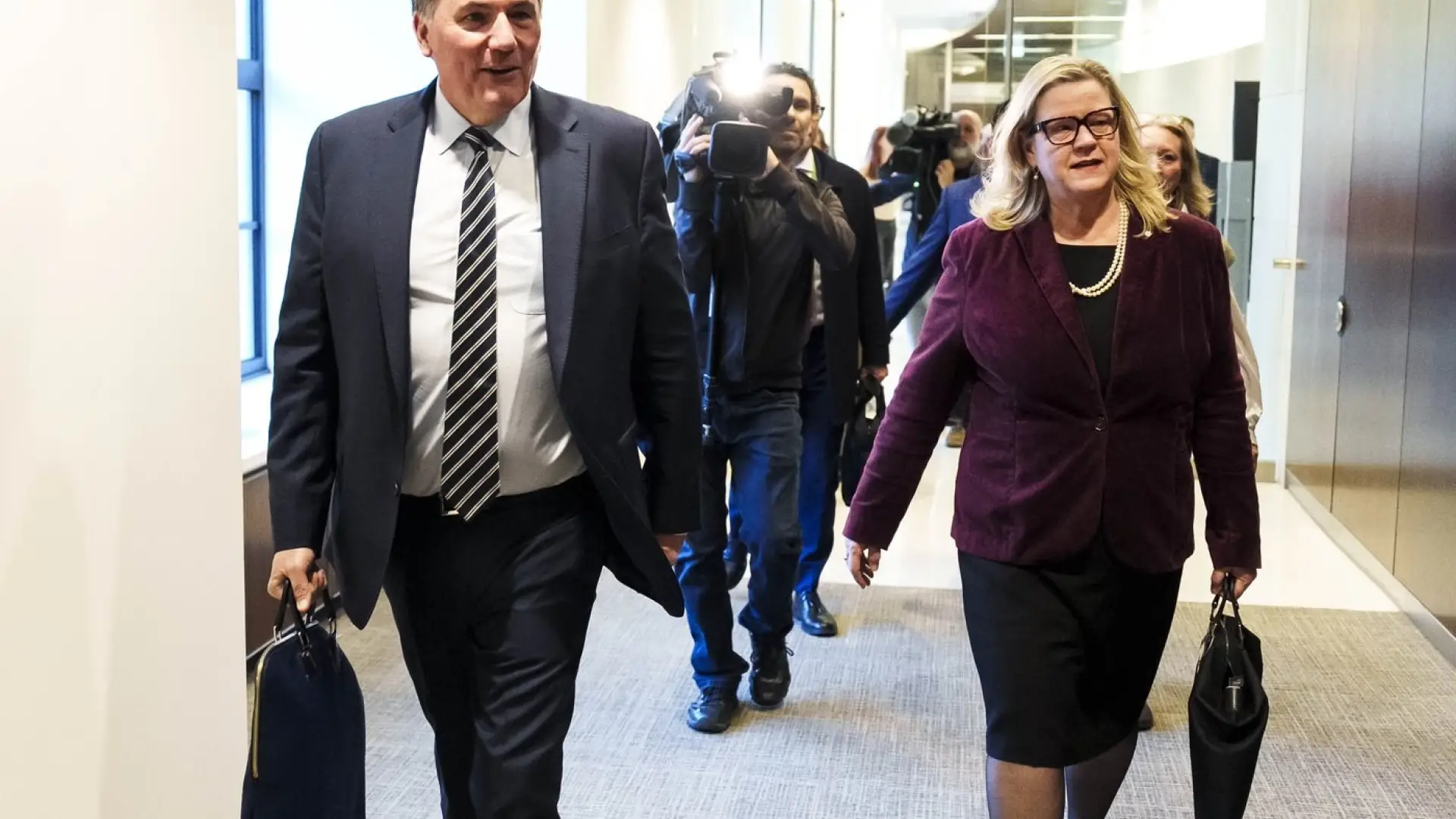
OTTAWA -- Canada-U.S. Trade Minister Dominic LeBlanc maintained Tuesday that Prime Minister Mark Carney's version of the events leading up to the collapse of U.S. trade talks was accurate as he was questioned by members of Parliament in Ottawa.
"The prime minister accurately described the conversations we had in those last days in Washington," LeBlanc told MPs on the standing committee on international trade.
U.S. President Donald Trump's trade war rapidly escalated after trade talks broke down in August, as Ottawa and Washington accused each other of pushing eleventh-hour changes.
Carney said at the time that Trump's team wanted to restrict Canada's ability to make trade deals with other countries, endanger Canada's protections for language and culture, and maintain hefty tariffs on some automobiles.
United States Trade Representative Jamieson Greer said in response that the prime minister's description of the trade talks "goes far beyond anything we've discussed."
Conservative MP Jacob Mantle questioned LeBlanc about the competing narratives. "Who is telling the truth?" he asked.
"I think the prime minister was absolutely correct to say on that last day were introduced elements that would have restricted Canada's ability to enter into free trade agreements with other countries," LeBlanc said.
"Certain sectors were identified by the Americans. At the end of the day it was a balance … where the prime minister concluded that that is in the sovereign interest of Canada."
Mantle pointed to sections of the Canada-U.S.-Mexico Agreement on trade, known as CUSMA, that already bar partner countries from entering into trade agreements with non-market economies. LeBlanc replied that Mantle was assuming those conversations were about non-market economies.
Tuesday's hearing provided no real insights into the trade talks or the current state of negotiations.
LeBlanc told the committee that he and Greer agreed not to publicly discuss details. The minister said he remains in contact with Greer and U.S. Commerce Secretary Howard Lutnick.
A bilateral deal that benefits Canada and the United States is still possible, LeBlanc told the hearing.
The Trump administration softened its public stance toward Canada after Democrats swept this month's midterm elections — a result that was a clear rebuke of the president's policies, including his sweeping tariff agenda.
Democrats have indicated that ending the trade war with Canada will be a top priority when they take the majority in Congress in January. Some experts say it may be challenging for Democrats to achieve the supermajority they would need to override the president’s veto.
Observers also have said Democrats likely will only tackle one of Trump's tariff tools — Section 338 of the Tariff Act of 1930 — while leaving in place other duties still hammering parts of the Canadian economy.
Trump used Section 338 to hit an array of Canadian goods with 50 per cent levies. Weeks later, using the same Depression-era statute, he banned imports of other Canadian goods, including motorcycles and some alcohol and dairy products.
Democrats are expected to be much less likely to take down Trump’s separate sectoral tariffs or his 10 per cent duty linked to claims of forced labour in supply chains.
Democrats have a broad protectionist streak of their own and many of their newly elected members of Congress are not opposed to using tariffs to protect domestic industries.
At Tuesday's hearing, Conservative MP Shuvaloy Majumdar asked Canada's chief trade negotiator, Janice Charette, if Ottawa's goal is still to achieve tariff-free trade.
Charette said the United States is changing its trade with every country and all of Trump's deals have included some level of tariffs. Canada has to prepare for a world where a tariff-free arrangement may not be possible, she said.
The objective is to "get to the lowest rate of tariff on the narrowest basket of goods with the most preferential access for Canadian businesses and Canadian workers," Charette added.
"That is the premise for the CUSMA agreement. That is what has made us so successful, so prosperous as three countries in North America, and we'd like to try and get as close back to that as possible," she said.
"But we do have another partner on the other side of the table and they have shown to date an unwillingness to enter into any arrangement in which there is full tariff-free trade."
Charette and LeBlanc also fielded questions about how Canada is reaching out to Mexican colleagues as Ottawa and Mexico City continue to advocate for a renewal of the continental trade pact.
The Trump administration in July chose not to renew CUSMA. The decision triggered a rolling annual review for up to a decade, at which point the agreement will expire if the three countries cannot agree on an extension.
Carney met earlier Tuesday with Mexican President Claudia Sheinbaum on the sidelines of an economic summit in China.
This report by The Canadian Press was first published Nov. 17, 2026.
— By Kelly Geraldine Malone in Washington
1935