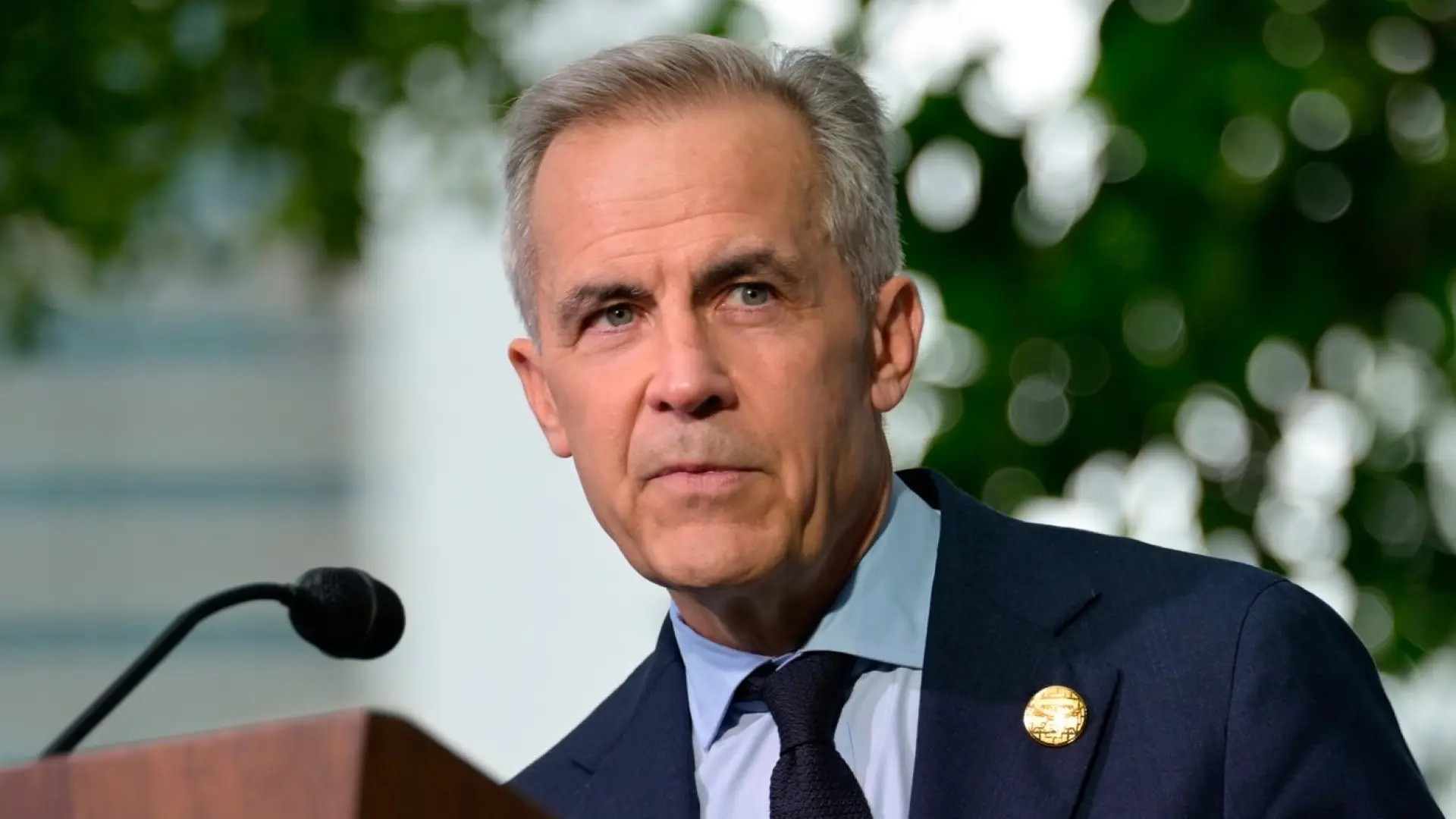
SHENZHEN -- Prime Minister Mark Carney met with U.S. President Donald Trump in Shenzhen, China on Wednesday — shortly after saying that trade talks with Washington are far more complex than the ones Canada is having with Beijing.
Carney's office said the two leaders spoke for just under 20 minutes during what was dinnertime in Shenzhen and the early morning in Canada.
"The leaders discussed the work underway to reach a mutually beneficial trade agreement that would create good jobs, boost affordability, and fully respect Canada’s languages, culture and sovereignty," said a readout from Carney's office.
"They agreed to continue the work and to stay in close contact."
Carney's office said the meeting included U.S. Trade Representative Jamieson Greer, U.S. Commerce Secretary Howard Lutnick, Trump's chief of staff Stephen Miller and U.S. Secretary of State Marco Rubio. Carney's chief of staff Marc-André Blanchard and Foreign Affairs Minister Anita Anand were there on the Canadian side.
Shortly before the meeting, Carney told a news conference that he doesn't believe Trump is uncomfortable with Canada expanding its trade relationship with China. He said Trump has sought to understand where Canada is going with its trade ties with China.
Both leaders are attending the Asia-Pacific Economic Cooperation summit in Shenzhen, China's tech hub. Canada and China agreed at the summit this week to drop trade restrictions on Canadian pork and some Chinese steel.
Canada is sending a trade mission to China in 2027 and Carney brokered a deal with Xi in January to allow a limited number of Chinese electrical vehicles to be sold in Canada.
Carney said Wednesday it's been easier for Ottawa to secure new trade arrangements with China because Canada's trade relations with the United States are "much more complex."
"The United States fundamentally changed its trade objectives and we are focused on getting the right deal for Canadians," he said.
He added that Canada is focused on exporting to China commodities such as iron and oil, rather than sensitive advanced technologies like superconductors.
Prime Minister Mark Carney says it's been easier for Ottawa to reach new trade arrangements with China than the United States because Canada's trade relations south of the border are "much more complex." (Nov. 18, 2026)
Stephanie Kusie, the Conservative international trade critic, said Wednesday it's "always concerning" to see the government engage with China, given its human rights record and previous tariffs on Canada.
She said it's good that Canada is diversifying its trading relationships but she accused Carney of using that effort as a "distraction" from his failure to secure a deal with the United States.
Kusie said Canada has a "far more significant" relationship with the U.S. "through history and geography … and we should be leaning into that, not into a nation which does not promote democracy, human rights, the rule of law."
The diplomatic relationship between Canada and the U.S. has been rattled by Trump's heavy tariffs and calls for Canada's annexation. It became more tense when Carney's government walked away from formal trade talks in August, and as Ottawa and Washington accused each other of pushing eleventh-hour changes.
Carney has said Trump's team wanted to restrict Canada's ability to make trade deals with other countries, endanger Canada's protections for language and culture, and maintain hefty tariffs on some automobiles.
In response to the collapse of trade talks, Washington imposed tariffs on billions of dollars of Canadian goods. Ottawa then followed up with retaliatory tariffs on American products.
Trump has long claimed that Canada has treated the United States unfairly, despite the fact that the Canada-U.S.-Mexico Agreement on trade, also known as CUSMA, was negotiated during his first term.
Carney has said repeatedly he will only agree to a deal with the U.S. if it's good for Canada.
"We will do what's necessary in order to achieve that deal, but only that deal that is in the interests of Canadians," he said.
Carney also has said trade talks with Washington would shape how Canada approaches Chinese investment, and that Canada could turn to Chinese automakers if those talks fail.
Democrats have indicated that ending the trade war with Canada will be a top priority when they take the majority in Congress in January.
This report by The Canadian Press was first published Nov. 18, 2026.
— With files from Aaron Sousa in Edmonton and The Associated Press
1243