SHENZHEN -- Prime Minister Mark Carney has left China to return to Ottawa after a whirlwind trip that took him to four summits in Ireland, the Philippines, Cambodia and the Chinese tech hub of Shenzhen.
Here are some main take-aways from the trip, in chronological order.
1) Touching base on Ukraine peace talks
Carney started his trip last Wednesday, arriving in Dublin on the eve of the European Political Community summit, an informal gathering of leaders from around Europe that has occurred every six months since Russia's full-scale invasion of Ukraine in 2022.
Ukrainian President Volodymyr Zelenskyy attended and briefed Carney and a dozen European leaders on the state of negotiations with Russia.
The Ukrainian leader discussed this week's talks in Abu Dhabi with Russian officials organized by U.S. President Donald Trump's envoy Steve Witkoff and his son-in-law Jared Kushner.
Those talks reportedly included Russia's desire to change the security infrastructure that has had countries bordering Russia in a military alliance with other Europeans, the U.S. and Canada.
Carney later told a news conference that Canada would stand by its NATO allies, and that it's up to the Europeans to craft arrangements that would secure their continent.
2) Opening up trade
Carney and his Philippine counterpart concluded talks for a free-trade agreement in Manila, with the deal expected to be formally signed next year.
The news came on the sidelines of the Association of Southeast Asian Nations summit in Manila, hosted by Philippine President Ferdinand Marcos Jr.
The deal aims to expand Canadian exports in agriculture, forestry, mining and energy -- while shifting trade toward more advanced fields such as aerospace technology and artificial intelligence
Canada is also pursuing a broader trade agreement with the ASEAN bloc, which includes the Philippines and 10 other countries such as Thailand.
The region hosts some of the world's fastest growing economies, including nearly 700 million people. Ottawa says the region is key to Carney's goal of doubling exports to countries other than the U.S. by 2035.
Carney then flew to Cambodia for the Francophonie summit.
3) The first Plamondon meeting
In Cambodia, Carney met Quebec Premier Paul St-Pierre Plamondon for the first time since the province elected a sovereigntist government last month.
St-Pierre Plamondon has repeatedly raised his aspiration to have Quebec become an independent country.
The two were cordial in their meeting and focused on shared objectives, with Carney mentioning homelessness and St-Pierre Plamondon speaking about the use of the Francophonie for business investment.
"We will continue in a professional way -- friendly but not necessarily a bromance. I have a wife," Carney quipped in French.
The prime minister complimented St-Pierre Plamondon's looks, and the premier seemed bemused. They joked about who was the better goaltender for Oxford University's hockey team, a role they both held.
Carney later said Quebec could engage with American counterparts on trade as a "stakeholder" but said: "International agreements are negotiated between federal governments."
4) A vision for the French language
Prime Minister Mark Carney closed off his visit to Phnom Penh by defending the French language in the digital age, urging leaders of French-speaking countries to band together against the forces of American big tech.
"Canada will always defend the French language and francophone cultures, including in the face of pressure from tech giants and our closest neighbour," he said in French.
The prime minister said Canada wants to mobilize other countries to make sure American tech giants give French-language content a prominent place on online platforms.
Carney said French-language content should be easily retrievable, like in a library catalogue -- rather than an old warehouse of books with the lights turned off.
The prime minister was greeted by rousing applause from leaders at a formal plenary and an innovation event, with many African countries represented.
Carney said artificial intelligence risks leaving behind French speakers and flattening linguistic diversity. He also said French-speaking countries should partner with Canada in seeking economic gains through the responsible use of AI.
The Francophonie summit takes place every few years. Canada is set to host the next summit in 2028 in the Ottawa region. Carney says he wants to work with Quebec and New Brunswick -- who are also full members -- to have the summit focus on French in the digital age, youth and the economy.
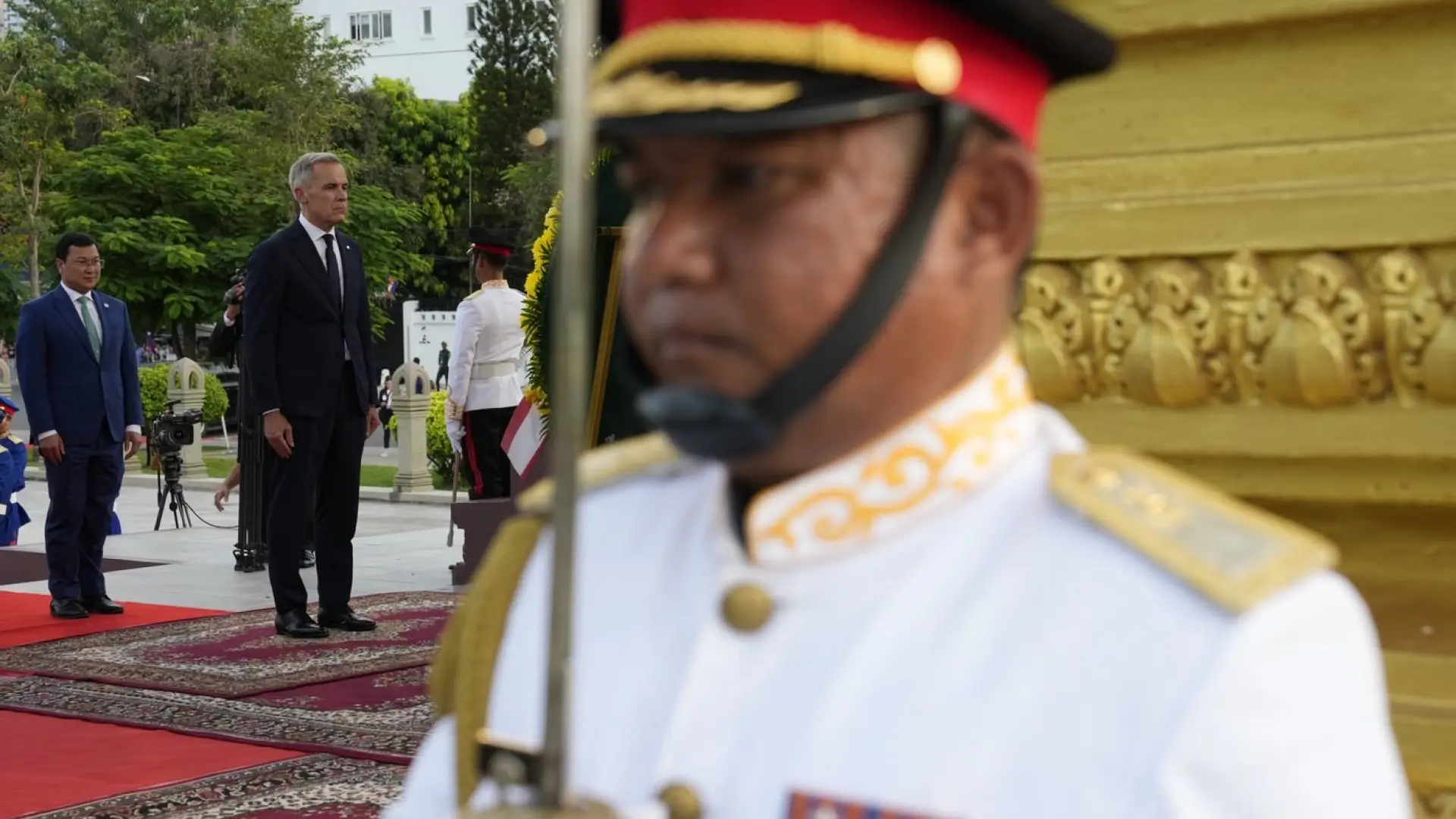
Carney ended his brief Cambodia stay with a visit to the prime minister's palace after laying wreaths at monuments surrounded by military officials. Between the two, Carney's motorcade was greeted by groups of children holding flowers and Canadian flags.
5) Deeper relations with China
Prime Minister Mark Carney travelled to Shenzhen late Monday, where he was greeted by dozens of synchronized dancers on the tarmac.
The next morning, Carney met with Chinese President Xi Jinping at a lavish guest house surrounded by lush, manicured gardens, nestled among skyscrapers in the high-tech metropolis that abuts Hong Kong.
The two agreed to drop trade restrictions on more goods at a bilateral meeting in China, with more access for Canadian agricultural products such as pork in exchange for more imports of Chinese steel and aluminum.
The pork sector hailed that as a big step in restoring some of the market access lost over years of diplomatic strain, since bilateral relations hit a nadir in late 2018.
The leaders noted progress in multiple fields since Carney visited Beijing in January to "recalibrate" relations with China, opening up more trade and investment while hiving off "guardrails" in sensitive sectors.
Tuesday's deal came ahead of Xi hosting the Asia-Pacific Economic Cooperation summit, or APEC.
Carney said Shenzhen's breakneck economic growth -- "from a rustic fishing village to an innovation-forward megacity" -- is a model for how Canada wants to speed up development by cutting red tape and investing in big projects.
6) Meeting with Trump
Carney met with Trump on the sidelines of the APEC summit for a roughly 20-minute meeting that included U.S. Trade Representative Jamieson Greer and U.S. Commerce Secretary Howard Lutnick, among others.
Carney's office said they discussed work for "a mutually beneficial trade agreement" that includes protections for the French language and a viable Canadian auto sector. The prime minister has said those issues derailed talks in August.
Anand told reporters the in-person meeting was the first in a while between Trump and Carney, aside from regular phone calls and text messages.
She said Canada would diversify its trade regardless of the results of this month's U.S. midterm elections, which saw the Democrats take control of Congress for the rest of the Republican president's term.
She called it a "lame-duck Congress."
Carney's recent agreements with China on trade have infuriated some of the people closest to Trump, notably trade adviser Peter Navarro.
Carney has said Canada is focused on exporting to China commodities such as iron and oil, comparing that to American trade with China, which he said involves sensitive, advanced technologies like superconductors.
Trump met Thursday with Xi Jinping and Russian President Vladimir Putin, which has raised concerns about an end to the war in Ukraine that does not adequately protect Europe.
Carney and Anand have said they welcome any meeting that helps advance a just peace.
Before the three-way meeting began, the U.S. president had a separate one-on-one meeting with Xi, lasting about an hour. Trump also sat down with Putin.
This report by The Canadian Press was first published Nov. 19, 2026.