
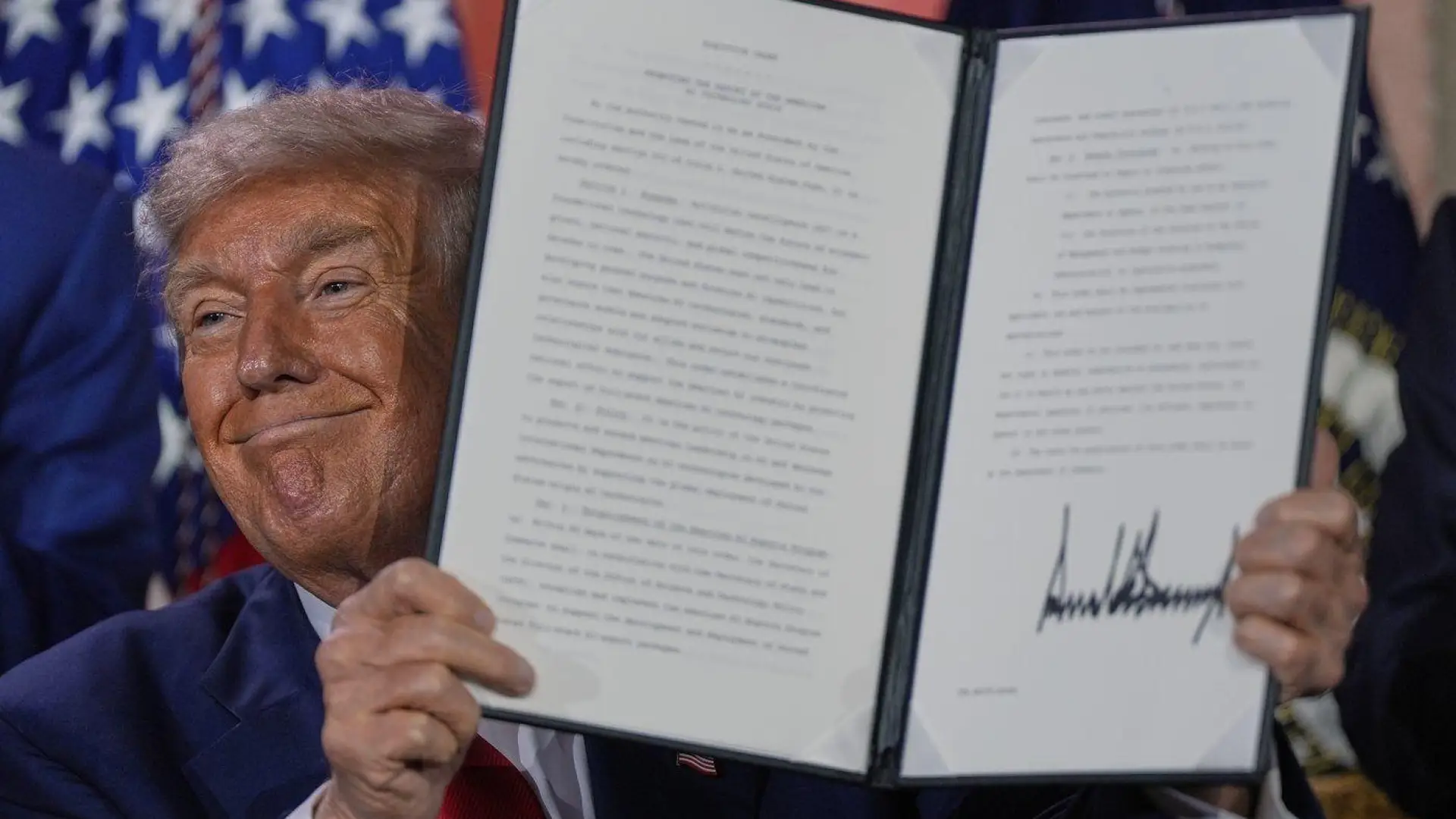
Trump’s new AI Action Plan, released last week, is unapologetically internationalist—calling for open markets, minimal regulation, and global reach. That’s a sharp break from his protectionist stance on trade. The good news for Canada is that MAGA is splintering on trade, which may open the door to easier talks. But a far bigger shift is underway. The US is gearing up to flood global markets with AI products and platforms—just as Canada starts to rebuild its economy. Are we ready for the coming deluge of American AI?
The Trade-AI Tensions in MAGA
Trump’s America First economics has always blended nationalism, grievance, and the promise to bring industry home. Still, last week’s AI Action Plan shouldn’t have surprised anyone. The President was delivering to Silicon Valley what he promised them during the election: open markets, deregulation, and rapid infrastructure build-out.
But there was a bonus. The Plan’s trade posture reveals a deeper realignment inside Trump’s White House: AI libertarians are pushing back against MAGA protectionists.
That shift broke into view last week when Trump reversed a ban on US chip sales to China. The original restriction had blocked Nvidia’s H20 chips—high-performance, export-specific models—from reaching Chinese buyers. The goal was to slow China’s AI progress.
This was a problem for Nvidia CEO Jensen Huang, costing him billions in sales. Huang found a sympathetic ear in White House AI czar David Sacks, and the two teamed up to convince Trump to reverse course. They argued that selling chips to China keeps Beijing dependent on US technology. Blocking exports would only push China to develop its own chips—and that, they said, was the greater threat.
Trump ultimately agreed, but not because he’s softened on trade. This wasn’t about the virtues of free markets. It was sold to Trump as a power move. The shift is that Trump now believes American control will come less from protectionism, and more from building platforms the world can’t do without.
David Sacks and Export Dominance
Tech libertarians like Sacks believe that the path to American dominance in AI runs through export ubiquity, not restriction. The goal, he says, is simple: “We want the world to consolidate around an American standard.” Don’t block countries from buying American. Bind them to American know-how. Make the world run on U.S. chips, U.S. platforms, U.S. models.
This idea—Export Dominance—is becoming the strategic spine of Trump’s AI agenda. It’s not just about selling more. It’s about embedding American AI—models and infrastructure—so deeply into the global system that dependency becomes a decisive advantage. Just as countries have long relied on access to US consumer markets, they will now rely on US AI to power their institutions, services, and economies.
For Trump, the argument has deep appeal. It turns “America First” into a global AI strategy. It doesn’t ask him to embrace free trade. It just asks him to get out of the way and let American companies do what they must to dominate the markets. And the AI industry has the capital to make that happen.
What MAGA’s Split Reveals
Will Trump stand behind AI?
His chip reversal didn’t just provoke China hawks. It exposed a deeper fracture inside MAGA: two competing visions of “America First.”
One side is MAGA 1.0—nationalist, protectionist, instinctively distrustful of Big Tech and foreign entanglements. Figures like Steve Bannon and Marjorie Taylor Greene see AI not as a tool of American power, but as a vulnerability—something to be contained, not scaled.
On the other side is a new coalition: the AI wing of MAGA. Fueled by capital, compute, and libertarian ideology, this group sees AI as the next economic engine—and a geopolitical lever. Their priority isn’t to protect the homeland. It’s to wire the world with American AI models and infrastructure.
In the chip reversal, this faction won. Trump sided with scale over protectionism. With Sacks and Huang over Bannon and Greene. The ban was lifted, the investment pledged, and the global race rejoined.
That doesn’t mean the old MAGA is gone. But it is losing ground. The AI faction isn’t inclined to compromise. In this version of America First, you don’t win by building walls. You win by building systems—and making everyone else run on them.
Old MAGA still has the Base. But new MAGA is aligned with what’s coming next: a new kind of trade, a new kind of power. If American AI keeps growing like it is, it’s hard to see why Trump would back away from it.
What’s the lesson for Canada?
What This Means for Canada
International trade has moved through eras: natural resources, manufacturing, services—and now AI. But this phase may be different in kind, not just in scale.
It’s not just the speed of change. It’s the belief—shared by some in the White House—that this may be a race with a finish line. That whoever reaches general or superintelligent AI first—likely the U.S. or China—won’t just dominate the market. They’ll lock in the architecture of global advantage for a generation or more.
If true, this is not a normal trade cycle. It’s a paradigm shift. And while Canada isn’t out of the game, we’re not built for this kind of race. Our AI sector is vibrant but small. We don’t have our own compute stack. We rely on foreign platforms. And we haven’t decided whether to build toward self-sufficiency or embed strategically in someone else’s system.
The Carney government sees AI as an enabler of sovereignty and growth. That may still be true. But if the ground is shifting—from markets to models, from trade to platforms—we should be asking a deeper question.
Not just: What should Canada do? But: What kind of world is emerging?
Conclusion
In this new era, it the US succeeds in building the models and infrastructure everyone else relies on, it will set the rules.
And America is already moving. Fast. Not just with policy, but with investment, coordination, and a generation of leaders that views this as a winner-take-all contest—one it believes it can win.
China is moving too.
And Canada?
We’re preparing carefully, thoughtfully—perhaps even commendably. But if this race really does have a finish line, a plan that only gets us to the middle is of no use.
This is all about the endgame—and the finish line may already be coming into sight.
Don Lenihan PhD is an expert in public engagement with a long-standing focus on how digital technologies are transforming societies, governments, and governance. This column appears weekly. To see earlier instalments in the series, click here.