
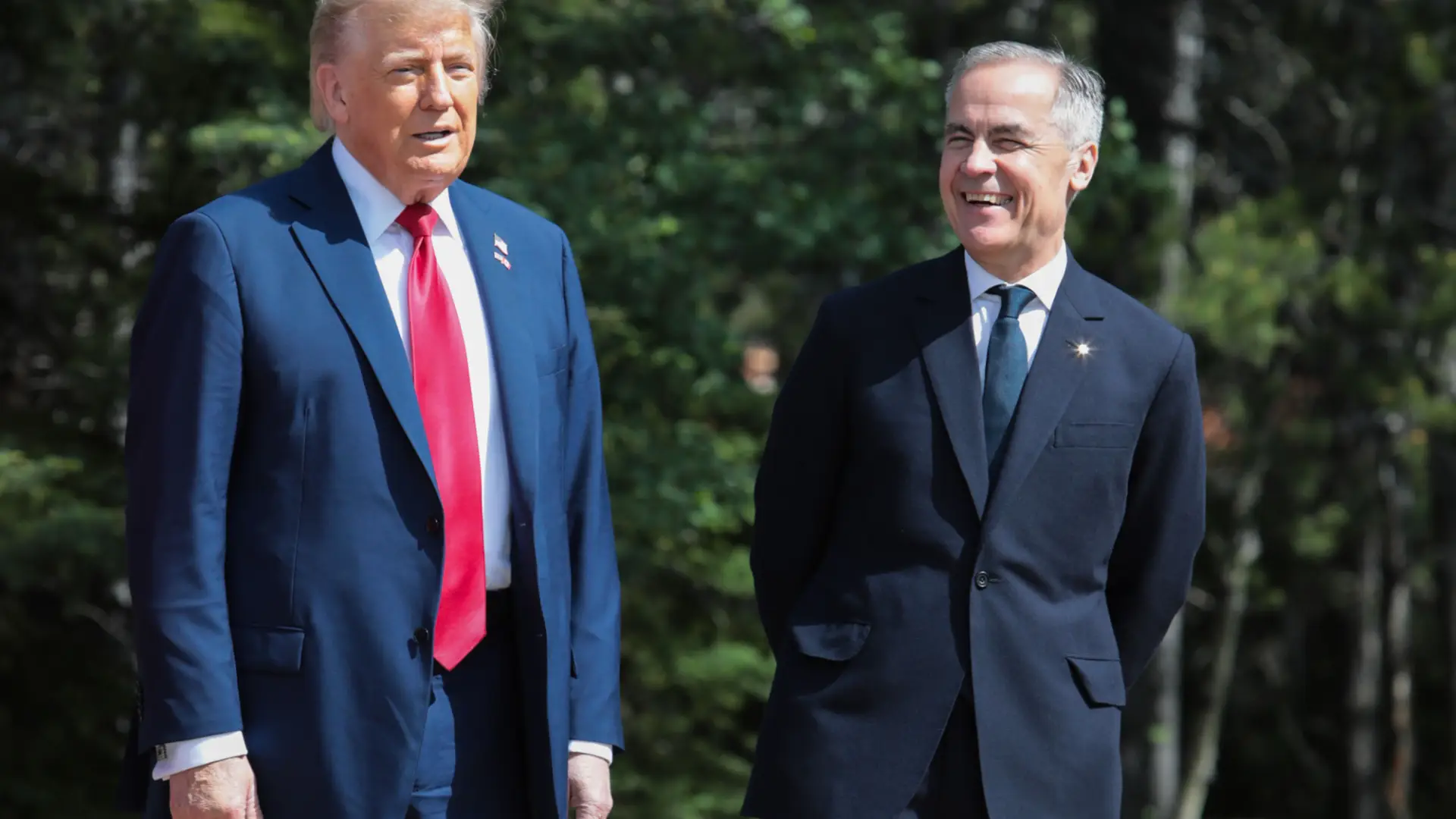
Mark Carney wants to disentangle Canada’s economy from the United States, and he rightly sees AI as a critical enabler. Meanwhile, Donald Trump’s White House is hammering out an AI strategy that reindustrializes America at home, while dominating global AI markets abroad. The goal is to make America an AI superpower. This puts Canada’s ambitions for sovereign AI directly in the path of America’s emerging AI juggernaut. Is North America big enough for both?
From MAGA 1.0 to the Super-Strategy
Trump’s original political vision, MAGA 1.0, was unapologetically populist and inward-looking. It called for physical walls to block migrants, tariffs walls to block imports, and a political war against the “elites” whose globalization agenda left whole regions of the country rusting out.
Trump’s second term has seen the rise of a new ideological wing—Tech Right—which is driven by globalist and libertarian, techno-elites like Elon Musk, Peter Thiel, Marc Andreessen, and David Sacks. These men see AI as the next frontier of global power. They believe America can dominate the new era by moving faster, scaling bigger, and pushing harder than anyone else.
The tensions and disagreements between MAGA 1.0 and Tech Right are well known. But out of that struggle, the basis for a truce may be emerging—a MAGA AI super-strategy that combines the populist goal of industrial renewal with Tech Right’s vision of global dominance.
This super-strategy has two main parts: (1) make America a global superpower in AI infrastructure, models, and services; and (2) ensure American firms dominate global AI markets across the whole chain, from research and development to deployment and use.
The Trump Administration’s recent AI Action Plan contains over 90 measures to advance this vision. And Silicon Valley is fully onside. Last year, US firms invested $109 billion in AI—11 times more than China, by far the second largest AI investor. And the trend is skyward. US firms have already earmarked more than a trillion dollars over the next four years to build AI infrastructure, train new models, and design AI applications—much of this in the US.
Trump’s own role in this transformation is more patron than architect. If he was cautious at first, he now seems to have been won over. While he still measures political success by tariffs and walls, increasingly, he weaves in stories about the billions being spent on AI research and data centres. In short, the MAGA story is evolving—still nationalist, still combative, but increasingly anchored in the conviction that AI is the lever by which America can both rebuild at home and dominate abroad
What This Means for Canada
The implications for Canada are profound. Disentanglement from the U.S. economy is at the centre of Carney’s economic vision, with Sovereign AI as a critical engine. That project was always going to be difficult, but MAGA’s evolving AI super-strategy raises the stakes. It frames the next few years as a winner-take-all race for global dominance — and Trump is ready to do what’s necessary to keep America in the lead.
A few weeks ago, he reversed the ban on chip sales to China, convinced it would keep Chinese firms dependent on American technology. Last week, when Intel needed capital, he put $10 billion into the company, taking nearly a 10 percent government stake. And he’s more than comfortable threatening governments and investors with tariffs if they fail to channel AI infrastructure spending onto US soil. These are not the gestures of a laissez-faire administration, but signs of a White House ready to use state power aggressively to achieve its goals.
As CUSMA renewal talks begin, Canada should beware: Trump’s super-strategy could reshape the agenda. Tariffs may not stop at cars or steel but could target the technologies and services Canada is counting on to build its own AI sovereignty.
Indeed, the very idea of Canadian AI sovereignty conflicts with MAGA’s plan. American firms need access to international markets, including North America. If Canada limits that access by carving out a sovereign digital space, industry will almost certainly retaliate, buying up our firms, reshaping our regulations, and absorbing Canadian AI into the American system. These firms have very deep pockets, and their agenda is clear. America is building an AI empire, and North America is on the front lines.
Canada has lived this story before. First, as a branch-plant economy to Britain and then the United States. Then came free trade, which integrated our two economies so deeply that Trump now holds entire industries hostage simply by threatening to walk away. That kind of leverage is unacceptable. Hence Carney’s “It’s over!” speech—a cathartic declaration that Canada’s era of deep dependence on US markets must end. Yet here we stand, facing a third chapter: full integration into an American AI economy — an end-to-end dependence where the prospect of being absorbed no longer needs to mean being annexed.
Conclusion
Much has been written about the decline of the American empire. But as MAGA’s AI super-strategy unfolds, it looks more like the opposite: the beginning of a new kind of empire, built not on armies or alliances but on silicon, data, and the infrastructure of artificial intelligence. An empire stronger than before—but more elitist, and less democratic.
If so, perhaps Canada truly has arrived at a moment of reckoning—and existential dilemma: can we stand apart and preserve sovereignty, or are we destined to be overpowered, overwhelmed, and absorbed?
Don Lenihan PhD is an expert in public engagement with a long-standing focus on how digital technologies are transforming societies, governments, and governance. This column appears weekly. To see earlier instalments in the series, click here.