
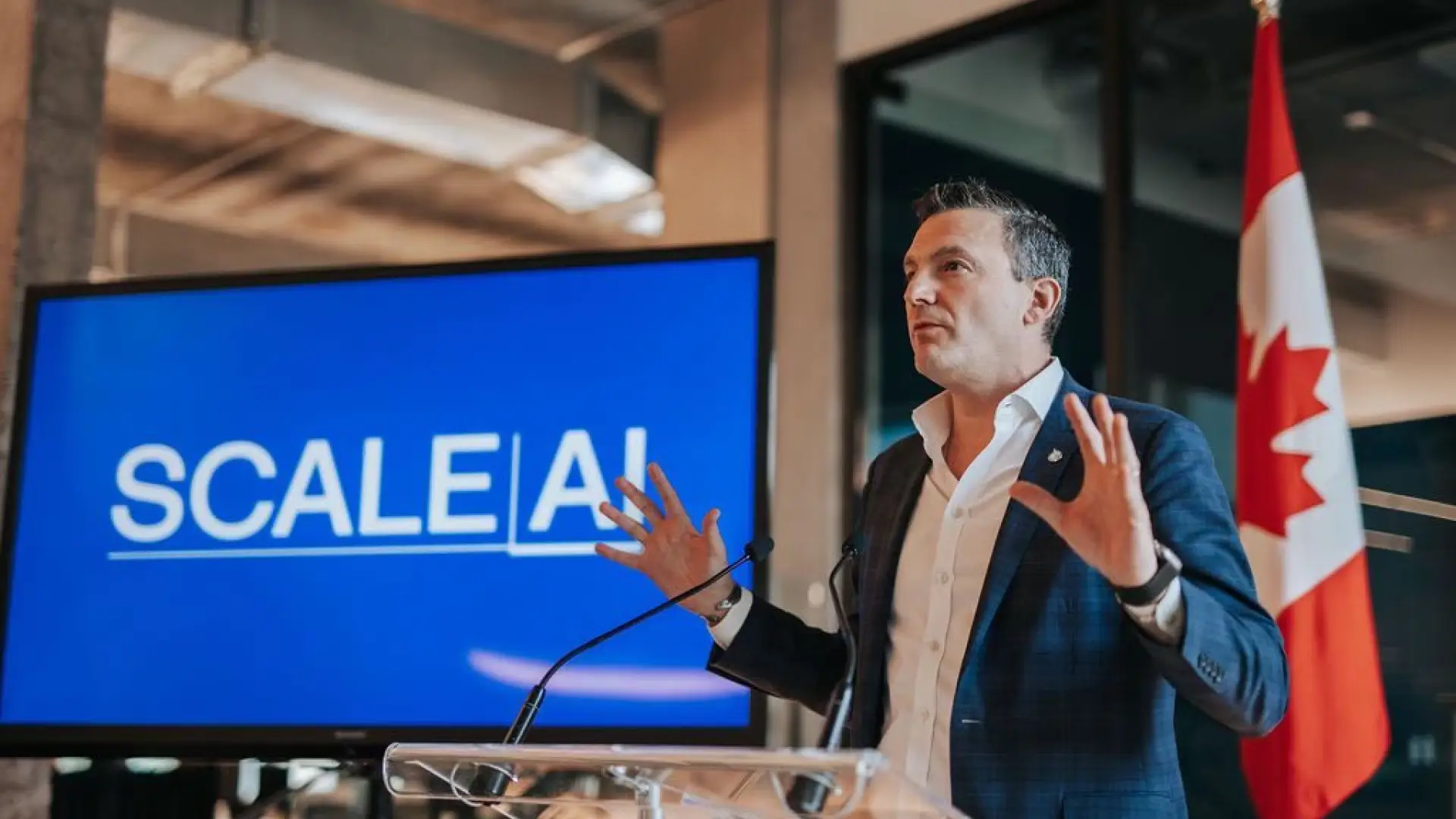
AI Minister Evan Solomon says Canadians need a sovereign cloud to keep us “free from coercion… [one] that someone else can’t turn off.” In other words, it should reduce our reliance on the US so future leaders like Trump can’t use our dependence as leverage. In fact, Solomon’s hybrid model could make us even more dependent, effectively rebuilding the branch-plant model in digital form. Worse, there is no obvious alternative.
From the Digital to the AI Economy
Canada is transitioning from a digital to an AI economy. Much of the early digital era (circa 1990 - 2020) was about turning filing cabinets, libraries, and recordings into bits that could be stored, organized, and transmitted digitally. This paved the way for global connectivity, cloud computing, and massive data collection.
Today’s AI systems don’t just move or manage data; they extract patterns, generate insights, and create new tools and products. If the digital era gave us online banking, video streaming, and telemedicine, AI now analyzes financial markets in real time, generates realistic images and simulations, and predicts outbreaks of diseases.
Over the last three decades, Canada has used health records, environmental monitoring systems, education records, transportation networks, energy flows, census data, and much more to build massive data sets. In the coming years, they could fuel innovation in healthcare, sustainability, smart cities, personalized learning, and inclusive policymaking, turning the raw data into valuable products and services. But will they?
Solomon’s Three Levels of Data Security
Solomon proposes to keep these assets confidential and to protect them from theft and manipulation with a three-part security system:
- The fully sovereign cloud will contain highly sensitive material, like defense, intelligence, and critical infrastructure. The data will be entirely controlled by Canadian companies, never leave Canadian soil, and be fully subject to Canadian law. Under the US CLOUD Act, data stored on servers owned by American companies can be seized even if those servers are in Canada. Canadian ownership avoids this.
- Next is the hybrid model. This category will house most of Canada’s valuable datasets—the raw material for the AI economy—such as health, finance, research, energy, and climate. Solomon calls it “hybrid” because American firms like Google and Microsoft can hold the valuable data under various forms of Canadian oversight, and subject to Canadian law. (Giving data owners full control over encryption helps protect data against the CLOUD Act.)
- Finally, the public cloud is the least restricted level, where data can be stored and accessed without the same sovereignty concerns. This includes material like street maps, weather data, or library collections.
Solomon’s tripartite model is sensible. Clearly, some data requires the highest security, and some can be routinely shared or stored elsewhere. The decisive question is with the hybrid middle, where some of our most important and economically valuable data will live and grow.
A good case can be made that the hybrid provides adequate security. But will it support Canadian innovation? That’s a very different question.
What is Data Sovereignty?
When Canadians think of sovereignty, typically, we think of more than protecting our borders. Sovereignty is also about exercising our collective will by working together to build a health system that reflects shared values or negotiating a trade deal that enhances our prosperity. In this view, our society and economy are expressions of our sovereignty.
The same holds for data sovereignty: security matters, but it is also about our capacity to use our assets to advance societal goals. Solomon is right when he says, “…we need a meaningful Canadian sovereign backbone…to build the economy of the future.” Just as natural resources were crucial to our past, data will be crucial to our future. Much of that data will be stored in Solomon’s hybrid system.
But if the hybrid model looks cooperative—Canadian and American firms sharing responsibility for managing this resource—the emerging model is anything but. American tech giants like Google, Microsoft, and Apple compete to provide services to clients. And siloing the client’s data is an integral part of the business model.
Take health: Microsoft now provides many Ontario hospitals with a cloud-based, secure network for electronic health records. In the financial sector, Scotiabank recently moved its core operations onto Google Cloud to improve security and integrate AI tools. In both cases, the pattern is the same. Once data and workflows are embedded in the vendor’s system, more services are layered on, deepening reliance and creating a silo effect. Even federal departments are fragmenting across vendors.
This is not wrong or bad. From a management perspective, it makes good sense. When banks, hospitals, universities, or governments purchase basic cloud services from a big supplier like Google or Microsoft, they expect more services to be layered on over time. Indeed, the vendor often uses their data to help create and tailor these services. The financial model thus aims to build “vertical stacks” of services, which in turn lock clients in.
By including foreign firms, Solomon’s hybrid space thus virtually assures that Canadian data gets carved up into vendor-siloed, vertical clouds, making it very difficult to leverage data across domains. Basically, the model prevents Canadians from innovating at scale. And that’s where the idea of data sovereignty takes an ominous turn.
This is not Solomon’s fault. If American firms meet his security qualifications, he has little choice but to admit them. Further, demand for AI services in finance, health, environment, and law will surge in the coming years. While Canadian businesses will benefit and grow, they won’t have the capacity to meet the demand. America’s AI sector is vastly bigger, offers far more services, and already serves Canadian clients. Canada needs these American suppliers, and they will fill the gap.
But there is a cost. Each new service we add deepens reliance and reduces our ability to innovate with our own data. Much of the quality data in the hybrid space will get stored in American clouds and shaped by American tools. Canada’s valuable data will be entrenched n vendor silos.
Conclusion
Sovereignty here is not about privacy or legal clauses. It’s about capacity. A hybrid that fragments our data into foreign silos undermines our ability to innovate with our own resources.
This is the branch-plant model in digital form. Canada hosts the factories (the data centres) but strategic control lies abroad. We depend on foreign firms’ infrastructure, policies, and incentives, which don’t prioritize Canadian integration.
The only way out of the branch-plant trap is to treat Canadian data as a public resource and ensure space for Canadian capacity in that hybrid zone. But is that realistic? America’s AI giants are already here, at scales Canada can’t hope to match.
If Solomon has some ideas, Canadians are listening.
Don Lenihan PhD is an expert in public engagement with a long-standing focus on how digital technologies are transforming societies, governments, and governance. This column appears weekly. To see earlier instalments in the series, click here.